For decades, the family vehicle debate has followed an unwritten, predictable rule: if you want undeniable practicality, you buy a minivan; if you care about style, road clearance, and modern curb appeal, you buy a 3-row crossover SUV. Minivans like the Toyota Sienna, Honda Odyssey, and Chrysler Pacifica earned legendary status because they are unapologetically designed around human cargo. Their massive power sliding doors, flat load floors, and cavernous rear cargo wells make loading strollers, groceries, and squirming toddlers nearly effortless. Yet, despite their brilliance, millions of parents still resist the sliding-door stigma, opting instead for compromised midsize 3-row SUVs that force adults to contort into cramped third rows and leave almost zero cargo room once every seat is occupied.
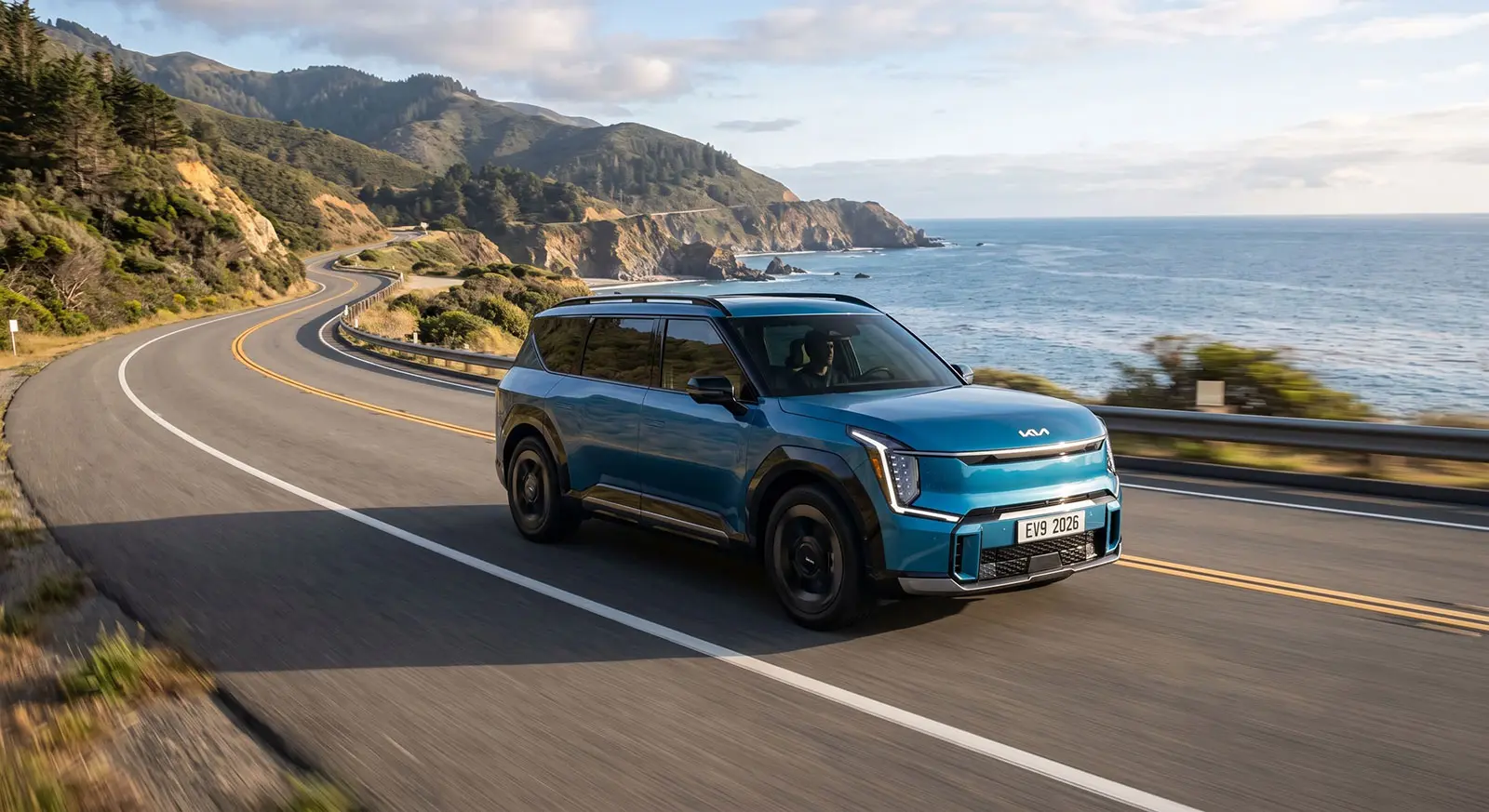
Enter the 2026 Kia EV9. Built on Hyundai Motor Group’s dedicated Electric Global Modular Platform (E-GMP), the EV9 arrives with sharp, geometric styling, a bold cyberpunk light signature, and upright dimensions that make a strong visual statement in any school pickup line. But unlike traditional gas-powered midsize SUVs that package bulky combustion engines, mechanical driveshafts, and exhaust tunnels beneath the floor, the EV9 leverages dedicated skateboard EV packaging. By placing the battery flat beneath the cabin and pushing the wheels outward to the corners, Kia promises the best of both worlds: genuine three-row passenger space, flat cabin floors, futuristic technology, and true road trip capability all wrapped in an SUV silhouette.
Can this all-electric flagship actually convince loyal minivan drivers to ditch their sliding doors for good? In this comprehensive hands-on review, we evaluate real-world seating, cargo hauling with full family gear, highway efficiency, and 800V fast-charging performance to find out if the 2026 Kia EV9 is the ultimate electric minivan alternative.
Exterior Practicality — Bold SUV Aesthetics vs. Sliding Door Reality
When assessing whether an SUV can genuinely replace a minivan, the exterior battle lines are drawn around accessibility, ingress, and suburban ergonomics. The 2026 Kia EV9 embraces a commanding, upright design with a 122-inch wheelbase and 7.8 inches of ground clearance on standard trims. Its geometric silhouette, squared-off wheel arches, and aerodynamic flush door handles make it one of the sharpest-looking vehicles in any parking structure. However, styling choices carry functional consequences that every parent must weigh before signing a lease.
The Tight Parking Space Dilemma The greatest superpower of a traditional minivan like the Toyota Sienna or Kia Carnival is its pair of power-sliding side doors. In tight school drop-off lanes or narrow parking garage bays, sliding doors glide backward flush against the body, offering a wide, unobstructed 30-plus-inch opening without ever risking door dings against neighboring vehicles. With the EV9, you get conventional hinged doors. While Kia engineered the rear passenger doors to swing open nearly 80 degrees for easier access, you still have to manage door swing clearance when parked beside an oversized pickup or concrete garage pillar. Parents loading restless infants into rear-facing child seats will immediately notice that they must squeeze themselves into the door gap rather than standing freely as they would next to an open minivan slider.
Step-In Height and Load Floors Because minivans lack tall off-road suspension setups and underfloor battery packs, their load floors sit remarkably low—typically under 18 inches from the ground. Toddlers and elderly grandparents can climb inside with effortless single-step ease. The EV9's elevated SUV ride height provides great forward visibility and confident snow clearance, but the higher step-in height means smaller children will need assistance climbing in and out. On the flip side, the EV9 counters with a powered smart liftgate with adjustable opening heights, sturdy integrated roof rails capable of holding heavy cargo carriers, and a dedicated front trunk (frunk) under the hood that provides clean, separate storage for muddy charging cables, emergency kits, or wet sports shoes.
Interior Space & Seating — Real-World 3-Row Comfort
The true test of any family hauler lies within the passenger cabin. Minivans have reigned supreme for generations because their interiors are cavernous, allowing parents to move freely between rows to soothe a crying infant or hand out snacks. The 2026 Kia EV9 tackles this benchmark by taking full advantage of its dedicated E-GMP electric architecture. With the high-voltage battery array packaged entirely flat beneath the floorboards and no mechanical driveshaft intruding into the cabin, the EV9 delivers an expansive interior environment that feels distinctly airier than traditional gas-powered midsize SUVs like the Kia Telluride or Toyota Highlander.
First and Second-Row Ergonomics Up front, the driver and passenger enjoy an uncluttered, minimalist dashboard anchored by a continuous panoramic glass display housing dual 12.3-inch screens with a dedicated 5.0-inch climate control segment. The center console offers an open, floating bi-level storage tray capable of swallowing large handbags, tissue boxes, or multiple tablets. In the second row, buyers can choose between a standard 60/40-split three-person bench seat (7-passenger layout) or luxurious VIP executive Captain’s Chairs (6-passenger layout). In the 6-passenger configuration, the second-row seats feature power adjustments, heating, ventilation, and extendable power footrests—dubbed "Relaxation Mode"—which allow tired passengers to recline deeply during DC fast-charging stops. Installing bulky rear-facing infant car seats is straightforward thanks to exposed ISOFIX/LATCH anchors and substantial second-row legroom (up to 42.8 inches), preventing tall front passengers from feeling crammed against the dashboard.
The Third-Row Reality Check Where most midsize 3-row SUVs compromise severely is the rearmost bench, often relegated strictly to small children due to non-existent thigh support and sub-30-inch legroom. The EV9 breaks this mold significantly, offering 32.0 inches of rear legroom and generous headroom courtesy of its boxy, non-sloping roofline. An average 6-foot adult can sit in the third row with knees comfortably clear of the seatback in front, aided by power-sliding second-row seats that allow families to balance legroom across all three tiers. Dedicated third-row amenities include fast-charging USB-C ports on each armrest, dedicated air vents, and large rear quarter windows that reduce claustrophobia. While it lacks the wide, three-across bench seating of a minivan's third row, as a dedicated 6- or 7-seater, the EV9 delivers legitimate multi-adult usability for long-distance family journeys.
Cargo Capacity & Daily Living — Strollers, Sports Bags, and Home Depot Runs
Cargo versatility is the defining metric where minivans have historically decimated traditional three-row crossover SUVs. In a minivan like the Chrysler Pacifica or Toyota Sienna, you get a deep, sunken cargo well behind the third row that offers over 33 cubic feet of vertical storage space—plenty of room to stand an unfolded full-size double stroller upright alongside four carry-on roller suitcases. The 2026 Kia EV9 offers a competitive 20.2 cubic feet of cargo volume behind its upright third row, expanding to 43.5 cubic feet with the third row folded flat, and a massive 81.7 cubic feet when both the second and third rows are dropped.
The Daily Trunk Test: Strollers vs. Cargo Wells In everyday family life, those numbers translate into distinct practical differences. Behind the EV9's rearmost seats, you have ample flat floor area to fit a collapsed modular stroller (such as an UPPAbaby Vista), a week's worth of grocery bags, and a couple of kids' soccer backpacks. Underneath the primary cargo floorboard, Kia provides a shallow sub-floor compartment ideal for storing tire inflation kits, portable charging adapters, and window shades. However, because the EV9 houses its rear electric motor and inverter hardware beneath the rear axle, it lacks the deep, sunken trench of a minivan. When hauling taller, bulky items on a full family road trip, you must pack more intentionally, stacking softer duffel bags rather than tossing tall luggage directly into a floor well.
Folding Utility and Small-Item Storage Where the EV9 shines is its sheer flexibility when switching between passenger hauling and bulky cargo transport. Power-folding buttons located conveniently in the rear hatch trim allow you to drop the 50/50-split third row and release the second row instantly, creating a completely flat load floor. Whether you are transporting a flat-pack bookcase from IKEA, multiple sets of golf clubs, or camping gear for a weekend getaway, the squared-off interior opening and wide tailgate aperture make loading effortless. Throughout the cabin, Kia integrated parent-friendly touches: dual-tier front storage consoles, slide-out drawer-style bins for second-row passengers, dedicated cupholders and phone slots in all three rows, and integrated coat and bag hangers molded into the front headrests.
Performance, Road Manners & Driving Dynamics
The driving experience is where the 2026 Kia EV9 completely separates itself from the traditional minivan segment. Most modern minivans, while exceptionally smooth and competent cruisers, rely on naturally aspirated V6 engines or four-cylinder hybrid setups paired with continuously variable transmissions (CVTs). When loaded down with six passengers, luggage, and a roof box, passing a slow semi-truck on a two-lane highway or merging into fast-flowing freeway traffic often results in an uninspiring engine drone and hesitant throttle response.
Instant Torque vs. Engine Drone The EV9 offers two primary powertrain configurations: a single-motor rear-wheel-drive (RWD) long-range model putting down 201 horsepower and 258 lb-ft of torque, and a potent dual-motor all-wheel-drive (AWD) variant generating a stout 379 horsepower and up to 516 lb-ft of torque in the GT-Line trim. In dual-motor guise, the EV9 launches from 0 to 60 mph in just 4.5 to 5.0 seconds. The instant, seamless electric torque transforms family driving: short highway entrance ramps and gap merges become completely stress-free, without gear hunting, turbo lag, or mechanical vibration reverberating through the passenger cabin.
Chassis Rigidity, Isolation, and Low Center of Gravity Traditional tall SUVs and long-wheelbase minivans tend to suffer from body roll in sweeping highway curves and secondary float over pavement undulations. Because the EV9's massive 99.8 kWh battery pack sits low and flat within the chassis floor, the vehicle benefits from an exceptionally low center of gravity. Combined with a multi-link rear suspension and frequency-selective dampers, the EV9 delivers a composed, German-luxury-adjacent ride that stays remarkably planted over rough asphalt. Road noise, tire roar, and wind buffeting are heavily suppressed thanks to standard acoustic laminated front and side glass, making it substantially quieter than traditional boxy vans.
Suburban Maneuverability and Smart Parking Tech Despite measuring nearly 197 inches in overall length, the EV9 handles tight suburban parking lots and drive-thru lanes with ease. The steering is light and progressive at low speeds, complemented by a tight turning circle. To make suburban parking stress-free, Kia equips the EV9 with a high-definition 360-degree Surround View Monitor, dynamic blind-spot view cameras in the instrument cluster, and Remote Smart Parking Assist 2 (RSPA), which allows you to pull the vehicle into or out of tight parking spots using just the key fob—a lifesaver when an adjacent car parks too close to your door.
Family Road Trips — Real-World Range, 800V Fast Charging & V2L Power
For any family considering replacing their trusted gas-powered or hybrid minivan with an EV, the road trip question looms largest. Traditional minivans excel at cross-country cruising, easily delivering 500 to 600 miles of highway range on a single tank of gas with 5-minute fuel stops. To compete, a 3-row EV must deliver both dependable real-world highway range and ultra-fast charging speeds that align naturally with family rest-stop cadences.
Real-World Highway Range Under Load The 2026 Kia EV9 Long Range RWD model achieves an EPA-rated range of up to 304 miles, while the popular dual-motor AWD models (Wind and Land trims) are rated around 280 miles, and the top-tier GT-Line sits at 270 miles. In real-world 70–75 mph highway testing with all three rows occupied, luggage packed in the back, and dual-zone climate control maintaining 70°F, expect realistic range in the 230 to 255-mile window on AWD variants. While that necessitates planning stops every 3 to 3.5 hours, it aligns closely with the biological needs of toddlers, kids, and drivers needing bathroom breaks and snacks.
The 800V Charging Game Changer Where the EV9 truly dominates other 3-row electric contenders is its native 800-volt charging architecture. While many mainstream EVs are limited to 400-volt systems and 150 kW peak rates, the EV9 can pull up to 235 kW at a 350 kW DC fast-charging station. Under optimal battery preconditioning, the EV9 charges from 10% to 80% state-of-charge in just 24 minutes. In practice, by the time you unbuckle the kids, escort them through the rest stop, and grab coffee, the EV9 has added 180–200 miles of fresh range and is ready to roll—drastically shrinking road trip charging penalties.
Vehicle-to-Load (V2L): The Ultimate Family Powerhub One massive advantage the EV9 holds over every traditional minivan on the market is its bi-directional Vehicle-to-Load (V2L) functionality. Utilizing an exterior adapter plugged into the charge port or the 120V household outlet inside the rear cargo area, the EV9 can output up to 1.9 kW of standard AC electricity directly from its traction battery. Whether you are running an electric skillet and coffee maker on a camping trip, inflating paddleboards at the lake, powering a portable movie projector at a campsite, or keeping home refrigerators running during severe storm power outages, the EV9 acts as a mobile high-capacity power station.
Total Cost of Ownership & Long-Term Family Value
When weighing the 2026 Kia EV9 against segment-defining family minivans—such as the hybrid Toyota Sienna, Kia Carnival Hybrid, or Chrysler Pacifica Plug-in Hybrid—financial considerations extend well past the initial window sticker. The EV9 commands a starting MSRP in the mid-$50,000 range for the standard-range RWD model, climbing into the mid-$70,000s for a fully loaded GT-Line AWD. In contrast, popular hybrid minivans typically transact between $40,000 and $55,000.
Fuel and Energy Cost Comparison Where the EV9 begins clawing back its upfront premium is in operating expenses. A typical family driving 15,000 miles per year in a 36-mpg hybrid minivan will spend roughly $1,500 to $1,800 annually on gasoline. Charging an EV9 primarily at home on standard overnight residential electric rates (averaging $0.14 to $0.16 per kWh) brings that annual fueling cost down to approximately $650 to $800—generating consistent annual operational savings. Furthermore, pure electric vehicles eliminate routine internal combustion maintenance items like engine oil changes, transmission fluid flushes, spark plugs, and serpentine belts, reducing scheduled shop visits.
Long-Term Reliability and Resale Outlook Kia backs the EV9 with its industry-leading 10-year/100,000-mile powertrain and high-voltage EV battery warranty, offering substantial peace of mind for families planning long-term ownership. While hybrid minivans maintain historically strong residual value due to sustained suburban demand, the accelerating shift toward electrification and the EV9’s premium positioning provide strong market appeal that positions it as a genuine luxury-tier investment without European maintenance upkeep.
Conclusion & Final Verdict — Should You Make the Switch?
The 2026 Kia EV9 represents a massive evolutionary leap for family transportation. By leveraging a dedicated electric skateboard platform, Kia has engineered a 3-row crossover that solves many of the historical packaging flaws associated with gas-powered midsize SUVs. It provides genuine adult-sized comfort in all three rows, whisper-quiet highway isolation, explosive dual-motor passing power, and groundbreaking 800V DC fast charging paired with vehicle-to-load versatility that traditional minivans simply cannot duplicate.
When the Kia EV9 is the Clear Winner:
-
You want an emissions-free, quiet, and refined driving experience with instant electric acceleration.
-
You frequently take family road trips and can leverage 800V ultra-fast charging networks to power through 20-minute rest stops.
-
You want the all-weather confidence of all-wheel drive combined with 7.8 inches of ground clearance for snowy winters or light outdoor trails.
-
You value high-tech capabilities like V2L utility for powering campsites, tailgate electronics, and household gear.
When a Traditional Minivan Still Rules:
-
Your daily routine involves tight urban parallel parking or narrow school drop-off lanes where power sliding doors prevent door dings.
-
You have three or more children in bulky rear-facing car seats requiring daily walk-through cabin access.
-
You frequently haul bulky gear requiring the cavernous deep sunken trunk well behind the third row.
For families ready to embrace electrification without sacrificing legitimate passenger room, the 2026 Kia EV9 is the closest an SUV has ever come to capturing the practical magic of a minivan while elevating styling, performance, and modern technology to unprecedented levels.

Written by Kousar Shabbir
Published Aug 21, 2026 in Car Reviews.