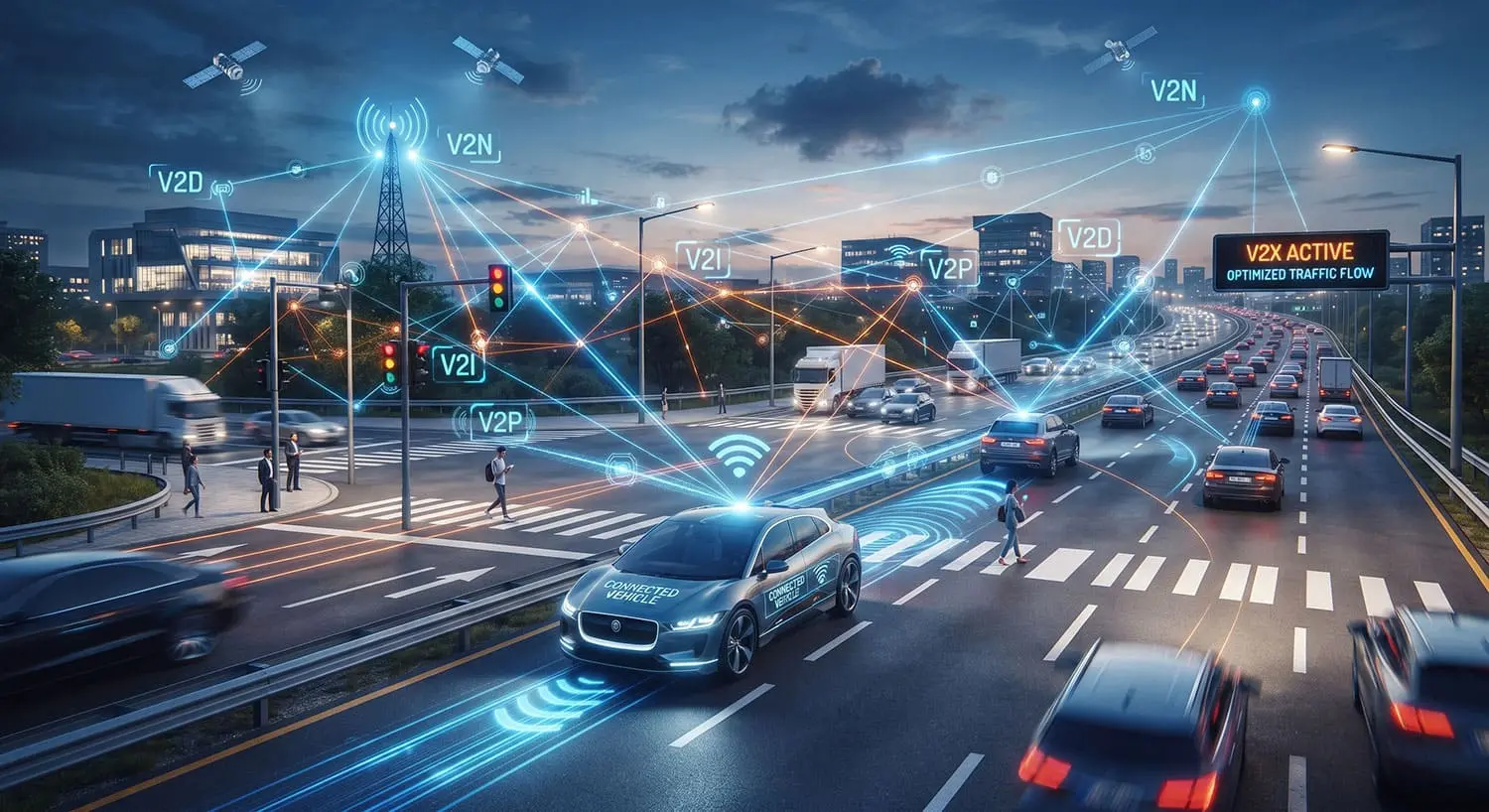
Imagine your car knowing that a vehicle three cars ahead just slammed on its brakes. Or imagine it knowing that a cyclist is about to roll out from behind a parked truck, long before you or your camera can see them. That is the promise of Vehicle-to-Everything (V2X) communication. It lets cars talk to the world around them using wireless signals and share warnings in a fraction of a second.
For years, V2X sounded like a distant idea from tech shows and research labs. In 2026, it is finally becoming real. Rules are changing in the United States, China is building roadside networks in many cities, and chipmakers are racing to put V2X radios into new cars. In this guide, we explain what V2X is, how it works, its main benefits, its biggest challenges, and what it means for your next car.
What Is V2X Communication?
V2X stands for Vehicle-to-Everything. It is a wireless technology that lets a vehicle send and receive short messages with anything nearby that can affect its journey. That includes other cars, traffic lights, road signs, people walking, and online networks. Each message carries basic data such as the vehicle's position, speed, and direction, along with any hazards or road conditions it has detected. The "X" simply means "everything."
Think of it as a sixth sense for your car. Today's driver assistance features depend on cameras, radar, and sensors, and these can only see what is in their line of sight. V2X lets the car "hear" what is happening around corners, over hills, or behind large trucks. It does not replace sensors. Instead, it works alongside them to give the car a fuller and more reliable picture of the road.
The Four Main Types of V2X
V2X is an umbrella term that covers four main links. Vehicle-to-Vehicle (V2V) lets cars warn each other directly about sudden braking or a crash ahead. Vehicle-to-Infrastructure (V2I) connects cars with roadside units, traffic signals, and work zones. Vehicle-to-Pedestrian (V2P) helps cars detect people walking and cycling, usually through their smartphones or wearable devices.
The fourth type is Vehicle-to-Network (V2N). It is the ordinary mobile connection to the cloud that many cars already use for navigation, music streaming, and live traffic updates. Some experts also list smaller categories, such as Vehicle-to-Device (V2D) for Bluetooth links. Together, these links let a car understand its surroundings, both near and far, in a way no single sensor can.
V2X Communication vs. V2X Charging
Many readers get confused because the term V2X is also used in the electric vehicle world. In EV charging, it refers to sending power out of the car battery. In that sense, V2X is a general term that covers Vehicle-to-Grid (V2G), Vehicle-to-Home (V2H), and Vehicle-to-Load (V2L), where the car can power tools, appliances, or even a house.
These two ideas share a name but solve very different problems. V2X charging is about moving electricity, while V2X communication is about sharing safety data over radio. This article focuses only on communication. If you see "V2X" on an EV spec sheet or in a car advert, check the context to know whether it means power sharing or road safety messaging.
How Does V2X Technology Work?
Every V2X car carries an onboard unit, often called an OBU. This small unit combines a GPS receiver, a V2X radio, an antenna, and special security hardware. On the roadside, cities install roadside units (RSUs) on traffic lights, poles, and overhead signs. Both types of units broadcast short safety messages many times every second, and any equipped device nearby can pick them up.
When your car receives a message, its computer quickly checks whether the information matters to you. If a car ahead reports hard braking, or a signal is about to turn red, the system can warn you with a sound, a dashboard alert, or a gentle brake. In pilot projects in the United States, equipped intersections send signal timing data to approaching cars so they can warn drivers about an upcoming red light.
DSRC vs. C-V2X: The Two Competing Standards
For a long time, V2X had two rival technologies. The first is Dedicated Short-Range Communications (DSRC), which is based on a WiFi style standard called IEEE 802.11p. Europe uses its own version, called ITS-G5. Volkswagen made it well known by fitting it to the Golf 8 and its ID electric models in Europe under the name Car2X.
The second is Cellular V2X (C-V2X), which came from the mobile industry and reuses chips similar to those found in smartphones. It can talk directly to nearby devices without any phone tower, and it can also use the cellular network for wider coverage. The United States and China, the two biggest car markets in the world, have both chosen C-V2X and moved away from DSRC.
Where 5G Fits In
The first version of C-V2X was built on 4G LTE. A newer version based on 5G arrived later and is designed for very low delay and much higher data capacity. That matters when cars need to share more than simple warnings, such as detailed sensor information or precise movement plans.
With 5G, cars could share what their cameras see, plan lane changes together, or drive in tight groups called platoons. These features are meant for cooperative driving that the older LTE version cannot handle alone. For everyday drivers, this means V2X will start with simple alerts and slowly grow into smarter, more cooperative features over the coming years.
Key Benefits of V2X for Drivers and Cities
The biggest reason governments support V2X is safety. Sensors are powerful, but they cannot see through walls or around blind corners. V2X fills these gaps by sharing information that no camera could ever capture. The European Union and South Korea actively promote V2X as a technology that could save lives and reduce pollution at the same time.
V2X also helps beyond safety. It can make traffic flow better, help emergency vehicles move faster, and support future automated cars. Common uses include collision avoidance, cooperative adaptive cruise control, emergency vehicle warnings, and help at busy intersections. Let us look at the main benefits in more detail.
Fewer Crashes and Safer Intersections
Intersections are among the most dangerous places on any road. With V2X, a car approaching a junction can learn that another vehicle is about to run a red light, even when buildings block the view. It can also get a warning about a stalled car past a sharp bend, or about ice reported by a car a few hundred meters ahead.
Pedestrians and cyclists gain protection too. Through V2P, a phone or a small device on a bike can tell nearby cars that a person is about to cross. Road workers in work zones can be flagged the same way. These early warnings give drivers extra seconds to react, and in a near miss, a second or two can make all the difference.
Smoother Traffic and Lower Fuel Use
Traffic lights that talk to cars can help drivers time their speed to catch a run of green lights. Instead of stopping and starting at every junction, cars can roll through at a steady pace. This saves fuel, reduces brake wear, and cuts emissions, which is a win for both drivers and cities trying to clean up their air.
Emergency services benefit as well. An ambulance can ask the traffic signals ahead to turn green and warn nearby cars to move aside safely. Traffic managers can also gather road data in real time and spot jams before they grow. Over time, these small improvements add up to shorter trips and less stress for everyone on the road.
A Building Block for Self-Driving Cars
Self-driving cars rely on sensors to understand the road, but sensors have limits in heavy rain, fog, or darkness. V2X gives automated systems a second source of information. If a camera misses a hazard, a message from another car or a roadside unit can still alert the system in time to act.
This is why many experts see V2X as key support for higher levels of automation. In China, analysts expect V2X adoption to grow as rules tighten, especially rules requiring V2X in cars with Level 3 and above driving systems. For drivers, this means V2X today is laying the foundation for safer self-driving cars tomorrow.
Challenges and Global Adoption in 2026
Despite its promise, V2X has been slow to arrive. The technology works best only when many cars and roads use it at the same time. Rules, funding, and competing standards have held it back for more than a decade. Many drivers today have never heard of it, and very few cars on the road are fitted with it.
Global numbers show how early we still are. Industry estimates suggest only around one million V2X cars are on the road worldwide, mostly in Europe and China. The good news is that the picture is now changing quickly. Here are the main hurdles and where things stand in 2026.
Security and Privacy Concerns
Any wireless system can be a target for hackers. If someone could send fake V2X messages, they might trigger false warnings or confuse cars on the road. To prevent this, V2X systems use digital certificates to sign messages, so a car can check that each message came from a trusted source. Onboard units also include special security chips that are hard to tamper with.
Privacy is the other worry. Cars broadcast their position many times a second, so people naturally ask whether they can be tracked. Most V2X designs use temporary identities that change regularly, which makes it hard to follow one vehicle over time. Still, strong rules and clear privacy policies will be important for winning public trust.
The Chicken and Egg Problem
V2X faces a classic chicken and egg problem. Automakers do not want to add the hardware until roads support it, and cities do not want to spend money on roadside units until enough cars can use them. A single V2X car on an empty road gains very little from the technology, so both sides wait for the other to move first.
China shows how hard this is, even with strong government support. The country has full C-V2X coverage in around 20 cities and more than 11,000 roadside units. Yet fewer than 30 production models carry the technology, and only about 4% of new vehicles had it in 2025. Analysts expect that share could reach about 25% by 2030 if government rules get stricter.
Where V2X Stands in 2026
The United States is in the middle of a big shift. New FCC rules for C-V2X took effect in February 2025, and older DSRC systems will no longer be allowed after December 14, 2026. The rules set aside 30 MHz in the 5.9 GHz band, which carmakers can use as three separate channels or combine into larger ones.
Europe is taking a technology neutral path, so both C-V2X and the WiFi based standard can be used, and some suppliers offer dual radios that support both. The industry is also consolidating. In 2025, Qualcomm bought V2X chip maker Autotalks to speed up global rollout. These moves suggest V2X is finally moving from pilot projects to real production cars.
Should You Look for V2X in Your Next Car?
Right now, V2X should not be the main reason you pick a car. Few models offer it, and its benefits depend on how many connected cars and roadside units are in your area. Drivers in parts of China and Europe, or near US pilot corridors, will see more value than drivers in other regions.
Still, it is worth asking the dealer about it, especially if you plan to keep your car for many years. A V2X ready car could gain new features through software updates as more roads get connected. Also check whether the car uses C-V2X, since that is the standard most major markets are moving toward.
Conclusion
Vehicle-to-Everything communication gives cars a way to talk with other vehicles, traffic lights, pedestrians, and networks. It covers four main links, runs on either DSRC or C-V2X, and grows more powerful with 5G. Its biggest promises are fewer crashes, smoother traffic, cleaner cities, and a strong base for self-driving cars.
The road ahead still has bumps, from security worries to slow adoption by automakers. But with the US switching fully to C-V2X, China building large roadside networks, and chipmakers investing heavily, V2X is closer than ever to everyday driving. Keep an eye on this technology, because the next car you buy may be able to see around corners.

Written by Maarukh Shahbaz
Published Oct 22, 2026 in Auto Tech.