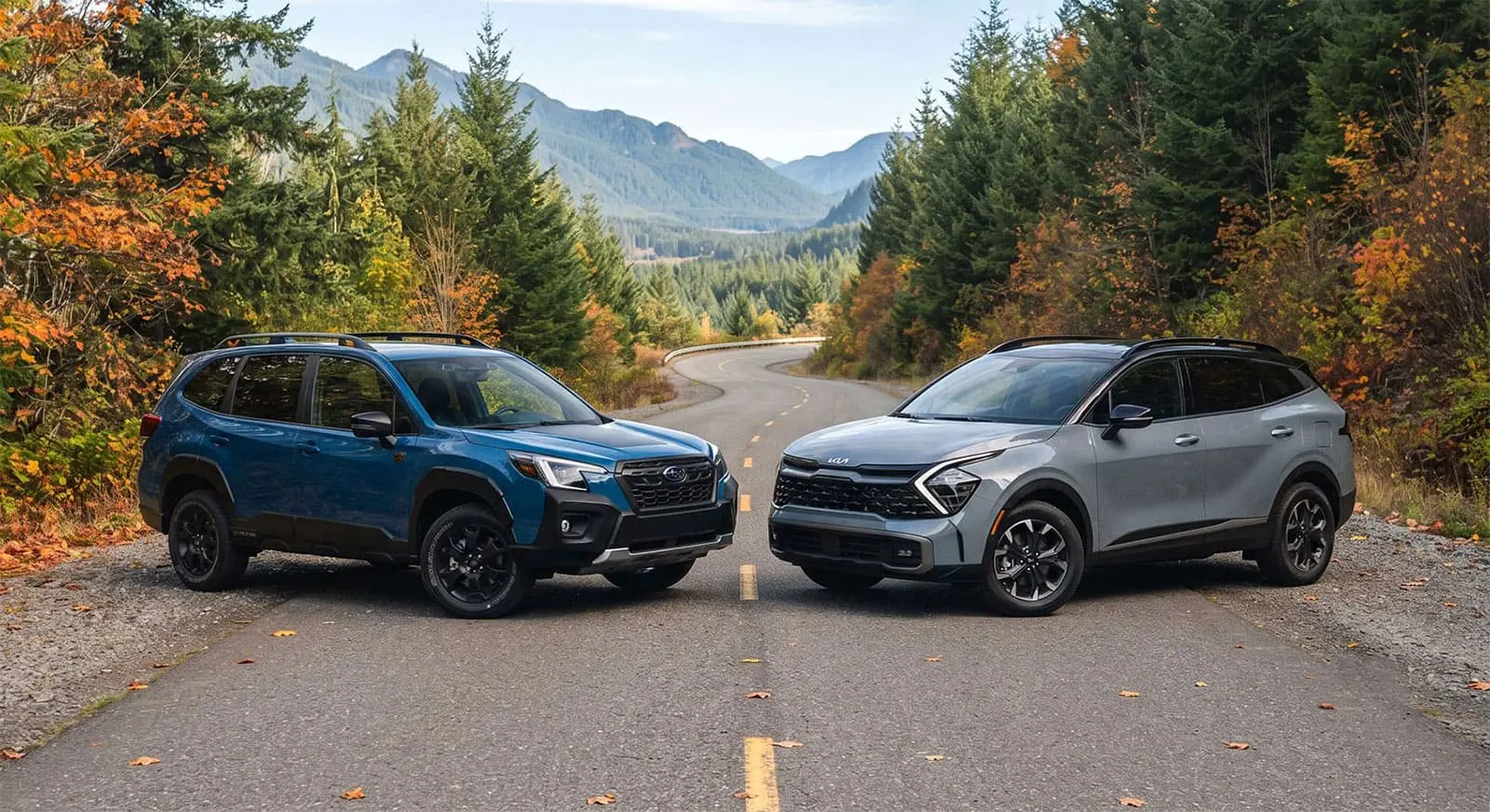
When shopping for a compact SUV in 2026, safety isn't just a checklist item; it’s the foundational pillar of peace of mind for families, daily commuters, and weekend adventurers alike. With roadways becoming increasingly congested and distracted driving on the rise, automakers are pouring billions into advanced driver-assistance systems (ADAS) and crash-mitigation tech. Two vehicles consistently dominate the conversation in this hyper-competitive segment: the newly redesigned 2026 Subaru Forester and the tech-forward 2026 Kia Sportage.
Both of these compact crossovers boast stellar safety reputations, but they achieve peace of mind through radically different engineering philosophies. Subaru relies on its legendary, camera-centric EyeSight suite, a system famed for its redundancy, natural-feeling lane-centering, and rugged weather reliability. Meanwhile, Kia counters with its high-tech Drive Wise package, leveraging a fusion of radar, cameras, and ultrasonic sensors to deliver multi-layered alerts and semi-autonomous Highway Driving Assist capabilities.
Choosing between them is more than a simple spec-sheet comparison; it’s about deciding whether you value Subaru’s steadfast, all-weather mechanical and visual integration or Kia’s comprehensive, gadget-rich electronic safety shield. In this comprehensive head-to-head, we will dive deep into how these two titans stack up across active safety features, structural crashworthiness, real-world sensor reliability, and IIHS testing performance. Whether you're navigating torrential downpours on a highway commute or tackling a muddy backroad trail, understanding how Subaru EyeSight and Kia Drive Wise protect you and your passengers will help you make the ultimate, safest purchasing decision for your garage.
Subaru EyeSight vs. Kia Drive Wise: Core Safety Philosophies and Standard Features
When evaluating active safety, the divergence between the 2026 Subaru Forester and the 2026 Kia Sportage comes down to how their respective suites, Subaru EyeSight and Kia Drive Wise, gather data and intervene. Both systems aim to eliminate driver error, but they utilize distinct technological frameworks to achieve top-tier safety ratings.
Subaru’s Vision-Centric Redundancy
Subaru has long championed a stereo-camera configuration for its EyeSight system, avoiding heavy reliance on vulnerable bumper-mounted radars for primary environmental tracking.
-
The Dual-Camera Setup: Positioned snugly against the rear-view mirror inside the cabin, dual color cameras capture a wide, high-definition stereoscopic view of the road ahead, accurately gauging depth, speed, and the exact distance of obstacles, pedestrians, and cyclists.
-
Weather and Environmental Resilience: Because the cameras are mounted safely behind the windshield and kept clear by the vehicle's wipers, they remain operational even when bumper sensors are caked in mud, slush, or road salt—a vital advantage for rugged utility vehicles facing unpredictable elements.
-
Standard Inclusions: Every 2026 Forester equips EyeSight standard, featuring Advanced Adaptive Cruise Control with Lane Centering, Pre-Collision Braking, and Lane Keep Assist.
Kia’s Multi-Sensor Fusion Approach
Kia’s Drive Wise suite leverages a comprehensive hybrid matrix combining forward-facing cameras, wide-angle radar units, and ultrasonic sensors to build a 360-degree protective digital envelope around the vehicle.
-
Active Electronic Shielding: By blending radar waves with visual feed, Drive Wise excels at calculating rapid closing speeds in dense, multi-lane highway traffic and low-visibility conditions where pure optics might momentarily struggle.
-
Semi-Autonomous Integration: Drive Wise powers features like Highway Driving Assist (HDA), which actively combines Smart Cruise Control with Lane Following Assist to manage steering, acceleration, and braking smoothly on qualifying highways.
-
Comprehensive Proactive Alerts: Standard and available features include Blind-Spot Collision-Avoidance Assist, Rear Cross-Traffic Collision-Avoidance, and Safe Exit Warning, ensuring occupants are protected even when parked.
Head-to-Head Feature Comparison and Real-World Safety Performance
When moving past the spec sheets and looking at active deployment, both the 2026 Subaru Forester and the 2026 Kia Sportage offer incredible peace of mind, but they handle dynamic road hazards slightly differently.
Collision Avoidance and Braking Dynamics
-
Forward Collision-Avoidance (FCA): Both vehicles feature high-speed and low-speed autonomous emergency braking with pedestrian and cyclist detection. Subaru’s EyeSight uses its sharp dual-lens optical system to precisely track walking speeds and trajectory angles. Kia’s Drive Wise utilizes its radar-camera fusion to quickly anticipate rapid deceleration in multi-lane traffic, engaging braking pressure smoothly to prevent rear-end collisions.
-
Lane Keeping & Centering: On long highway stretches, Subaru’s Lane Centering function offers a natural, progressive steering assist that reduces driver fatigue without feeling abrupt. Kia’s Lane Following Assist, integrated with Highway Driving Assist, actively centers the vehicle using crisp road markings, providing a semi-autonomous feel that excels on well-paved interstate corridors.
Weather Adaptability and Sensor Reliability
One of the most critical factors for rugged compact SUVs is how safety tech performs when Mother Nature turns hostile.
-
Subaru’s Optical Advantage in Snow and Mud: Because Subaru’s stereo cameras are safely tucked behind the heated upper windshield area and cleaned by the wipers, they remain fully operational even when lower bumpers and side panels are caked in heavy winter slush, mud, or road salt.
-
Kia’s All-Condition Multi-Sensor Array: Kia mitigates weather variables by combining radar waves with visual feed. While heavy ice or direct, blinding glare can occasionally tax bumper sensors or forward cameras, the multi-sensor fusion ensures that if one data stream is partially obstructed, the secondary sensor helps pick up the slack.
Real-World Performance, Weather Adaptability, and Sensor Reliability
When evaluating modern compact SUVs, safety technology must perform flawlessly not just on dry, sunlit pavement, but when Mother Nature turns hostile. Both the 2026 Subaru Forester and the 2026 Kia Sportage feature sophisticated driver-assistance suites, but their engineering differences heavily influence how they handle inclement weather and daily commuting stressors.
Weather Adaptability: Stereo Optics vs. Sensor Fusion
-
Subaru’s Optical Advantage in Snow and Mud: Because Subaru’s EyeSight stereo cameras are securely mounted behind the upper heated zone of the windshield and kept clear by the vehicle's wipers, they remain fully operational even when lower bumpers, side panels, and grilles are caked in heavy winter slush, mud, or road salt. This optical placement ensures that lane-keeping and pre-collision braking systems do not drop offline during rugged outdoor adventures or severe blizzards.
-
Kia’s All-Condition Multi-Sensor Array: Kia mitigates weather variables by combining radar waves with visual feeds. While heavy ice or direct, blinding glare can occasionally tax bumper sensors or forward cameras, the multi-sensor fusion ensures that if one data stream is partially obstructed, the secondary sensor helps pick up the slack to maintain active safety alerts.
Usability, Alert Fatigue, and Daily Commuting
Beyond raw environmental resilience, the day-to-day user interface plays a massive role in driver safety:
-
Subaru’s Progressive Assistance: Subaru designs its EyeSight alerts to feel intuitive and natural, minimizing abrupt steering corrections or startling acoustic alarms. The lane-centering feature provides smooth, incremental torque to keep you centered, reducing cognitive fatigue during bumper-to-bumper rush hour traffic.
-
Kia’s Multi-Layered Warning System: Kia’s Drive Wise utilizes prominent visual dashboard indicators and targeted chimes to notify drivers of potential hazards. While highly effective at grabbing attention, drivers switching from traditional vehicles may experience a brief adjustment period to manage alert frequency in tight urban environments.
IIHS and Safety Ratings Breakdown: How They Stack Up
When the Insurance Institute for Highway Safety (IIHS) puts compact SUVs through its rigorous evaluations, only the best escape with top-tier accolades. Both contenders in this matchup rise to the occasion, but their paths to industry recognition highlight unique engineering strengths.
The 2026 Subaru Forester: A Legacy of Top Safety Pick+
The Subaru Forester continues its dominant streak in crash safety, securing the coveted IIHS TOP SAFETY PICK+ rating.
-
Crashworthiness Excellence: Under the updated, stricter 2025/2026 testing standards, which feature rigorous evaluations of rear-passenger protection in the moderate overlap front crash test, the Forester achieved "Good" ratings across the board.
-
Structural Integrity: Its upgraded occupant safety cage and robust side-impact performance effectively shield both front and rear occupants, minimizing head, neck, and torso injury risks during high-energy collisions.
The 2026 Kia Sportage: Advanced Protection and Elite Design
Mirroring its rival's ultimate achievement, the 2026 Kia Sportage (specifically models built after May 2025) earned the prestigious IIHS TOP SAFETY PICK+ designation.
-
Rigorous Test Performance: The Sportage aced the small overlap front, updated moderate overlap front, and updated side crash tests with flying colors, locking in maximum "Good" scores.
-
Pedestrian Mitigation: Backed by standard pedestrian automatic emergency braking and well-rated headlights across its trim lineup, the Sportage proves that its active electronic safeguards work hand-in-hand with its passive structural safety framework.
Long-Term Ownership, Maintenance, and Resale Value Insights
When investing in a modern compact SUV, buyers look beyond initial safety ratings to evaluate total cost of ownership over a 5-to-10-year span:
-
Subaru Forester Maintenance Profile: Thanks to its horizontally opposed Boxer engine layout and symmetrical all-wheel-drive system, routine maintenance follows predictable intervals. Subaru’s strong brand loyalty and high demand for pre-owned utility vehicles help the Forester retain exceptional residual and resale values, often outperforming segment averages.
-
Kia Sportage Maintenance Profile: Backed by Kia's industry-leading 10-year/100,000-mile powertrain limited warranty, initial buyers enjoy robust peace of mind against mechanical defects. Parts availability is widespread, and routine service intervals are straightforward, though long-term depreciation tends to be slightly steeper compared to Subaru's stellar resale retention.
Conclusion: Which 2026 Compact SUV Wins the Safety Crown?
When looking at the big picture of active driver-assistance, structural crashworthiness, and real-world reliability, both the 2026 Subaru Forester and the 2026 Kia Sportage earn their rightful places at the pinnacle of modern compact SUV safety. However, because they approach occupant protection through completely different design philosophies, the right choice ultimately depends on your driving environment, lifestyle priorities, and personal preferences behind the wheel.
-
Choose the 2026 Subaru Forester if: You frequently encounter severe weather conditions, live in areas prone to heavy mud, snow, or road salt, and value robust, long-term optical reliability. Subaru’s EyeSight stereo-camera system is uniquely engineered to stay clear behind the heated upper windshield zone, making it a stellar companion for outdoor adventurers and drivers who want straightforward, natural-feeling lane-centering and a proven legacy of top-tier crash protection.
-
Choose the 2026 Sportage if: You lean toward advanced electronic integrations, multi-layered digital alerts, and comprehensive semi-autonomous highway cruising capabilities. Kia’s Drive Wise suite leverages radar-camera sensor fusion to provide an extra safety net in dense multi-lane traffic, offering tech-savvy commuters a rich array of active safety features wrapped in modern styling.
Ultimately, both vehicles secure the prestigious IIHS Top Safety Pick+ rating, proving that whether you favor Subaru’s rugged mechanical vision or Kia’s high-tech digital envelope, you can drive off the lot with total peace of mind.

Written by Maarukh Shahbaz
Published Jul 22, 2026 in Comparisons.