
Choosing between a CVT and a traditional automatic transmission can be confusing because both allow you to drive without changing gears yourself. From the driver's seat, they may seem very similar at first. You select Drive, press the accelerator, and the car starts moving. However, the way these two transmissions deliver power is quite different. A CVT changes its ratio continuously instead of moving through a fixed number of gears. A traditional automatic transmission uses several fixed gear ratios and changes from one gear to another as the vehicle gains or loses speed. These different designs affect how the car feels during acceleration, how the engine sounds, how quickly power reaches the wheels, and how the vehicle behaves during daily driving. They can also affect fuel use, maintenance needs, repair costs, and long-term ownership. Understanding the difference between a CVT and a traditional automatic transmission can help you choose a vehicle that feels comfortable and fits the type of driving you do most often.
The CVT vs traditional automatic transmission debate becomes even more important when reliability enters the discussion. Some drivers enjoy the smooth operation and efficiency of a CVT, while others prefer the familiar gear changes of a normal automatic transmission. Reliability cannot be judged only by the name of the transmission. Some modern CVTs have shown good durability when they are maintained correctly, while certain older designs have developed expensive problems. Traditional automatic transmissions also vary greatly between manufacturers, models, and years. Maintenance history, transmission fluid quality, heat, driving habits, towing, vehicle weight, and engineering quality can all affect how long a transmission lasts. A well-cared-for transmission can often provide many years of service, while a neglected one can develop problems much earlier. Instead of simply calling one type better than the other, it is more useful to understand how both systems work, how they feel on the road, and what owners can do to protect them.
How CVT and Traditional Automatic Transmissions Work
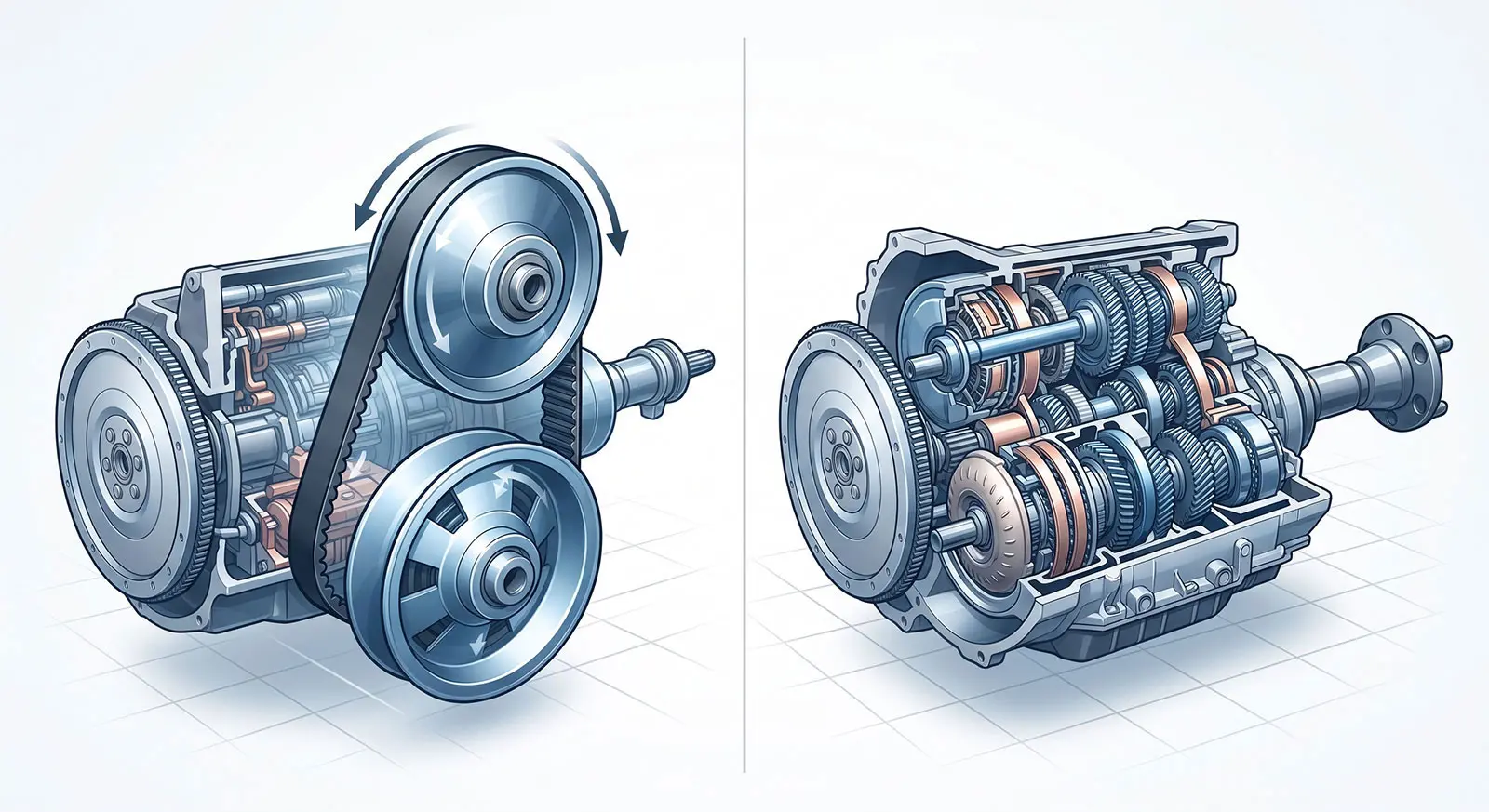
A continuously variable transmission, commonly called a CVT, does not use a normal set of first, second, third, and fourth gears. Many common CVT designs use two adjustable pulleys connected by a strong steel belt or chain. As the vehicle changes speed, the pulleys change their effective size. This allows the transmission to continuously adjust the ratio between the engine and the wheels. Because the system is not limited to a small number of fixed ratios, it can choose a ratio that keeps the engine operating in an efficient range. During gentle driving, the CVT can keep engine speed relatively low to help improve fuel economy and reduce unnecessary engine effort. When more power is needed, it can quickly select a ratio that allows the engine to produce stronger acceleration. The change happens continuously, so the driver usually does not feel the separate gear shifts that are common in a traditional automatic. This smooth operation is one of the main reasons CVTs are widely used in small cars, family sedans, crossovers, and many hybrid vehicles.
A traditional automatic transmission works in a different way. It normally uses planetary gear sets, internal clutches, hydraulic systems, electronic controls, and usually a torque converter. Instead of constantly changing its ratio, it selects from a fixed number of gears. A modern automatic transmission may have six, eight, nine, or even ten forward gears. As the car accelerates, the transmission moves from one ratio to the next. The driver often feels a small change in engine speed each time this happens. Modern automatic transmissions can make these shifts very smooth, but the basic feeling is still different from a CVT. Fixed gears can also make traditional automatic transmissions suitable for vehicles that produce strong torque, carry heavy loads, or tow trailers. Many larger vehicles, performance cars, trucks, and sport utility vehicles still use traditional automatic transmissions for this reason. Both designs perform the same basic job of sending engine power to the wheels, but the way they manage that power creates very different driving characteristics.
CVT vs Traditional Automatic Transmission Driving Feel
Driving feel is one of the biggest differences between a CVT and a traditional automatic transmission. A CVT usually feels very smooth during normal city driving because there are no normal gear changes interrupting acceleration. Press the accelerator gently, and the vehicle can build speed in one continuous motion. This can make driving in heavy traffic comfortable, especially when you constantly slow down and speed up. The transmission is able to adjust its ratio without creating the small pauses that can happen when a traditional automatic changes gears. This smoothness can also make a CVT feel relaxed during daily commuting. The engine can stay at an efficient speed while the transmission quietly changes its ratio in the background. Drivers who value comfort, quiet driving, and smooth power delivery may enjoy this behavior. However, someone who is used to a normal automatic transmission may find the experience unusual because there is no clear feeling of the vehicle moving through different gears.
The difference becomes much more noticeable when you press the accelerator hard. A CVT may quickly raise the engine speed and hold it there while the vehicle continues to accelerate. The engine can sound busy even though the car is steadily gaining speed. Some drivers describe this as a rubber band feeling because engine sound and vehicle speed do not always increase together in the familiar way. This behavior is usually normal and does not automatically mean something is wrong with the transmission. A traditional automatic feels more familiar because engine speed rises, the transmission shifts, engine speed drops, and the cycle repeats. Many drivers enjoy this rhythm because it gives a stronger sense of speed and acceleration. Traditional automatics may also feel more responsive during passing because the transmission can quickly move to a lower gear and provide stronger power. Some manufacturers now program CVTs with simulated gear changes to make them feel more like traditional automatics. These programmed shifts can make a CVT feel more natural to drivers who prefer the sensation of normal gear changes.
CVT vs Traditional Automatic Transmission Reliability
Reliability is one of the biggest concerns for people comparing a CVT vs traditional automatic transmission. Traditional automatic transmissions have been used and improved for many decades, so repair shops have a great deal of experience working on them. Their internal gears, clutches, and hydraulic systems can be very strong when the transmission is designed well and maintained correctly. Many traditional automatic transmissions can provide years of dependable service. They can still develop problems, including worn clutch components, valve body faults, torque converter problems, fluid leaks, sensor failures, or electronic control issues. The advantage is that many experienced transmission specialists understand these systems very well. In some cases, damaged parts can be repaired, or the transmission can be rebuilt rather than replaced completely. However, traditional automatic transmission reliability still varies between vehicle models. Some designs are known for excellent durability, while others have experienced repeated problems. Buying a vehicle only because it has a traditional automatic does not guarantee trouble-free ownership.
CVT reliability is more complicated because the quality of different CVT designs has varied between manufacturers and generations. Modern CVTs can provide long service when the transmission is properly designed, kept cool, and maintained with the correct fluid. However, the belt or chain, pulley surfaces, bearings, hydraulic components, and electronic controls all need to work under carefully controlled conditions. Excessive heat can be especially harmful because high temperatures can reduce fluid quality and increase wear inside the transmission. Heavy towing, repeated hard acceleration, carrying too much weight, and ignoring maintenance can also place additional stress on some CVT systems. When serious internal damage happens, repair options can sometimes be more limited compared with a traditional automatic. Some workshops may recommend replacing the complete unit rather than repairing individual internal parts. This can make a major CVT failure expensive. Still, it would be wrong to say that all CVTs are unreliable. Many newer systems have improved greatly. The best approach is to research the exact vehicle model, year, service history, and transmission reputation before making a purchase.
Maintenance and Long-Term Ownership
Maintenance plays a major role in the life of both transmission types. Transmission fluid does much more than provide basic lubrication. It also helps control heat, hydraulic pressure, friction, and internal operation. CVTs normally require fluid that is specifically designed for their transmission system. Using the wrong type of fluid can affect performance and may cause serious internal damage. Owners should follow the vehicle manufacturer's service information rather than assuming that all transmission fluids are the same. Driving conditions also matter when deciding how carefully a transmission should be maintained. A vehicle that spends most of its time in heavy traffic, extreme heat, mountain areas, or under heavy loads may place much more stress on its transmission than a vehicle that is driven gently on open roads. Stop-and-go traffic can also increase heat because the transmission is constantly adjusting and working. If the manufacturer recommends more frequent service for severe driving conditions, following that advice can help protect the transmission and reduce the chance of expensive repairs later.
Traditional automatic transmissions also need proper maintenance even though some drivers believe they are more forgiving. Old or damaged transmission fluid can reduce lubrication and cooling, while leaks can cause the fluid level to become dangerously low. Drivers should pay attention to warning signs such as delayed engagement, unusual vibration, slipping, rough gear changes, strange noises, or a burning smell. CVT owners should also watch for shuddering, hesitation, unusual whining, unexpected changes in engine speed, warning lights, or weak acceleration. A professional inspection is a good idea when these symptoms appear because continuing to drive with a transmission problem can make the damage worse. For used car buyers, maintenance records can be just as important as mileage. A lower mileage vehicle with neglected transmission service may actually be a greater risk than a higher mileage vehicle that received proper care. Owners should also avoid placing more load on the transmission than the vehicle is designed to handle. Correct maintenance, smooth driving habits, and early attention to warning signs can make a major difference in long-term reliability.
Conclusion
The CVT vs traditional automatic transmission comparison does not have one answer that fits every driver. A CVT is often a good choice for someone who wants smooth acceleration, comfortable city driving, and an engine that can operate efficiently without moving through fixed gears. Its continuous operation can make daily commuting calm and easy, especially in busy traffic. The main adjustment is the unusual feeling during strong acceleration, when engine speed may remain high while road speed continues to increase. Some drivers do not mind this behavior at all, while others prefer a stronger feeling of mechanical connection. A traditional automatic provides the gear changes that most drivers already recognize. It can feel more natural during acceleration and may offer a stronger sense of control when passing or driving at higher speeds. Traditional automatics are also widely used in vehicles that need to handle stronger power, heavier loads, towing, and more demanding driving situations. Drivers who enjoy feeling the transmission move through gears may find a traditional automatic more satisfying.
When reliability is your main priority, it is better to research the exact vehicle than to judge every transmission by its type. A well designed and well maintained CVT can provide dependable service, while a poorly maintained traditional automatic can fail much earlier than expected. The opposite can also be true. Before buying a vehicle, check its service history, transmission reputation, manufacturer maintenance requirements, and previous owner care. Take the car for a proper test drive and pay attention to how the transmission behaves during slow driving, normal acceleration, highway driving, and stronger acceleration. Listen for unusual sounds and notice any hesitation or vibration. If you prefer smoothness, easy driving, and good efficiency, a CVT may suit you better. If you prefer familiar gear changes, a more traditional driving feel, and wider repair experience, a traditional automatic may be the better choice. In the end, the best transmission is not simply the one with the best reputation. It is the one that fits your driving style, your vehicle needs, your maintenance habits, and your long term ownership plans.



Written by Kousar Shabbir
Published Oct 5, 2026 in Comparisons.



