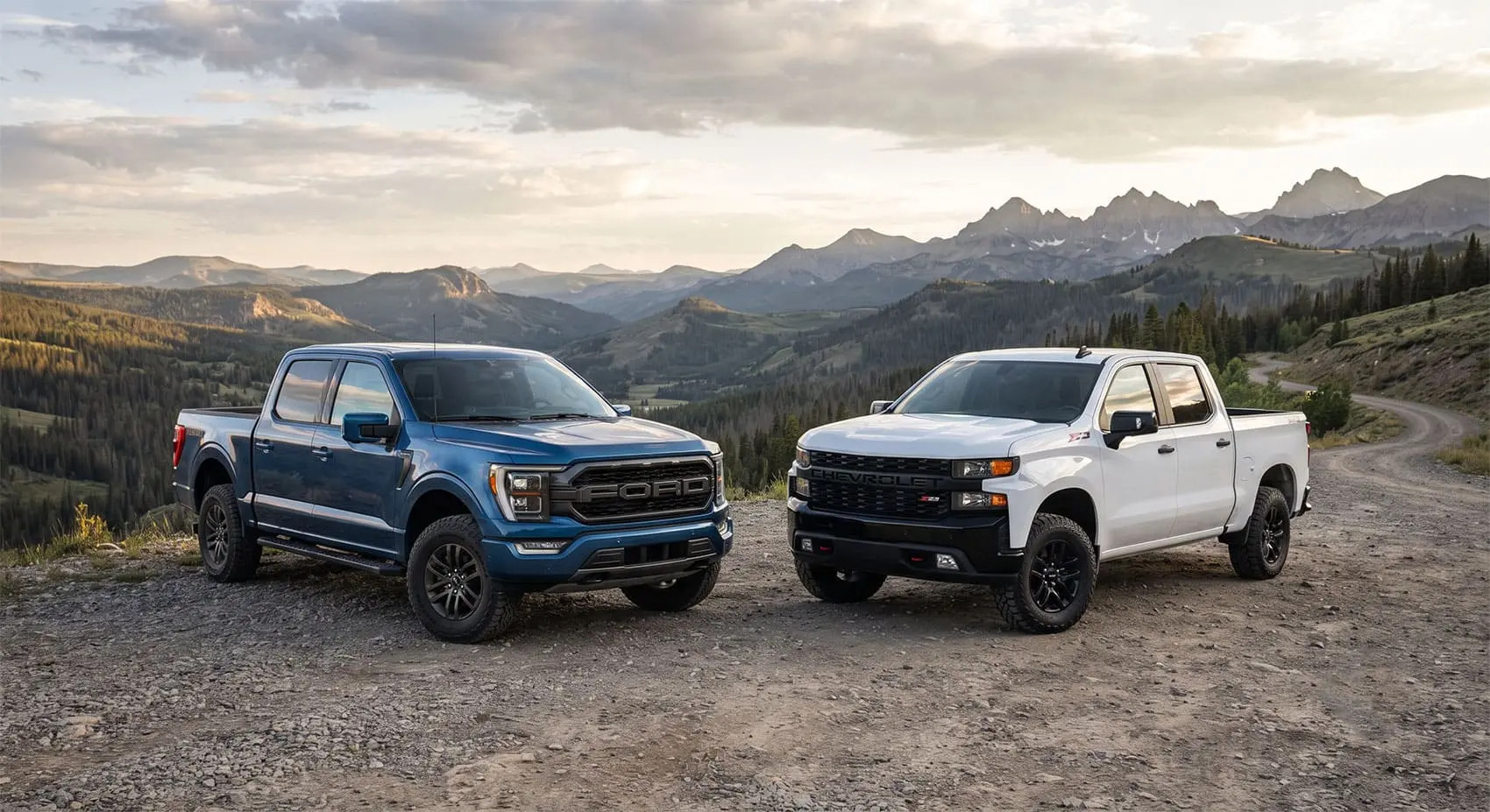
When it comes to the heavy-duty automotive landscape, few rivalries run as deep, passionate, and fiercely contested as the battle between the Ford F-150 and the Chevrolet Silverado 1500. For decades, these two American automotive titans have fought tooth and nail for dominance in driveways, job sites, and commercial fleets across the globe. Buyers choose full-size pickup trucks not just for their brute strength, towing capacity, or modern interior luxury, but also as significant financial investments.
Because trucks represent a substantial upfront cost, savvy buyers weigh heavily how well a vehicle will maintain its financial value over time. Depreciation is often the silent killer of automotive budgets, turning a dream purchase into a heavy financial loss if chosen unwisely. Understanding which of these legendary trucks better protects your investment over 3- and 5-year ownership horizons is crucial. This face-off dives deep into depreciation metrics, market demand drivers, and the mechanical traits that determine whether your truck retains top-tier resale value or plummets faster than expected.
Furthermore, the modern pre-owned pickup truck marketplace is influenced by an unprecedented array of economic variables, including shifting consumer credit rates, fluctuating fuel prices, and the rapid evolution of hybrid and alternative powertrain technologies. Whether you are a commercial contractor looking to maximize your fleet's asset turnover or an individual private owner planning your next vehicle trade-in, recognizing the subtle patterns of residual value retention can save you thousands of dollars at the dealership. This comprehensive face-off dives deep into precise depreciation metrics, global market demand drivers, regional preferences, and the critical mechanical traits that determine whether your truck retains top-tier resale value or plummets faster than expected.
F-150 vs. Silverado Depreciation Basics
When evaluating asset depreciation for full-size American pickup trucks, automotive analysts typically look at a standard 3-year and 5-year ownership window. During the initial three years on the market, light-duty trucks experience their steepest financial drop-off as they transition from brand-new status to the pre-owned inventory pool. Market research from major automotive platforms indicates that both the Ford F-150 and Chevrolet Silverado 1500 follow a relatively close depreciation trajectory, though subtle market forces tilt the scales differently depending on the specific year and data tracker you consult.
On average, a Chevrolet Silverado 1500 exhibits a 3-year depreciation rate hovering around 38% to 42%, stabilizing toward a total 5-year value loss of roughly 42% to 43%. Conversely, the Ford F-150 displays a varied pattern: some analytical studies highlight an impressive early retention rate, losing under 20% to 35% in the first three years while long-term 5-year tracking places its total depreciation closer to 43% to 50% due to massive high-volume market saturation.
-
The Initial Drive-Off Hit: Both trucks shed roughly 15% to 20% of their sticker value the moment they are driven off the dealership lot.
-
The 3-Year Turning Point: Mid-term value retention heavily depends on regional work demand, fleet retirement cycles, and fuel price volatility.
-
The 5-Year Stabilization: Beyond year five, the depreciation curves for both models flatten out significantly, turning mechanical reliability and maintenance records into the primary drivers of residual value.
Ford F-150 Resale Performance
When examining the specific value retention of the Ford F-150, its status as America's perennial best-selling vehicle acts as a double-edged sword. On one hand, massive market saturation means there is always an active, hungry pool of used truck buyers looking for an F-150. On the other hand, high-volume production means pre-owned lots are never starved for inventory, forcing sellers to compete fiercely on price. Over a 5-year ownership span, well-maintained F-150 models typically retain roughly 50% to 52% of their original sticker price, depending heavily on the chosen powertrain and trim level.
-
The Impact of Lightweight Aluminum Construction: Ford's military-grade aluminum body architecture provides a major advantage in regions prone to heavy winter road salting, effectively eliminating rust-out concerns that plague older steel frames. This structural longevity keeps trade-in values high.
-
Powertrain Influence (EcoBoost vs. V8): Traditional 5.0L V8 models and high-demand 3.5L EcoBoost V6 variants tend to command stronger secondary market attention than base utility engines. Meanwhile, emerging hybrid configurations (like the PowerBoost) are starting to hold unique appeal for fuel-conscious buyers navigating fluctuating pump prices.
-
Trim-Level Winners: Mid-to-high tiers like the XLT and Lariat strike the sweet spot, balancing modern tech features (such as BlueCruise and advanced towing packages) with reasonable depreciation curves, whereas ultra-luxury trims like the Limited or Platinum suffer steeper initial dollar losses.
Chevrolet Silverado 1500 Resale Performance
When shifting the lens to the Chevrolet Silverado 1500, its market position closely mirrors that of its eternal rival, though with distinct variations in how different powertrain configurations and regional preferences dictate depreciation curves. On average, a well-maintained Silverado 1500 retains roughly 48% to 51% of its original sticker value after a standard 5-year ownership cycle. The truck benefits immensely from an intensely loyal base of commercial and private buyers who value traditional truck utility, making pre-owned models a hot commodity on regional used-car lots.
-
The Durability of V8 Powerplants: Unlike Ford's aggressive push toward forced-induction turbocharged V6s, Chevrolet's legendary EcoTec3 V8 engine lineup (such as the 5.3L and 6.2L blocks) continues to command massive respect in the secondary market. Buyers seeking long-term mechanical simplicity and traditional rumble often pay a premium for used V8 Silverados, which directly props up residual values.
-
Modern Interior Updates and Tech Integration: Recent model years have introduced vastly improved infotainment systems, Super Cruise technology, and rugged multi-flex tailgates. These luxury and utility upgrades have helped mitigate the steep interior depreciation hits that older generation Silverado models historically suffered from.
-
Trim-Level Winners: Just like the F-150, mid-tier workhorses and popular stylistic packages like the RST, LTZ, and Trail Boss tend to hold their market value far better than bare-bones base models or overly complex, ultra-expensive High Country trims.
Head-to-Head Comparison
When the dust settles on the ultimate value-retention showroom floor showdown, deciding whether the Ford F-150 or the Chevrolet Silverado 1500 takes the resale crown depends heavily on how long you intend to keep your asset and which tracking metrics you trust most. On one side, industry platforms like iSeeCars historically score the Ford F-150 with a slower early-stage depreciation curve during the first three years, largely driven by its unmatched sales volume, continuous generation lines, and massive ecosystem of parts. On the other side, tracker indexes such as CarEdge and Kelley Blue Book point out that the Chevrolet Silverado 1500 fights back aggressively with stable long-term value preservation, sometimes yielding a tighter overall 5-year percentage loss depending on the specific regional inventory mix, trim level, and its classic V8 mechanical demand.
-
The Short-Term Winner (Years 1–3): The Ford F-150 often edges out slightly in early trade-in flexibility due to massive consumer awareness, heavy pre-owned market searches, and high-demand tech packages like BlueCruise and the Pro Power Onboard generator.
-
The Long-Term Stabilizer (Years 4–10): As mileage climbs and factory warranties expire, buyers shopping on a budget lean heavily toward mechanical simplicity. The Silverado's robust EcoTec3 V8 powertrains and straightforward configurations help it close the gap significantly, matching or occasionally out-pacing the F-150 as both depreciation curves flatten out.
-
Final Verdict for Buyers: If you plan to flip or trade your truck within three years, a well-optioned mid-tier F-150 (such as an XLT or Lariat) serves as a formidable shield against rapid initial drops. However, if you are investing in a long-term utility vehicle where lower initial purchase costs and time-tested V8 durability dictate your return on investment, the Chevrolet Silverado 1500 stands as an equally brilliant financial contender
Market Trends & Total Cost of Ownership
To truly understand why the F-150 and Silverado trade blows so intensely on the used market, we must look beyond standard sticker depreciation and analyze the total cost of ownership (TCO). When a prospective second-hand truck buyer browses online marketplaces, they aren't just looking at the upfront price tag; they are calculating long-term fuel efficiency, insurance premiums, maintenance frequency, and the availability of affordable replacement parts.
-
Fuel Economy & Alternative Powertrains: With global fuel prices remaining volatile, modern truck buyers heavily favor powerplants that minimize trips to the gas station. Ford’s introduction of the EcoBoost V6 lineup and the innovative PowerBoost Hybrid system changed the game by offering V6-like efficiency with V8 towing capacity. Meanwhile, Chevrolet's integration of the Duramax 3.0L Turbo-Diesel inline-six engine has created a cult following among long-haul commuters and heavy towers, resulting in diesel-powered Silverado variants holding onto their residual values remarkably well compared to standard gas-guzzling configurations.
-
Maintenance and Repair Costs Over 5 Years: Maintenance history can make or break a truck's resale value. Both Ford and Chevy benefit from an endless supply of aftermarket and OEM replacement parts, meaning mechanical repairs rarely suffer from the astronomical parts-delay costs associated with luxury import brands. However, routine services like transmission servicing, brake replacements, and suspension wear play a critical role. Trucks equipped with heavy-duty towing packages that have been subjected to commercial abuse often see a sharp decline in trade-in value, whereas private-owner vehicles with clean, documented service records easily command top dollar regardless of whether they wear the Blue Oval or the Bowtie.
Conclusion
When all factors are weighed, from initial 3-year depreciation curves to long-term 5-year value stabilization, the Ford F-150 and Chevrolet Silverado 1500 prove to be remarkably resilient financial investments compared to standard passenger cars. Navigating the competitive full-size truck market requires looking past mere initial impressions and recognizing how mechanical durability, regional utility, and configuration choices protect your long-term capital.
The Ford F-150 ultimately takes a slight edge in short-term market liquidity and early trade-in value, largely fueled by its massive sales volume, widespread consumer awareness, and advanced technology offerings like BlueCruise and onboard power generators. Its military-grade aluminum body architecture also ensures stellar structural longevity in regions prone to heavy winter road salting or coastal humidity. On the other hand, the Chevrolet Silverado 1500 fights back as a formidable long-term value stabilizer, holding its ground exceptionally well thanks to the enduring appeal of its time-tested EcoTec3 V8 engines, robust diesel variants, and rugged mechanical simplicity that appeals heavily to commercial fleets and traditional purists alike.
Ultimately, whether you choose the aluminum-bodied innovation of the F-150 or the traditional V8 powerhouse of the Silverado, protecting your future resale value boils down to strategic decision-making. Savvy buyers should focus on investing in well-balanced mid-tier trims (such as an XLT, Lariat, RST, or Trail Boss), maintaining meticulous, verifiable service logs, and selecting configurations that align closely with real-world secondary market demand. By planning your purchase with depreciation in mind, you ensure that your heavy-duty investment remains a valuable asset rather than a financial liability down the road.

Written by Maarukh Shahbaz
Published Jul 22, 2026 in Comparisons.