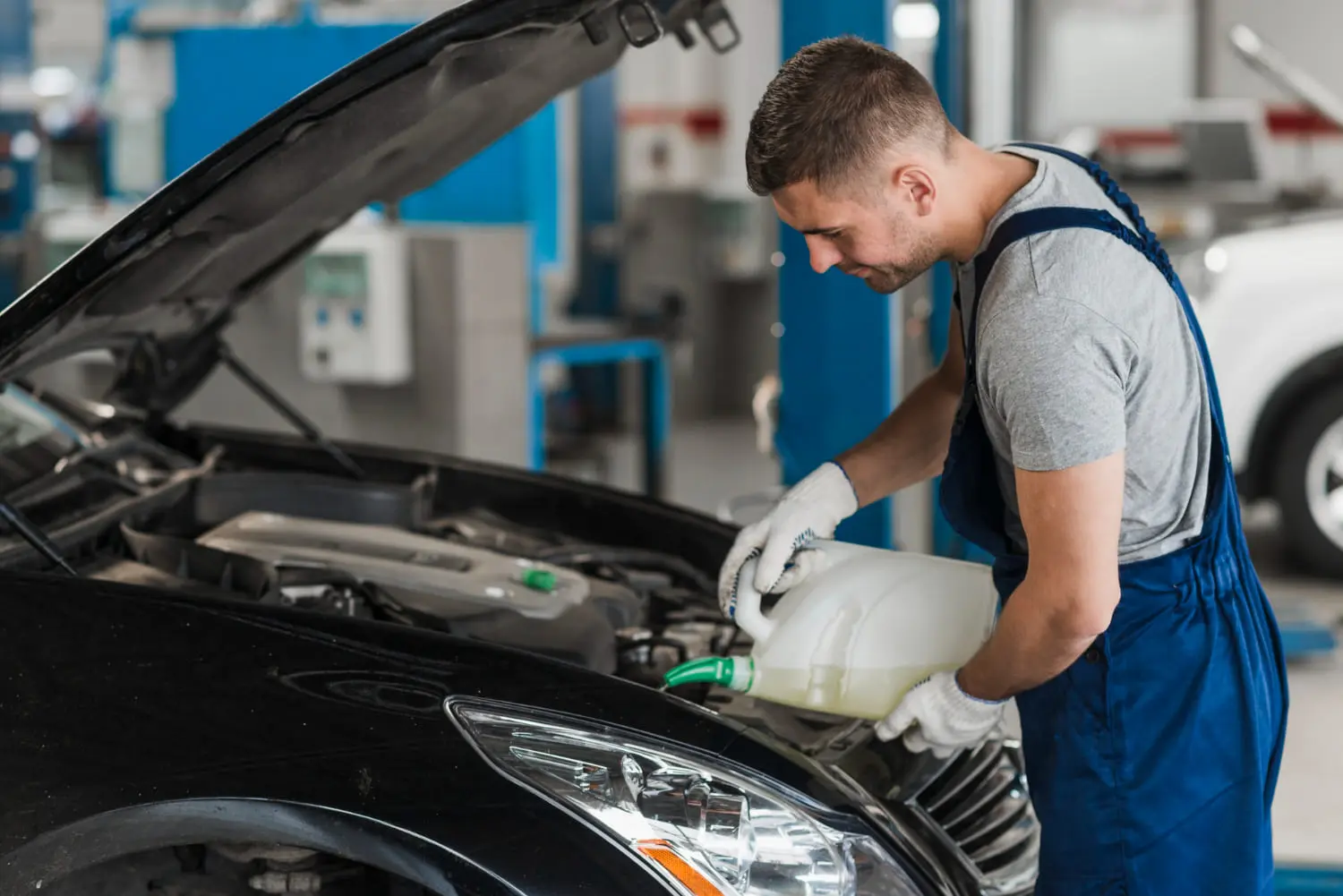
Every driver eventually faces the glowing check-engine warning or the subtle creep of the temperature gauge ticking past center. When you pop the hood, you are greeted by an expansion reservoir with a translucent fluid sitting just beneath the minimum indicator line. The immediate impulse is natural: grab an open jug of antifreeze from the garage shelf, pour it in until the line is met, snap the cap shut, and drive away assuming the problem is solved. For many routine scenarios, this quick top-off keeps your engine running within its standard thermal threshold. However, treating a simple fluid top-off as a permanent substitute for a comprehensive cooling system flush is one of the most expensive misunderstandings in modern automotive care.
Engine coolant, commonly known as antifreeze, is not a static fluid designed to last indefinitely without chemical breakdown. While its base mixture of ethylene glycol or propylene glycol retains basic freeze and boil resistance over extended periods, the specialized chemical additives responsible for safeguarding your engine do not. Over tens of thousands of miles of intense thermal cycling, these vital corrosion inhibitors, pH stabilizers, anti-foaming agents, and water pump lubricants degrade completely. Once depleted, the once-protective fluid turns mildly acidic, silently attacking aluminum cylinder heads, copper heater cores, rubber radiator hoses, and steel water pump impellers from within.
Knowing the exact mechanical difference between topping off your coolant reservoir and executing a complete, pressurized cooling system flush can mean the difference between spending twenty dollars on preventive maintenance and shelling out thousands for a warped head gasket or blown radiator. Whether you are driving a high-mileage commuter vehicle, managing an aluminum-block turbocharged engine, or simply maintaining your daily driver, understanding fluid degradation, additive longevity, and chemical compatibility ensures your vehicle stays protected against extreme heat and freezing temperatures alike.
Coolant Basics: What Does Engine Antifreeze Actually Do?
Engine coolant is far more than colored water cycling through your engine block; it is an engineered chemical solution formulated to handle extreme thermal stress, prevent catastrophic mechanical failure, and protect delicate internal alloys. At its base level, coolant is composed of roughly 50% demineralized water and 50% glycol (primarily ethylene glycol or propylene glycol). This specific ratio alters the physical properties of the fluid, raising the boiling point to around 223°F (106°C) under standard atmospheric pressure—and significantly higher inside a pressurized cooling system—while depressing the freezing point down to -34°F (-37°C). Without this fundamental fluid dynamic, ambient winter freezes would crack cast iron engine blocks, while standard operating temperatures in rush-hour summer traffic would instantly vaporize pure water into high-pressure steam.
Beyond regulating extreme temperatures, the most crucial component of engine coolant is its additive package. Coolant serves as a vital corrosion inhibitor, a pH buffer, and a water pump seal lubricant. Modern combustion engines combine diverse metals within close proximity: aluminum cylinder heads, cast-iron engine blocks, copper heater cores, brass fittings, and steel thermostat springs. When water and heat interact with dissimilar metals, galvanic corrosion naturally occurs, stripping electrons from softer metals and causing rapid pitting, cavitation, and flaking. Coolant additives coat these internal metal surfaces with a microscopic protective passivation layer, neutralizing natural acidic byproducts and ensuring water pump bearings spin smoothly without premature abrasive wear.
To make informed maintenance decisions, drivers must understand the three primary coolant formulations used across the automotive industry:
-
Inorganic Additive Technology (IAT): The traditional green fluid used in older vehicles (pre-2000s). It relies on fast-acting silicates and phosphates to form a protective barrier over iron and aluminum. However, these inorganic inhibitors deplete rapidly, requiring replacement every 2 years or 24,000 to 30,000 miles.
-
Organic Acid Technology (OAT): Commonly found in modern GM (Dex-Cool), European, and Asian vehicles (often orange, pink, or red). OAT coolants do not use silicates; instead, they contain organic acids that provide slower, long-lasting corrosion protection specifically tailored for modern aluminum engines, boasting service lives of 5 years or 100,000 to 150,000 miles.
-
Hybrid Organic Acid Technology (HOAT): A hybrid blend combining organic acids with a small dose of silicates or phosphates (frequently yellow, turquoise, or blue). HOAT is widely used by Ford, Chrysler, and several European manufacturers, providing both rapid initial surface protection and extended-drain longevity.
Topping Off Coolant: When Is It Appropriate?
Topping off your engine coolant is a routine maintenance action intended strictly to correct minor, natural volume fluctuations within an otherwise healthy, functioning cooling system. Over thousands of miles, small amounts of moisture naturally escape through the radiator pressure cap's vapor relief valve during intense thermal expansion cycles, or minor evaporation occurs in non-pressurized recovery tanks. When checking the transparent plastic coolant reservoir during routine multi-point inspections or before embarking on a long highway road trip, finding the resting fluid level resting slightly between the "MIN" and "MAX" cold indicator lines is common. In this specific scenario, adding a modest quantity of compatible fluid directly into the reservoir safely restores the required volume without demanding a complete system teardown.
However, executing a proper top-off requires strict adherence to fluid chemistry and dilution ratios. The safest and most effective method is using a 50/50 pre-diluted (pre-mixed) coolant matching the exact specification mandated in your vehicle's owner manual. If you are working with concentrated antifreeze, it must always be mixed in an exact 1:1 ratio with distilled or demineralized water—never tap water or well water. Household tap water contains dissolved minerals such as calcium, magnesium, and chloride, which precipitate out under engine heat to form hard limescale deposits that clog radiator tubes and degrade the water pump's mechanical face seals. Furthermore, safety is paramount: never attempt to open a radiator cap or pressurized reservoir on a hot engine, as boiling coolant under 15 to 20 PSI will instantly atomize into scalding steam.
The most dangerous pitfall when topping off coolant is the indiscriminate mixing of incompatible chemical formulations. While modern marketing promotes "universal" coolants, mixing disparate chemistries carries severe mechanical risks:
-
Chemical Precipitation (Gelling/Sludge): Mixing traditional silicate-based IAT (green) with OAT (such as orange Dex-Cool) triggers a chemical reaction where the silicates fall out of suspension. This transforms the liquid into a thick, gelatinous sludge that rapidly blocks narrow heater core channels and radiator passages, starving the engine of thermal transfer.
-
Additive Cancellation: Combining HOAT and non-compatible OAT formulas can chemically neutralize the organic acid corrosion inhibitors, leaving raw aluminum cylinder heads completely exposed to aggressive pitting and cavitation damage.
-
Persistent Leaks vs. Natural Consumption: If your reservoir continually drops below the minimum line every few weeks, topping off is merely masking a mechanical failure. Constant fluid loss indicates an external leak (cracked hose, leaking water pump gasket, pinhole in the radiator) or a catastrophic internal leak (failing head gasket or cracked cylinder block).
Coolant Flush: Why and When Is a Full Replacement Necessary?
A full coolant flush involves thoroughly draining the existing antifreeze, circulating a dedicated chemical cleaner and distilled water through the entire system to break down oxidized deposits, and refilling it with fresh, balanced coolant. Unlike a basic top-off that merely dilutes degraded fluid in the expansion tank, a full flush evacuates all old fluid residing deep inside the engine block, heater core, water jacket passages, and lower radiator lines.
The primary driver for a complete flush is additive depletion. Over repeated thermal cycles, the corrosion inhibitors, pH stabilizers, and lubricants naturally break down. When these protective chemicals oxidize, the coolant’s pH level drops from slightly alkaline (around 8.5 to 10.5) to acidic (below 7.0). Acidic coolant aggressively corrodes copper heater cores, aluminum cylinder heads, and steel impellers. Furthermore, old coolant loses its anti-foaming properties; microscopic air bubbles collapse violently against hot cylinder walls, creating cavitation erosion that can bore pinholes through aluminum water pump housings.
Automakers establish strict service intervals to prevent this chemical degradation:
-
Traditional IAT Coolants: Every 2 years or 24,000 to 30,000 miles.
-
Modern Long-Life OAT/HOAT Coolants: Typically every 5 years or 100,000 to 150,000 miles, with subsequent flushes recommended every 3 years or 50,000 miles thereafter.
Beyond scheduled mileage, critical warning signs indicating an immediate flush is required include:
-
Discolored or Cloudy Fluid: Dark brown, muddy, or rusty coolant signals severe internal oxidation and suspended corrosion debris.
-
Floating Sludge or Film: An oily film or gel-like buildup inside the radiator neck indicates fluid cross-contamination or chemical gelling.
-
Chronic Overheating: Engine temperatures spiking during normal driving often stem from scale and sediment restricting radiator core tubes.
-
Sweet, Pungent Odor in the Cabin: A persistent maple syrup smell inside the vehicle, often accompanied by a greasy haze on the windshield, points to a corroded heater core leaking depleted fluid.
Diagnostic Testing: How to Test Coolant Health at Home
Relying solely on visual inspection or arbitrary mileage counts to determine coolant condition can lead to premature cooling system failures or unnecessary replacements. Testing the chemical health and thermal properties of your engine antifreeze requires accessible, accurate diagnostic tools that measure pH balance, freeze protection, and galvanic voltage buildup.
-
Chemical Test Strips (pH & Corrosion Inhibitors): Dip test strips into cold coolant extracted from the radiator or reservoir. Healthy coolant should read between 8.5 and 10.5 on the pH scale. A reading falling below 7.0 indicates acidic degradation, signaling that corrosion inhibitors are exhausted and internal metal etching is actively underway.
-
Refractometers vs. Hydrometers (Freeze/Boil Protection): While inexpensive floating-ball hydrometers measure fluid specific gravity, they are easily skewed by temperature fluctuations. An optical refractometer provides lab-grade precision using only a few drops of fluid, projecting exact freeze-point depression and glycol concentration percentages (aiming for a standard 50/50 balance protecting down to -34°F).
-
Multimeter Voltage Testing (Electrolysis Check): Stray electrical currents from poorly grounded starters, alternators, or accessories can turn your cooling system into a galvanic battery. Set a digital multimeter to DC volts, place the negative probe on the battery's negative terminal, and submerge the positive probe directly into the coolant (without touching metal). A reading above 0.3 volts indicates active electrolysis, which rapidly strips metal from the heater core and radiator walls regardless of coolant age.
-
Visual & Olfactory Indicators: Degraded coolant loses its clear, fluorescent tint. Milky pink or milky brown fluid indicates oil cooler failure or head gasket breach (engine oil mixing with coolant). A dark, rusted tea color indicates heavy ferrous oxidation, while an acrid burnt smell indicates severe thermal breakdown.
The Financial and Mechanical Stakes: Flush vs. Top Off
When deciding between a routine cooling system flush and a simple top-off, the financial calculation extends far beyond the price of a gallon of antifreeze. A proactive cooling system flush is one of the most cost-effective preventive maintenance services in automotive care, typically costing between $100 and $200 at an independent repair facility, or under $50 when performed as a thorough DIY project using distilled water, chemical flush solvent, and concentrated OEM-spec coolant. In contrast, deferring fluid replacement until the additive package completely collapses leads to catastrophic collateral damage across expensive cooling components.
When degraded, acidic coolant circulates unchecked, it targets the thinnest, most delicate heat-exchange matrices first. Replacing a clogged or corroded radiator ranges from $400 to $900 in parts and labor. A failed water pump—often caused by depleted lubricants wearing down internal mechanical seals—demands $300 to $750 to repair, frequently requiring simultaneous timing belt replacement on interference engines. The most financially punishing failure is a leaking heater core buried behind the vehicle dashboard, where replacement labor alone routinely pushes repair invoices between $1,000 and $1,800. In severe overheating events, blown head gaskets or warped cylinder heads easily surpass $2,500 to $4,000 in major engine overhaul costs.
Choosing between a DIY drain-and-fill and a professional machine flush depends on equipment accessibility and chemical disposal capabilities:
-
DIY Drain-and-Fill: Involves opening the radiator petcock drain valve, draining the radiator, filling with distilled water and cooling system cleaner, running the engine to operating temperature with the cabin heater on full blast, and performing repeated drain cycles until completely clear before adding concentrated coolant. While budget-friendly, it requires meticulous air bleeding to avoid air pockets and strict adherence to local hazardous waste regulations.
-
Professional Exchange Machine Flush: Utilizes vacuum-assisted or fluid-exchange machines connected inline with the upper radiator or heater hoses. This method extracts virtually 100% of old fluid trapped inside the engine block water jackets and heater core under controlled pressure, eliminating airlock risks and safely recycling depleted ethylene glycol.
Conclusion & Best Practice Checklist
Maintaining your vehicle’s thermal efficiency demands a proactive approach that balances quick top-offs with timely, comprehensive cooling system flushes. Topping off your coolant is an effective, temporary fix for minor fluid losses caused by natural evaporation or seasonal temperature swings. However, relying solely on top-offs overlooks the inevitable chemical breakdown of vital corrosion inhibitors, pH buffers, and lubricants. Allowing depleted antifreeze to circulate indefinitely exposes your radiator, water pump, and heater core to internal oxidation, acid etching, and costly mechanical failure.
To keep your engine running reliably and avoid unexpected roadside overheating, follow this quick decision-making checklist:
When to Top Off:
-
The expansion reservoir level is slightly below the "MIN" mark during routine checks.
-
The existing fluid is clean, clear, and retains its original fluorescent color.
-
You are using an exact OEM-matched, pre-diluted 50/50 formula or a 1:1 blend with distilled water.
-
There are no signs of active fluid leaks, sludge, or overheating.
When to Perform a Full Flush:
-
The coolant has reached its manufacturer-recommended age or mileage threshold (e.g., 2 years for traditional IAT or 5 years/100k miles for OAT/HOAT).
-
Test strips show a pH reading below 8.0, or a multimeter measures galvanic voltage above 0.3V.
-
The fluid appears dark brown, cloudy, rusty, or contains floating gel/sludge.
-
You suspect incompatible coolant colors or chemistries were previously mixed.
-
You are replacing major cooling components like a radiator, water pump, or thermostat.
By inspecting your cooling system at every oil change, testing fluid health annually, and pairing routine top-offs with scheduled full flushes, you protect your engine against extreme temperatures and preserve its value for years to come.


Written by Maarukh Shahbaz
Published Aug 25, 2026 in Maintenance & Tips.