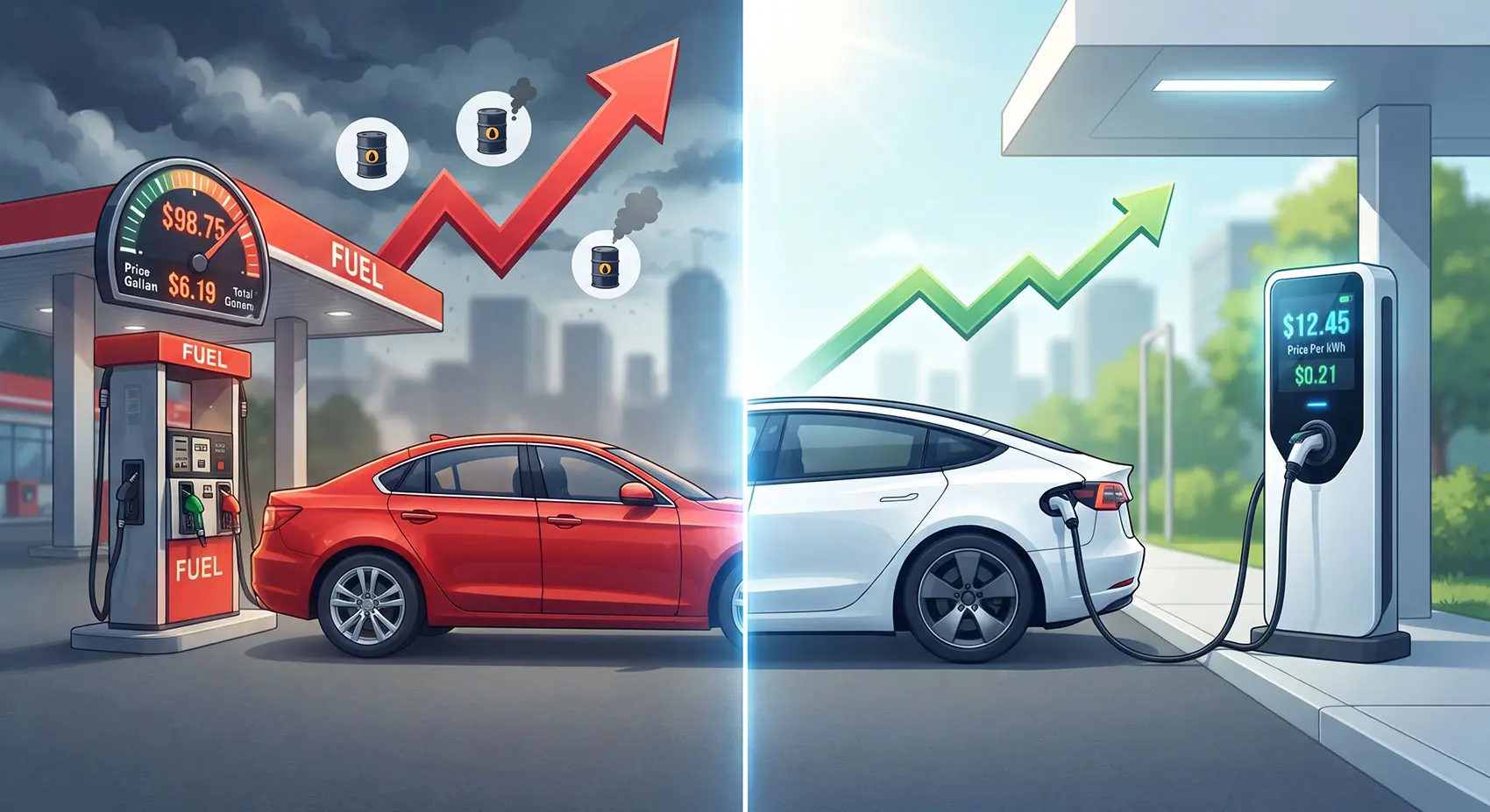
The automotive landscape is undergoing a monumental shift, and at the absolute center of this transformation is a friction point every vehicle owner feels directly in their wallet: energy costs. For decades, the ritual of pulling up to a gas station, watching the digits spin past twenty, forty, and sometimes sixty dollars, and swiping a plastic card was simply an accepted cost of modern life. Yet, as geopolitical turbulence, fluctuating global crude supplies, and persistent inflationary pressures continue to push fossil fuel pricing into erratic territory, drivers are increasingly looking for an exit strategy. Enter the electric vehicle (EV), championed as the ultimate refuge from volatile pump prices. But as electricity grids experience their own forms of inflation, utility companies adjust residential rate structures, and public fast-charging networks introduce peak pricing models, the financial narrative is far more nuanced than simple headlines suggest.
Is the era of cheap electric miles coming to an end, or does plugging in still leave traditional gasoline burning in the dust? To answer this question accurately, we must look beyond the initial shock of a high fuel bill and analyze the true cost of mobility. This means evaluating everything from midnight home-charging rates under off-peak utility tariffs to the steep markups of highway DC fast chargers, alongside the invisible maintenance savings that quietly accumulate over hundreds of thousands of miles. Whether you are a daily urban commuter weighing your next vehicle purchase or a road-trip enthusiast trying to budget for your next cross-country journey, understanding the real-world mechanics of gas prices versus EV charging costs will reveal which fuel option is truly winning the economic race.
The True Cost of Gasoline in 2026
When evaluating the financial reality of driving an internal combustion engine (ICE) vehicle in 2026, the pump price is merely the headline act of a much more expensive production. Average national gasoline prices have settled into a volatile baseline, frequently fluctuating in response to international supply chain shifts, refining capacity bottlenecks, and seasonal demand spikes. For the everyday commuter, filling a standard 15-gallon tank translates to a recurring weekly expenditure that quietly drains hundreds of dollars every month. When broken down into cost per 100 miles, the gold standard for comparing different modes of transportation—a traditional gas-powered car averaging 25 miles per gallon demands a significant cash outlay every time the odometer rolls over. If gasoline averages around three dollars and fifty cents to four dollars per gallon, every hundred miles driven carries a direct fuel penalty that outpaces electric alternatives by a factor of two or three.
Beyond the immediate pain at the pump, the true cost of operating a gasoline-powered vehicle includes a steady stream of secondary expenses that electric vehicle owners rarely encounter. Traditional engines rely on thousands of moving parts operating under extreme heat and friction, necessitating routine fluid changes, spark plug replacements, timing belt inspections, and frequent exhaust system maintenance. Furthermore, annual emissions testing and the constant replacement of wear-and-tear items like oil filters and transmission fluids add hundreds of dollars annually to the vehicle's maintenance ledger. Over a five-year ownership horizon, these cumulative expenses transform the gas-powered car into a financial anchor, proving that the true cost of fossil fuel mobility extends far beyond the numbers flashing on the gas station marquee.
Breaking Down EV Charging Costs: Home vs. Public
While the cost of gasoline remains tied to volatile global markets, the expense of fueling an electric vehicle offers a completely different financial dynamic dictated almost entirely by where, when, and how you plug in. For the vast majority of EV owners, the cornerstone of daily refueling happens right at home. Residential electricity rates, particularly when coupled with time-of-use (TOU) utility tariffs, allow owners to program their vehicles to charge overnight during off-peak hours when grid demand plummets. In many regions, charging an electric car while you sleep costs the equivalent of paying well under two dollars per gallon of gasoline, reducing the cost per 100 miles to a fraction of traditional ICE expenditures. Furthermore, homeowners with rooftop solar panel installations can offset their charging footprint entirely, transforming sunlight into zero-cost localized mileage.
However, the financial equation shifts dramatically the moment you hit the open road and rely on public charging infrastructure. Public DC fast charging networks provide the vital convenience of replenishing an empty battery in twenty to thirty minutes, but that speed comes with a steep financial premium. Charging operators face immense capital expenditures, high demand charges from local utility grids, and maintenance overhead, costs that are passed directly to the consumer through elevated per-kilowatt-hour pricing or idle fees. During peak demand hours, public fast-charging can occasionally approach or even exceed the cost-per-mile equivalent of a fuel-efficient hybrid or gas car. Navigating modern EV ownership therefore requires a strategic balance: capitalizing on cheap residential overnight rates for daily routines while treating public fast chargers as a convenient, albeit more expensive, tool reserved strictly for long-distance travel.
Regional Utility Rates and Grid Inflation
When calculating whether electric vehicles hold a definitive financial edge over traditional gasoline cars, geography plays a surprisingly powerful role. The cost of electricity is far from uniform; it varies wildly depending on whether you live in a region powered by abundant hydroelectricity, nuclear energy, coal, or natural gas. Furthermore, local utility rate structures dictate how much penalty or savings an EV owner experiences during peak hours. In states or countries with progressive grid management and robust renewable portfolios, residential electricity remains remarkably cheap and stable, amplifying the financial savings of home charging. Conversely, regions experiencing heavy grid infrastructure upgrades, high local demand, or regulatory pressures on energy distribution can see residential utility rates creep upward, narrowing the gap between fueling an EV and pumping standard gasoline.
Adding to this complex geographic matrix is the phenomenon of grid inflation and demand charges. As more households transition to electric mobility and heat pumps, local utilities face unprecedented strain on neighborhood transformers and distribution lines. To manage this peak-hour stress, many utility providers are rolling out time-of-use pricing models that penalize high-energy consumption during late afternoon and early evening hours, exactly when commuters return home and plug in their vehicles. Smart EV owners quickly learn to bypass these penalties by programming their cars to delay charging until the dead of night when grid demand hits its lowest trough. However, for households lacking smart-charging hardware or living in areas with high baseline electricity costs, regional utility pricing can significantly impact the projected monthly savings, making local energy economics a critical variable in the overall fuel-cost debate.
Total Cost of Ownership (TCO): Maintenance and Depreciation
When determining whether electric vehicles or traditional gas-powered cars are winning the financial race, looking solely at monthly energy bills paints an incomplete picture. Total cost of ownership (TCO) encompasses everything from routine maintenance to long-term asset depreciation, areas where electric vehicles introduce a radically different economic model. Traditional internal combustion engines rely on complex mechanical systems pistons, transmissions, fuel injection networks, and exhaust plumbing that inevitably wear down under constant thermal and mechanical stress. By contrast, an electric vehicle features an electric motor with a fraction of the moving parts, eliminating routine requirements like oil changes, spark plug swaps, timing belt replacements, and exhaust pipe repairs. This mechanical simplicity translates to significantly lower routine maintenance expenditures year after year, giving EV owners a quiet financial advantage that accumulates steadily over the vehicle's lifespan.
At the same time, the long-term health of an EV's battery pack remains a focal point for prospective buyers weighing depreciation and replacement risks. Early concerns regarding catastrophic battery failures have largely been put to rest by modern thermal management systems and comprehensive manufacturer warranties, which typically cover battery degradation down to a specified capacity threshold for eight years or more. While replacing a battery pack out of warranty would be a major financial hurdle, real-world data demonstrates that contemporary lithium-ion and LFP batteries degrade far more slowly than initially feared, often outlasting the rest of the vehicle's functional chassis. When combined with shifting market demand and improving residual values, the modern electric vehicle proves that total cost of ownership extends far beyond the pump or the charger, tilting the scales further in favor of electric mobility over its gasoline-burning counterparts.
Which Fuel Option Is Winning? A Side-by-Side Verdict
When all the economic variables are stacked side by side, determining which fuel option is truly winning depends entirely on an owner's daily driving habits, access to residential charging, and geographic location. For the vast majority of vehicle owners who have access to a garage, driveway, or reliable overnight Level 2 home charger, the electric vehicle emerges as the clear victor. By decoupling personal mobility from unpredictable crude oil prices and leveraging off-peak electricity utility rates, home-charging EV drivers consistently slash their per-mile fueling expenditures by seventy to eighty percent compared to traditional gasoline cars. When you factor in the elimination of routine engine maintenance such as oil changes, spark plug replacements, and complex exhaust repairs, the total cost of ownership tips decisively in favor of electric mobility over a standard five-to-ten-year ownership lifecycle.
However, the verdict changes for drivers who lack home-charging access and must rely exclusively on public DC fast-charging infrastructure. Urban apartment dwellers or frequent long-distance road warriors who depend heavily on commercial charging networks face significantly higher per-kilowatt-hour costs, especially during peak demand pricing hours. In these specific scenarios, the operational cost gap between an electric vehicle and a highly efficient hybrid or modern gas-powered car narrows considerably, occasionally making the financial savings negligible. Ultimately, while electricity wins the efficiency and home-fueling war hands down, the true winning fuel option for your specific garage comes down to infrastructure access: if you can plug in where you sleep, electric power dominates; if you live at the mercy of public fast chargers, the race is much closer than the marketing brochures suggest.
Conclusion
As we look across the modern automotive landscape, the debate between rising gasoline prices and electric vehicle charging costs ultimately boils down to a fundamental choice between volatility and predictability. Traditional internal combustion engines tie owners to an erratic global commodities market, where every geopolitical shift or supply bottleneck immediately reverberates at the local gas station pump. When you combine this constant price unpredictability with the steady drain of high-frequency maintenance oil changes, transmission fluid flushes, belt replacements, and exhaust repairs the true financial burden of driving a gas-powered car becomes glaringly clear. On the other side of the ledger, electric vehicles offer a stabilizing anchor for personal transportation budgets. By leveraging off-peak residential utility rates, overnight home charging transforms the daily fuel routine into a predictable, pennies-per-mile utility expense that is virtually immune to the daily drama of oil markets.
Yet, the ultimate victory belongs to those who align their vehicle choice with their real-world infrastructure access. Drivers who can plug in at home reap massive financial rewards, slashing operating costs and bypassing pump anxiety entirely. Conversely, those dependent entirely on public DC fast-charging networks navigate a narrower financial margin, where peak-hour electricity markups can occasionally rival the efficiency of a modern hybrid. Ultimately, the transition to electric mobility is no longer just an environmental statement; it is a calculated economic strategy. By understanding your driving patterns, securing reliable charging access, and weighing the total cost of ownership against short-term savings, you can confidently choose the fuel option that keeps your wallet firmly in the winning lane.



Written by Kousar Shabbir
Published Sep 2, 2026 in Auto News.