If you've been shopping for a new car in 2026, you've probably noticed that "hybrid" no longer means just one thing. Walk into any dealership, and you'll see two very different badges promising better fuel economy: the standard Hybrid (HEV) and the Plug-In Hybrid (PHEV). Both claim to save you money at the pump, both pair a gas engine with an electric motor, and both look nearly identical on the outside. Yet under the hood, they operate on completely different philosophies, and that difference has a real, measurable impact on your wallet.
The short answer is: it depends entirely on how you drive. A PHEV can slash your gasoline use to almost nothing if you plug in every night and rarely drive far. But if you skip the charger, that same PHEV can actually burn more fuel than a regular hybrid, because it's hauling around a heavier battery pack for no benefit. An HEV, on the other hand, delivers steady, predictable savings no matter what you do; you never have to think about it.
This confusion isn't your fault; automakers often market both powertrains under the same "electrified" umbrella, using similar badges, similar green leaf logos, and similar language about "efficiency" and "sustainability." But the underlying engineering, the ownership experience, and the actual fuel savings you'll see on your monthly gas bill can be dramatically different between the two.
In this guide, we'll break down exactly how these two powertrains work, compare their real-world fuel efficiency using current data, and help you figure out which one actually saves more fuel and money based on your own driving habits.
HEV vs PHEV: How They Actually Work
Before comparing numbers, it helps to understand what's actually different mechanically, because the fuel-saving math flows directly from these design choices.
The Traditional Hybrid (HEV)
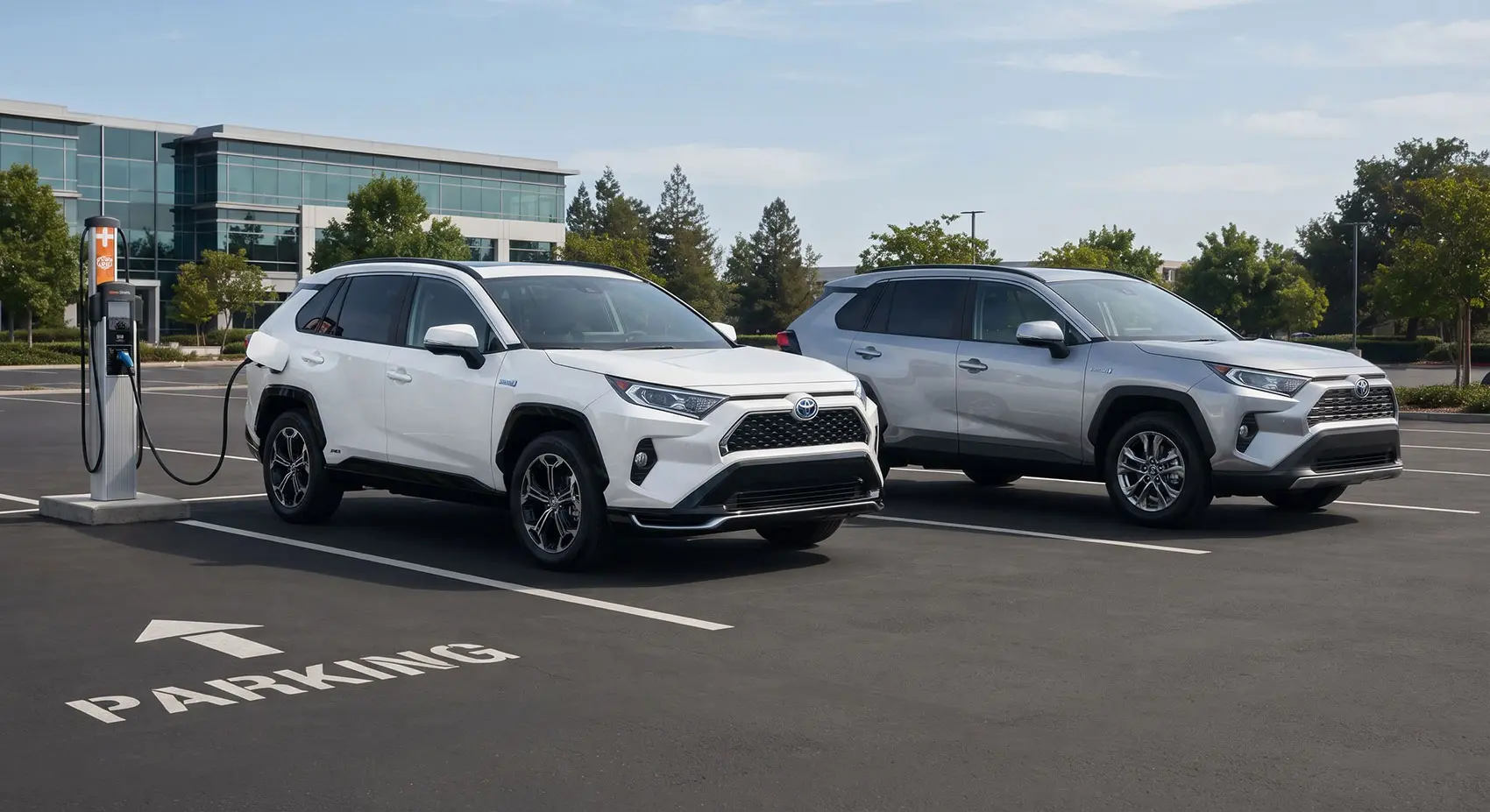
The Traditional Hybrid uses a small battery, typically just 1 to 2 kWh, that charges itself automatically through regenerative braking and the gas engine. You never plug it in; there's no cord, no charging port, and no changes to your routine. The electric motor mainly assists the engine during acceleration, takes over briefly at low speeds or idle, and helps recapture energy that would otherwise be wasted during braking. The gasoline engine remains the primary power source at all times, and the car's onboard computer decides, moment to moment, how much electric assist to apply. Popular examples include the Toyota RAV4 Hybrid, Honda Accord Hybrid, and Hyundai Tucson Hybrid.
The Plug-In Hybrid (PHEV)
The Plug-In Hybrid takes the same basic concept and scales it up significantly. It uses a much larger battery, usually 10 to 25 kWh that you charge externally, either from a home wall outlet or a Level 2 charger. This bigger battery allows the vehicle to drive on electric power alone for roughly 25 to 54 miles, depending on the model, before the gasoline engine needs to switch on. Once the battery is depleted, the PHEV essentially becomes a heavier version of a standard hybrid, running on gas with electric assist, a state often called "charge-sustaining mode." Popular examples include the Toyota RAV4 Prime, Hyundai Tucson PHEV, and Jeep Grand Cherokee 4xe.
The key distinction is this: an HEV is designed to be efficient 100% of the time using gasoline alone, while a PHEV is designed to eliminate gasoline entirely for short trips, but only if you actually plug it in.
Fuel Efficiency Comparison: The Real Numbers
This is where the picture gets genuinely interesting, because the "winner" flips depending on charging behavior.
When a PHEV Is Charged Daily
When plugged in consistently, a PHEV wins decisively. Combined gas-and-electric efficiency ratings for plug-in hybrids frequently exceed 80 to 100+ MPGe, since a meaningful share of daily miles are covered on pure electricity that never touches the fuel tank. For an owner with a short commute, say, under 30 to 40 miles round trip, it's realistic to go days or even weeks between fill-ups, since electric-only range comfortably covers routine errands and commuting.
When a PHEV Is Not Charged
Running purely on its gasoline engine, an unplugged PHEV typically returns lower fuel economy than a comparable HEV, often around 28 to 40 MPG compared to a hybrid's 40+ MPG. The reason comes down to simple physics: a PHEV's battery pack is significantly heavier (often 120 to 180 kg more than an HEV's), and that extra weight has to be hauled around regardless of whether it's ever used for propulsion. An uncharged PHEV is, in effect, a heavier, less efficient hybrid.
The Traditional Hybrid's Consistency
A standard HEV, by contrast, delivers the same solid fuel economy every single time you drive it, typically saving 25% to 50% compared to an equivalent gasoline-only vehicle. There's no behavior required to unlock these savings; the car manages the gas-electric balance automatically on every trip, whether it's a two-mile errand or a 300-mile highway drive.
To put real numbers behind this, cost comparisons using the 2026 Hyundai Tucson lineup found that the Hybrid version saves roughly $675 per year in fuel costs compared to the gas model, while the plug-in hybrid version can save approximately $900 to $1,200 annually, but that higher PHEV figure assumes consistent home charging. Skip the charging, and much of that advantage disappears.
Which One Saves More Money in the Real World
Fuel efficiency is only part of the equation; total cost of ownership tells a more complete story, and it's here that many buyers are surprised.
Purchase Price Matters More Than People Expect
PHEVs carry a substantial price premium over comparable HEVs, often ranging from $5,000 to well over $25,000 depending on the model and trim, due to the larger battery, onboard charger, and additional hardware. That premium has to be earned back through fuel savings before a PHEV becomes the financially smarter choice, and for many models, that payback period stretches well beyond five years, sometimes covering less than 15% of the price gap even after half a decade of driving.
Charging Infrastructure Adds Hidden Costs
Getting the most from a PHEV typically means installing a home Level 2 charger, which involves both equipment and electrician costs. Drivers without access to home charging, apartment dwellers, renters, or anyone relying on street parking, will struggle to plug in consistently enough to realize the PHEV's fuel advantage, making the HEV the far more practical option.
Maintenance Costs Favor Simplicity
According to industry cost studies, hybrid maintenance runs lower than gasoline vehicles but can still involve more complexity than people assume, and PHEVs add further complexity with their larger battery systems, charging components, and cooling systems. Fewer moving parts to worry about generally means fewer expensive surprises down the road.
Incentives Can Shift the Math
Federal, state, and local incentives can sometimes narrow the price gap between a PHEV and an HEV, since plug-in hybrids often qualify for rebates that traditional hybrids do not. However, these programs change frequently, income limits and vehicle price caps often apply, and not every model or trim qualifies. Before assuming an incentive will make a PHEV the cheaper option, check current eligibility rules for your state and the specific vehicle you're considering, since a shifted rebate program can quickly change which powertrain actually comes out ahead financially.
Driving Pattern Is the Ultimate Deciding Factor
A commuter with a short daily round trip and reliable home charging can realistically run a PHEV on electricity for the vast majority of their annual mileage, making the higher purchase price worthwhile over time. But a driver who frequently covers long distances, road trips often, or simply forgets to plug in most nights will find that the PHEV's advantages evaporate, leaving them with a more expensive, heavier vehicle that doesn't outperform a standard hybrid.
Which Should You Buy: HEV or PHEV?
There's no universal winner here; the right choice depends on matching the technology to your actual lifestyle, not the marketing brochure.
Choose a Traditional Hybrid (HEV) If:
- You don't have consistent access to home or workplace charging
- Your daily driving involves a mix of long trips and short errands
- You want the lowest upfront cost and the simplest ownership experience
- You'd rather never think about plugging in or managing a charging routine
- You live in an apartment or park on the street regularly
Choose a Plug-In Hybrid (PHEV) If:
- You can reliably charge at home every night
- Your daily round-trip commute fits within the vehicle's electric-only range (commonly 25–54 miles)
- You occasionally need to drive longer distances and don't want the range anxiety of a full EV
- You're willing to pay a higher upfront price in exchange for potentially near-zero gasoline use on typical days
- You qualify for available incentives that can help offset the price premium
A useful rule of thumb that keeps coming up across cost analyses: if your round-trip commute is comfortably under the vehicle's electric range and you're disciplined about plugging in, a PHEV can genuinely transform your fuel bill. If you're unsure whether you'll charge consistently, the HEV is the safer bet; its savings are guaranteed rather than conditional.
Conclusion
So, which actually saves more fuel, the PHEV or the HEV? The honest answer is that a Plug-In Hybrid has the higher ceiling, capable of running for days on pure electricity and dramatically outperforming a standard hybrid's fuel economy. But that ceiling only applies to drivers who charge consistently and whose daily mileage fits within the electric-only range. Without disciplined charging, a PHEV's extra weight can actually work against it, sometimes delivering worse gas-only mileage than a traditional hybrid, which is the opposite of what most buyers expect when they pay a premium for the "greener" option.
A Traditional Hybrid, meanwhile, offers something a PHEV can't guarantee: consistency. It saves fuel automatically, on every trip, with zero behavioral requirements, a lower purchase price, and none of the charging infrastructure hassle. For the majority of drivers, especially those without a driveway, a garage, or a dedicated parking spo,; that consistency is worth more in practice than the theoretical ceiling of a plug-in hybrid they may only charge sporadically.
The smartest approach is to be honest about your own driving habits before you decide, rather than choosing based on which technology sounds more advanced. If you can commit to plugging in nightly and your commute fits the electric range, a PHEV will likely save you more in the long run, and the environmental and financial benefits compound the longer you own it. If charging isn't realistic for your lifestyle, don't feel like you're settling; a well-built HEV remains one of the smartest, lowest-hassle ways to cut your fuel costs significantly compared to a gas-only vehicle, no cord, no charger installation, and no changed habits required. Either way, moving away from a traditional gasoline-only vehicle toward either hybrid option is a financially sound decision; the only real question is which flavor of hybrid actually fits how you live and drive.


Written by Kousar Shabbir
Published Sep 11, 2026 in Comparisons.