For decades, automotive safety was defined by the tangible: the crunch of a crumple zone, the physical restraint of a seatbelt, and the rapid inflation of an airbag. These were reactive measures, designed to protect passengers only after a collision had become inevitable. However, we have entered a new era of mobility where the vehicle is no longer a passive vessel but an active participant in its own safety. This is the promise and the reality of Advanced Driver Assistance Systems, or ADAS.
At its core, ADAS represents a sophisticated synthesis of sensor technology, machine learning, and automated physical control. It is an intelligent co-pilot that never blinks, never checks a smartphone, and never succumbs to road fatigue. Modern ADAS isn't just about bells and whistles like parking sensors; it is a complex ecosystem of hardware and software working in tandem to perceive the environment in 360 degrees, interpret that data against a backdrop of traffic laws and physics, and execute maneuvers that keep occupants and those around them out of harm’s way.
But how do these systems actually make the leap from detecting a hazard to applying the brakes? The process is remarkably similar to human perception but significantly more precise. Through a suite of cameras, radar units, and ultrasonic sensors, an ADAS-equipped car constructs a digital "worldview" that is constantly updated thousands of times per second. By analyzing object trajectory, speed differentials, and environmental conditions, the vehicle’s Electronic Control Units (ECUs) act as the central nervous system, making micro-decisions that can be the difference between a near-miss and a major accident. As we move closer to the era of autonomous vehicles, understanding these systems is no longer just for engineers; it is essential knowledge for the modern driver who trusts their life to these invisible guardians. In this article, we will peel back the dashboard to reveal the sensory anatomy of modern cars and explore how they are systematically eliminating human error from the road.
The Sensory Anatomy of ADAS: How Cars "See" the Road
To understand how modern driver assistance systems prevent accidents, you first have to look at how a car perceives its environment. Unlike human drivers—who rely primarily on eyes and ears while occasionally getting distracted by a passenger, a billboard, or a mobile phone—an ADAS-equipped vehicle relies on a multi-layered sensory network. This digital nervous system combines optical, radio-frequency, and acoustic technologies to construct a continuous, 360-degree virtual map of the road.
At the forefront of this architecture are Optical Cameras, typically mounted near the rearview mirror or embedded in the windshield. These high-definition lenses act much like human eyes, capturing visual data that is vital for recognizing lane markings, reading speed limit signs, detecting traffic lights, and distinguishing between pedestrians, cyclists, and other vehicles. Advanced computer vision algorithms process this pixel data in real time, allowing the car to understand what it is looking at, not just that something is in front of it.
Complementing the cameras are Radar Systems (Radio Detection and Ranging), which use radio waves to measure the exact distance, speed, and trajectory of objects surrounding the vehicle. Unlike cameras, radar units are unaffected by heavy rain, snow, fog, or blinding direct sunlight. They excel at tracking fast-moving targets on the highway, ensuring that Adaptive Cruise Control can smoothly adjust your speed even when visibility drops to near zero.
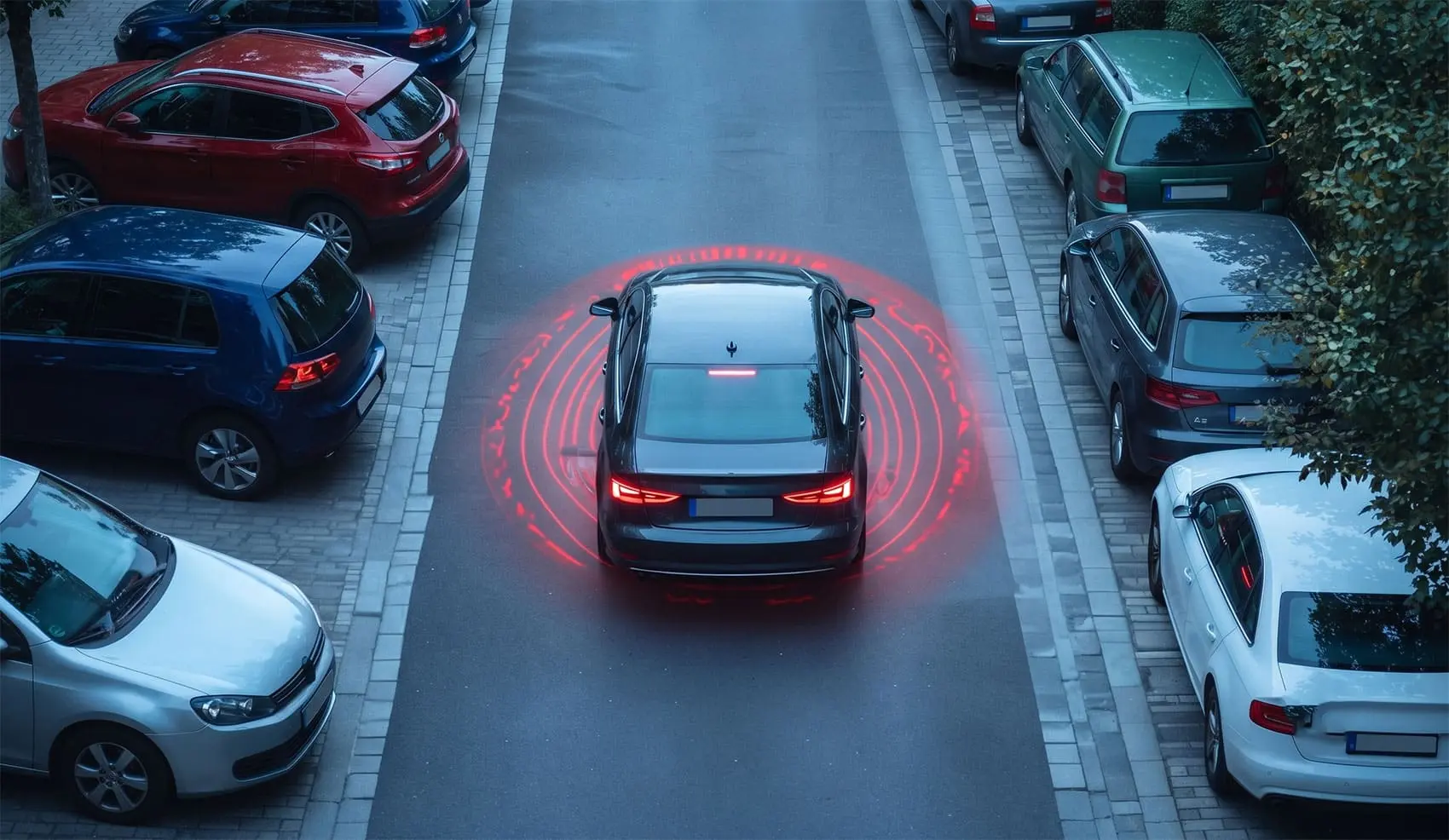
Finally, Ultrasonic and LiDAR Sensors round out the package. Ultrasonic sensors, hidden within the front and rear bumpers, use high-frequency sound waves to handle close-range tasks like parking assistance and blind-spot detection. Meanwhile, Light Detection and Ranging (LiDAR) uses laser pulses to create ultra-precise 3D depth maps of the environment. Together, these technologies give the car superpowers: superhuman vision, tireless endurance, and the ability to process threats faster than human muscle memory ever could.
Core Features Powered by Modern ADAS
Moving beyond the individual sensors, the true value of Advanced Driver Assistance Systems lies in how they integrate to perform complex driving tasks. Rather than operating in isolated bubbles, these technologies combine forces to handle repetitive highway stretches, tight parking spots, and split-second emergency maneuvers.
Take Adaptive Cruise Control (ACC), for example. Traditional cruise control is a blunt instrument; it simply maintains a static velocity, forcing the driver to constantly disengage and re-engage whenever traffic slows down. Modern ACC, powered by radar and forward-facing cameras, dynamically modulates your vehicle’s speed to maintain a safe, pre-set following distance from the car ahead. If traffic comes to a complete standstill, advanced ACC systems can bring the vehicle to a total halt and automatically resume movement when the line starts rolling again, taking the physical and mental strain out of bumper-to-bumper gridlock.
Another foundational pillar is the pairing of Lane Departure Warning (LDW) and Lane-Keeping Assist (LKA). While LDW acts strictly as an early-warning system triggering a visual alert, steering wheel vibration, or acoustic chime if you drift across a line without signaling LKA takes active measures. Utilizing optical cameras that read lane boundaries, LKA applies gentle counter-steering torque to guide the car safely back toward the center of the lane.
Finally, the most critical safety net in any modern vehicle is Automatic Emergency Braking (AEB) coupled with Forward Collision Warnings. AEB monitors the space immediately ahead for sudden hazards, such as a vehicle stopping abruptly or a pedestrian stepping into the road. If the system calculates that a collision is imminent and the human driver fails to apply adequate brake pressure or fails to brake at all AEB automatically applies braking force appropriate to the situation, potentially bringing the vehicle to a stop if conditions allow. Together, these features provides an additional layer of protection against common driving mistakes.
The Brain Behind the Operation: Electronic Control Units (ECUs) and AI
While cameras and radar act as the eyes and ears of a modern vehicle, they are ultimately useless without a powerful central nervous system to interpret their signals. This is where Electronic Control Units (ECUs) and advanced machine learning algorithms take the wheel. In a contemporary ADAS-equipped car, dozens of distributed computers process a constant torrent of data often measuring in gigabytes per second translating raw pixel feeds and radio wave bounces into immediate physical commands.
When a front-facing optical camera detects a pedestrian stepping off the curb, it does not just send a generic picture to a screen; it feeds a continuous stream of data into dedicated vision processors running convolutional neural networks. These algorithms evaluate the pedestrian’s vector, speed, and distance within milliseconds, weighing those variables against the car’s current momentum. The central ECU then calculates a split-second decision tree: Is the driver reacting? Does the car need to flash a warning, restrict throttle input, or autonomously slam on the brakes?
This entire calculation happens faster than a human neuron can fire. Furthermore, modern ADAS relies heavily on Sensor Fusion the software capability that merges inputs from disparate sources (combining radar’s distance precision with camera image recognition and LiDAR’s depth mapping) to eliminate blind spots and false positives. If a shadow or a wet patch on the road tricks a camera, the radar cross-checks the physical reality, ensuring the vehicle only reacts to genuine threats. Balancing this automated vigilance with human control is the ultimate achievement of modern automotive engineering, ensuring the car acts as a seamless extension of the driver's own instincts.
Real-World Limitations and Challenges
Despite the marvel of engineering that defines modern Advanced Driver Assistance Systems, it is critical for motorists to understand that these technologies are not infallible. The digital eyes and ears of a car have distinct physical boundaries, and mistaking ADAS for true, unsupervised autonomy is a leading cause of modern traffic incidents. Recognizing these limitations is essential for safe, responsible driving.
The most common adversary of ADAS is environmental interference. Optical cameras rely on clear lines of sight to read lane markings, traffic signs, and pedestrian movements. When a vehicle encounters blinding downpours, thick snowstorms, or the blinding glare of a low-hanging sunrise or sunset, camera visibility drops dramatically much like a human driver squinting through a dirty windshield. Similarly, road salt, mud, or ice caked over bumper-mounted ultrasonic sensors and radar transceivers can temporarily blind the system, triggering dashboard warnings that features like lane-keeping or adaptive cruise control are temporarily unavailable.
Furthermore, ADAS relies heavily on precise hardware calibration. Modern windshield replacements or minor front-end bumps can shift camera angles by mere fractions of a millimeter a microscopic shift that translates to feet of error down the road. If sensors are not professionally recalibrated after maintenance, the vehicle's electronic brain may miscalculate distances or misinterpret road layouts. Drivers must also remain psychologically engaged; systems like lane-keeping and automated braking are safety nets designed to mitigate human error, not excuses to zone out behind the wheel. Blending technological vigilance with active human awareness remains the only foolproof way to navigate today's increasingly automated roadways.
Looking Ahead: The Bridge to Full Autonomy (SAE Levels 0 to 5)
To truly grasp where Advanced Driver Assist Systems fit into the modern automotive landscape, it helps to look at the roadmap defined by the Society of Automotive Engineers (SAE). This taxonomy ranges from Level 0 where the human driver does 100% of the work with zero mechanical assistance all the way to Level 5, which represents complete, driverless autonomy in any condition. Today, the vast majority of consumer vehicles sit firmly between Level 1 and Level 2, with advanced packages pushing toward Level 2+.
At Level 1, a car can execute isolated automated functions, such as standard cruise control or maintaining lane position independently, but never at the same time. Step up to Level 2 which defines most modern ADAS suites on the market and the vehicle combines multiple technologies simultaneously. Systems like Tesla's Autopilot, GM's Super Cruise, or Ford's BlueCruise allow the car to manage both its steering and speed (adaptive cruise control paired with lane centering) concurrently on controlled-access highways.
However, a critical distinction remains: Level 2 systems are classified as "driver-support systems," meaning the human behind the wheel is legally and practically responsible for monitoring the environment at all times. The car can drive itself, but it cannot think for itself in unmapped or unexpected scenarios. True autonomy beginning at Level 3, where the vehicle can drive itself under specific conditions while allowing the driver to divert attention, and culminating in Level 5, where a steering wheel is optional requires massive leaps in legal frameworks, edge-case machine learning, and hardware redundancy. As automakers refine sensor fusion and neural processing, the bridge between today's ADAS and tomorrow's fully autonomous future grows shorter every day.
Conclusion
As we look across the modern automotive landscape, it is clear that Advanced Driver Assistance Systems have fundamentally redefined what it means to pilot a vehicle. What began as simple mechanical enhancements like rudimentary cruise control and anti-lock brakes has evolved into a hyper-responsive digital ecosystem. Today’s cars are no longer just mechanical machines powered by internal combustion or electric motors; they are rolling supercomputers equipped with the vision, processing power, and reflexes required to navigate an increasingly complex world.
Yet, as we navigate the spectrum from Level 1 convenience features toward a fully autonomous future, the responsibility still fundamentally rests with the human in the driver's seat. ADAS is an extraordinary shield a tireless co-pilot designed to catch human errors, mitigate fatigue, and prevent catastrophic collisions before they happen. However, it requires a partnership built on mutual understanding of its boundaries. By respecting system limitations, maintaining clean hardware sensors, and staying mentally engaged behind the wheel, drivers can harness the full safety potential of modern automotive technology. Ultimately, ADAS bridges the gap between human intuition and machine precision, steering us toward a safer, smarter, and more secure tomorrow on the road.


Written by Kousar Shabbir
Published Aug 7, 2026 in Auto Tech.