The automotive landscape has undergone a seismic shift over the past decade. We have transitioned away from an era where vehicle safety relied almost entirely on reactive, passive physics such as crumple zones, reinforced steel pillars, and expanding airbags—into an era defined by proactive digital intervention. Among the suite of Advanced Driver Assistance Systems (ADAS) reshaping our roads, Autonomous Emergency Braking (AEB) stands out as the ultimate guardian angel.
Consider a split-second scenario: traffic halts abruptly around a blind highway bend, or a pedestrian steps off the curb into the path of a moving vehicle. Human reaction times, historically benchmarked at roughly 1.2 to 1.5 seconds, can easily be the difference between a safe stop and a catastrophic collision. AEB systems operate on a vastly different temporal scale. Utilizing a relentless stream of real-time environmental data, modern AEB architectures detect imminent threats, calculate collision trajectories, and autonomously engage the vehicle's braking hydraulics in milliseconds, often before the driver has even lifted their foot from the accelerator.
But how does a mass-produced automobile instantly transform raw environmental data into heavy physical deceleration without human command? Under the hood, AEB is a masterclass in modern mechatronics, blending advanced solid-state physics, high-speed computer vision, multi-sensor fusion algorithms, and high-pressure hydraulic actuation.
Understanding the mechanics of AEB is no longer just for automotive engineers; it is vital knowledge for modern drivers, car buyers, and tech enthusiasts alike. In this deep dive, we will peel back the sheet metal to examine how millimeter-wave radar, optical camera arrays, and electronic control units communicate at lightning speeds to execute life-saving maneuvers on the fly.
The Anatomy of an AEB System: Hardware and Sensors
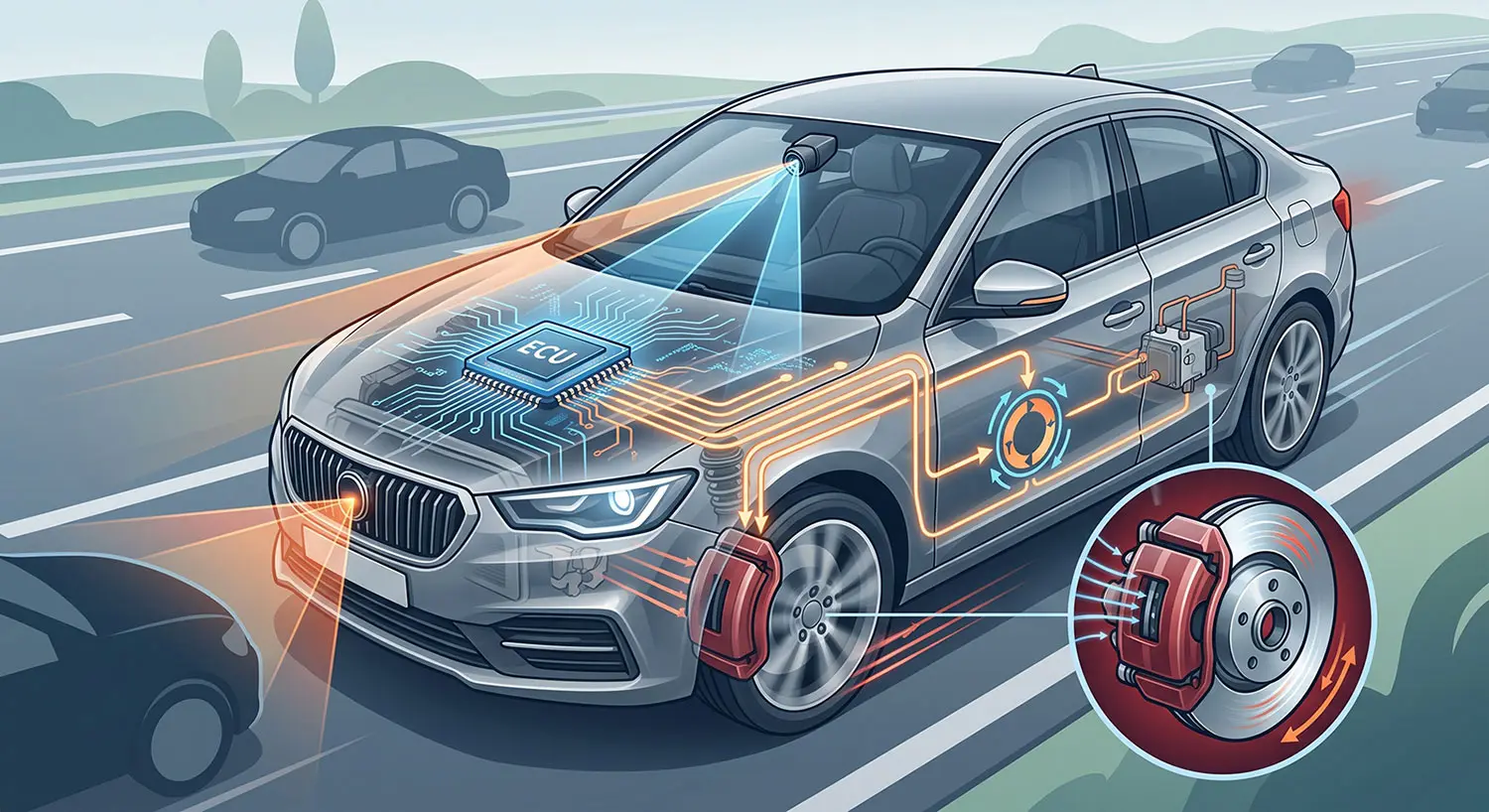
To understand how a vehicle reacts faster than humanly possible, we must first look at how it perceives the world. An autonomous emergency braking system does not rely on a single sensor; instead, it uses a multi-layered sensory array. Think of it as the car's nervous system, where each component plays a specialized role in scanning the road ahead.
The primary backbone of long-range detection is the Millimeter-Wave (mmWave) Radar. Operating typically at 24 GHz or 77 GHz frequencies, radar units emit radio waves that bounce off surrounding objects and return to the receiver. Radar excels at measuring distance and, crucially, relative velocity, how fast an obstacle is approaching or pulling away. Unlike human eyes or optical lenses, mmWave radar is virtually impervious to environmental obstructions. It cuts effortlessly through dense fog, heavy rain, blinding snow, and direct glare from a low-sun morning commute.
Complementing the radar is the Optical Camera Array, typically mounted near the rearview mirror behind the windshield. High-resolution computer vision serves as the vehicle's eyes for classification. While radar can tell where an object is and how fast it is moving, a camera tells you what it is. Advanced machine learning models process these camera feeds in real time to distinguish between a roadside metal guardrail, a stationary delivery truck, a crossing pedestrian, or a cyclist swerving unexpectedly.
To bridge the gap between long-range radar and close-range maneuvers, modern vehicles also integrate Ultrasonic Sensors and, in high-end ADAS setups, solid-state LiDAR. Ultrasonic sensors manage immediate low-speed proximity, such as parking lots or bumper-to-bumper crawl traffic, while LiDAR fires millions of laser pulses to create a high-definition 3D depth map of the environment. By fusing data from radar, cameras, and LiDAR simultaneously, the car builds a comprehensive, 360-degree digital twin of its surroundings, eliminating blind spots that would easily fool a human driver.
The Millisecond Decision Loop: Perception to Processing
Once the hardware sensors have harvested raw data from the environment, the real computational heavy lifting begins. Capturing a pedestrian stepping into the road or a vehicle ahead slamming on its brakes is only half the battle; the system must analyze that data, calculate risk, and make a binary life-or-death decision in less time than it takes to blink. This entire journey, from raw photon and radio wave capture to mechanical brake engagement, is known as the millisecond decision loop.
Data acquisition initiates the loop at an astonishing frequency, typically scanning the environment between 50Hz and 100Hz. Every ten to twenty milliseconds, the mmWave radar and optical cameras refresh their data streams, feeding a continuous torrent of velocity, distance, and vector information into the vehicle's central Advanced Driver Assistance Electronic Control Unit (ADAS ECU). However, raw sensor data in isolation can be flawed. A radar wave might bounce off a metallic overhead road sign, or a camera might misinterpret a deep shadow on the asphalt as a physical obstacle.
This is where Sensor Fusion Architecture becomes critical. The ADAS ECU runs advanced software algorithms that merge disparate data streams into a single, unified probabilistic model of the world. By cross-referencing radar's precise distance and speed metrics with camera-based object classification, the system filters out false positives. If the radar detects a stationary object ahead, but the camera confirms it is an overhead highway sign rather than a stalled vehicle, the system suppresses unnecessary warnings or emergency braking maneuvers.
Once the environment is mapped and verified, the ECU's risk assessment algorithm takes over in real time. The system constantly calculates the Time-to-Collision (TTC) by dividing the current distance to the obstacle by the relative closing speed. If the TTC drops below specific safety thresholds, the vehicle transitions through progressive warning tiers. It starts with visual and acoustic alerts to prompt driver action, but if the driver fails to respond and the TTC hits the critical threshold, the system crosses the Rubicon from passive warning to active emergency intervention.
The Actuation Phase: What Happens Under the Hood
When the ADAS Electronic Control Unit determines that an impact is unavoidable and the Time-to-Collision has breached critical safety tolerances, the system transitions from a digital observer into an active physical controller. This is the actuation phase, the moment when microchips command heavy mechanical forces to alter the vehicle's momentum in milliseconds.
The physical execution begins with the Hydraulic Modulator and Brake Booster. In a traditional panic stop, a human leg pushes down on the brake pedal, forcing brake fluid through master cylinders. During an autonomous emergency braking event, the process bypasses the driver entirely. High-speed solenoid valves within the electronic stability control (ESC) hydraulic modulator open and close rapidly, while an electric brake booster or high-pressure pump instantly pressurizes the brake lines. This builds maximum clamping force across all four rotors significantly faster than even a professional race car driver could manage.
AEB systems typically deploy a tiered mitigation strategy depending on how close the vehicle is to the hazard. The first tier often involves Partial Braking, gently tugging the vehicle downward in speed to alert distracted drivers and reduce closing velocity. If the hazard intensifies, the system escalates to Full Autonomous Emergency Stop, applying maximum hydraulic pressure to lock down the brakes and scrub off as much kinetic energy as possible before impact, or bringing the car to a complete, controlled halt safely clear of the obstacle.
Managing this massive deceleration requires seamless integration with the vehicle's broader dynamic control systems. Slamming the brakes at highway speeds on wet asphalt or loose gravel could easily cause a dangerous skid or rollover. Therefore, the AEB system coordinates in real time with the Anti-lock Braking System (ABS), Traction Control, and Electronic Stability Control (ESC). By dynamically modulating brake pressure to individual wheels based on real-time wheel-slip telemetry, the car ensures maximum stopping friction while maintaining steering control, preventing the vehicle from spinning out of control during an emergency stop.
Edge Cases, Limitations, and 2026 Realities
Even with state-of-the-art sensor fusion and lightning-fast hydraulic modulators, Autonomous Emergency Braking systems are not infallible. Understanding their boundaries is essential for both drivers and engineers pushing vehicle safety into the future.
The most common operational challenges stem from environmental interference. While millimeter-wave radar slices effortlessly through heavy fog and rain, optical cameras are bound by physics. Severe downpours, blinding snowstorms, low-angle sun glare during dawn and dusk, or heavy layers of road salt and mud caked directly over the windshield sensor housing can temporarily blind the computer vision system. When cameras lose visibility, the car's confidence score drops, and the system may gracefully deactivate or trigger a dashboard warning advising the driver to take full control.
Another critical anomaly is Phantom Braking. This occurs when the ADAS ECU misinterprets safe environmental features such as overhead metallic construction bridges, large blowing trash bags, steam vents in winter, or deep shadows cast by overpasses as imminent physical collisions. When this happens, the vehicle may autonomously apply a sudden, unexpected jolt of braking pressure on an open highway. While software engineers continuously refine machine learning classification models to filter out these false positives, eliminating phantom braking entirely remains an ongoing challenge in complex urban and highway environments.
Looking ahead, the next generation of AEB is evolving beyond independent vehicle sensors. Modern 2026 developments increasingly integrate Vehicle-to-Everything (V2X) communication, allowing cars to talk directly to nearby vehicles, traffic lights, and smart infrastructure. If a car two vehicles ahead slams on its brakes around a blind corner, V2X broadcasts that telemetry instantly, allowing the AEB system to begin pre-pressurizing brakes before the onboard cameras or radar even have a line of sight. Combined with predictive neural networks, future AEB systems will transition from merely reacting to threats to anticipating human error before it even manifests on the road.
Conclusion: Wrapping Up the AEB Revolution
As we look across the modern automotive landscape, Autonomous Emergency Braking represents far more than just a clever arrangement of microchips, radar waves, and high-pressure hydraulic valves. It represents a fundamental philosophy shift in how we engineer safety: moving from a reactive mindset that cushions the impact after human error occurs, to a proactive, real-time partnership that actively neutralizes dangers before they materialize.
Throughout this deep dive, we have unpacked the intricate mechanics that make split-second interventions possible. From the unwavering resilience of millimeter-wave radar slicing through blinding fog to optical camera arrays leveraging computer vision to classify pedestrians and cyclists, modern hardware provides the raw perception required to understand the road. We explored how the ADAS Electronic Control Unit executes the high-frequency decision loop at 50Hz to 100Hz—merging disparate data streams via sensor fusion, eliminating false positives, and calculating precise Time-to-Collision metrics in real time. Finally, we looked under the hood at the actuation phase, where high-speed solenoid valves and electric brake boosters instantly override human delay, locking down hydraulic pressure and coordinating seamlessly with ABS and Electronic Stability Control to scrub off kinetic energy without losing directional control.
While challenges remain, ranging from extreme weather sensor blinding and urban phantom braking to the ongoing refinement of machine learning edge cases, the horizon is brighter than ever. With the rapid integration of Vehicle-to-Everything (V2X) communication and predictive neural networks, future vehicles will not only react to immediate hazards but will anticipate threats blocks away, communicating across smart infrastructure to prevent accidents before a driver even perceives a hazard.
Ultimately, AEB serves as the unsung hero of modern driving. Operating silently in the background at millisecond speeds, it bridges the gap between human limitation and mechanical capability, bringing us closer to a future where roads are defined by zero fatalities and absolute confidence behind the wheel.



Written by Kousar Shabbir
Published Sep 23, 2026 in Auto Tech.