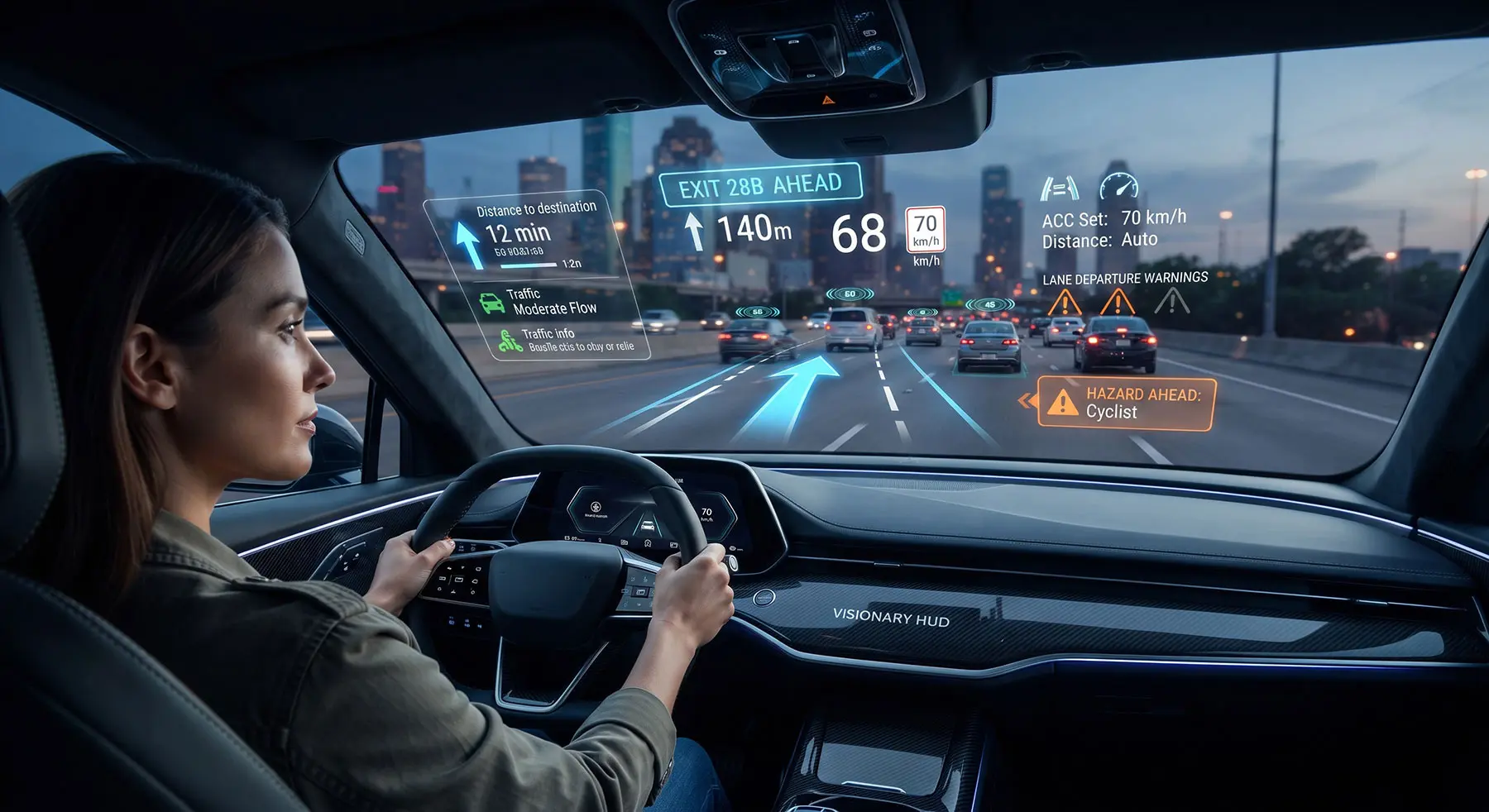
The automotive landscape is undergoing a radical visual transformation, moving away from the rigid boundaries of physical dashboards toward fluid, software-defined ecosystems. For decades, drivers relied on analog needles, basic digital cluster readouts, and glancing down at center-console navigation screens a design paradigm that inherently pulled eyes away from the road ahead. In 2026, Augmented Reality (AR) Head-Up Displays (HUDs) have officially matured from high-end luxury novelties into core architectural pillars of next-gen cabin design. By seamlessly projecting critical telemetry, navigation arrows, and hazard alerts directly onto the physical windshield as holographic overlays, modern automotive AR redefines how humans interact with their vehicles.
Driving a modern vehicle is an exercise in managing complex sensory streams. Advanced Driver Assistance Systems (ADAS), real-time traffic data, and intricate infotainment controls demand attention, often leading to cognitive overload. Traditional screens require the driver's eyes to continuously adjust focus between near-field cabin displays and far-field road conditions, introducing micro-delays in reaction time. AR HUD technology eliminates this friction entirely by fusing digital data directly with the physical environment. When a navigation cue aligns precisely with a street turn a hundred feet ahead, or when a lane-keeping alert highlights a drifting boundary in real-time, the interface becomes an intuitive extension of the driver's natural line of sight.
This paradigm shift is no longer restricted to experimental concept cars or six-figure flagship sedans. Automotive manufacturers have refined optical projection hardware, spatial tracking sensors, and wide-field-of-view (FoV) waveguides to make volumetric windshield displays viable across diverse vehicle tiers. As software-defined vehicles take over the market in 2026, the windshield is rapidly evolving into the primary interactive canvas of the automobile. Understanding the underlying mechanics, market drivers, and practical limitations of these holographic systems is crucial for anyone navigating the future of personal mobility.
The Core Mechanics of 2026 AR HUD Systems
The underlying mechanics of 2026 Augmented Reality Head-Up Displays rely on a sophisticated synthesis of optical hardware, real-time sensor fusion, and advanced spatial computing. Unlike older-generation HUDs that merely bounced flat, two-dimensional green or white speed metrics onto a localized patch of glass, modern systems generate true holographic volumes that appear to float organically meters ahead of the vehicle. This breakthrough is largely driven by wide-field-of-view (FoV) waveguides and digital micro-mirror device (DMD) projectors capable of rendering crisp graphics under intense midday sunlight. By manipulating light waves to match the driver's natural far-field focal plane, these systems ensure that reading a digital turning arrow requires zero ocular refocusing, dramatically reducing visual fatigue on long road trips.
Achieving this level of seamless environmental integration requires deep communication with the vehicle's surrounding sensor suite. Modern AR HUDs do not operate in a vacuum; they pull continuous telemetry streams from Advanced Driver Assistance Systems (ADAS), long-range radar, ultrasonic sensors, and vehicle-mounted LiDAR arrays. This sensor fusion allows the vehicle to map the road ahead in real-time, executing dynamic projective mapping. For instance, when the adaptive cruise control system locks onto a leading car, the HUD projects a subtle, color-coded bracket directly around the rear bumper of that vehicle. If the car ahead brakes suddenly, the graphical overlay shifts color instantly to alert the driver before they even register the hazard manually.
Furthermore, real-time environmental mapping transforms mundane commutes into intuitive guidance experiences. Lane-keeping assist modules no longer just vibrate the steering wheel; they project glowing virtual boundaries onto the actual asphalt lanes, dynamically widening or shifting to indicate construction zones or unexpected debris. By turning raw sensor data into spatially accurate visual cues, 2026 AR HUD hardware bridges the gap between raw machine intelligence and human spatial awareness, laying the groundwork for fully software-defined driving experiences.
OEM Innovations and Market Leaders in 2026
The commercialization of advanced augmented reality head-up displays in 2026 is heavily anchored by fierce competition among luxury and volume automotive manufacturers. Far from being uniform across brands, modern AR HUD implementations reflect distinct design philosophies regarding spatial display architecture, projection field-of-view, and driver interaction paradigms. Audi has cemented its position as a front-runner by refining its spatial awareness ecosystem. Their next-gen AR integration utilizes dual-plane projection layers that visually separate near-range alerts such as immediate blind-spot warnings from long-range navigation vectors. This separation eliminates visual clutter, allowing drivers to intuitively grasp directional turns over complex urban interchanges without losing track of dynamic pedestrian hazards closer to the vehicle bumper.
Meanwhile, BMW has expanded its footprint with advanced panoramic vision layouts that stretch display capabilities across the entire lower portion of the windshield. Rather than confining holographic elements to a traditional rectangular box in front of the driver, BMW's system enables expansive, pillar-to-pillar visualization. Front-seat passengers and drivers alike can interact with localized contextual data cards, media controls, and weather overlays that slide organically across the glass. This full-windshield approach redefines the cabin atmosphere, turning the front glass into a shared digital interface while prioritizing driver-centric focal safety zones that ensure critical ADAS notifications remain uncompromised and instantly recognizable.
Mass-market adoption trends are simultaneously being driven by manufacturers like Mercedes-Benz, Hyundai, and Toyota, who are trickling down sophisticated waveguide technology into mid-tier electric and hybrid lineups. By optimizing manufacturing costs for micro-LED projectors and utilizing AI-driven calibration routines that automatically adjust to different driver heights and seating positions, automotive brands are removing the historical barriers to entry. As proprietary software platforms mature in 2026, the battleground for cabin superiority has shifted entirely from physical horsepower to software-defined visualization, making seamless OEM AR integration a primary purchasing driver for modern car buyers.
Safety, Cognitive Load, and Driver Experience
The fundamental promise of augmented reality head-up displays is not merely aesthetic novelty; it is the radical mitigation of driver distraction and cognitive overload. Modern driving is an exercise in continuous multi-tasking, requiring operators to monitor speed, interpret navigation instructions, track blind spots, and respond to unpredictable pedestrian and vehicle movements. Traditional digital displays and center-stack touchscreens inherently sabotage this focus by forcing the driver's eyes away from the road, creating dangerous micro-blind spots. Empirical studies on driver reaction times consistently demonstrate that looking away from the windshield for even two seconds at highway speeds drastically increases stopping latency. AR HUD technology resolves this safety bottleneck by tethering critical information directly to the physical world, aligning visual cues with the driver's natural far-field focal plane.
Minimizing distraction, however, requires a delicate balance to prevent information overload. Early iterations of head-up displays frequently suffered from cluttered interfaces that projected too many competing graphics at once, effectively blinding drivers with excessive visual noise during high-stress maneuvers like highway merging. In 2026, advanced adaptive UI algorithms solve this issue through context-aware filtering. When the vehicle is cruising on an open stretch of interstate, the HUD strips away non-essential metrics, leaving only a subtle speed indicator and a streamlined horizon line. As the vehicle approaches an intricate urban intersection or enters heavy congestion, the system intelligently scales up its output, layering precise directional arrows, pedestrian hazard bounding boxes, and lane-selection highlights directly over the road surface.
Ergonomic customization and accessibility further enhance the safety profile of modern AR HUD setups. Because drivers vary significantly in height, posture, and visual acuity, 2026 systems use internal cabin cameras to track eye position and automatically calibrate the holographic projection angle in real time. This ensures that the augmented graphics remain perfectly aligned with external road features regardless of seat adjustment. By transforming complex telemetry into intuitive, low-friction visual layers that respect human cognitive limits, next-generation AR HUDs establish a new benchmark for active automotive safety.
Practical Limitations and Industry Challenges
Despite the remarkable trajectory of augmented reality head-up displays in 2026, widespread implementation still faces several formidable technical and economic hurdles. Chief among these is environmental interference, particularly performance stability in extreme weather. Traditional windshield displays rely on precise light projection and surface reflectivity. When heavy rain, blinding snowfall, or intense low-angle desert glare compromise the clarity of the exterior glass, the projected holographic elements can wash out or misalign. Furthermore, extreme thermal swings on extended summer drives test the physical limits of micro-LED hardware and projector units mounted near the dashboard, occasionally triggering thermal throttling or calibration drift that requires temporary system resets.
Economic barriers also shape the current adoption curve. While luxury marques embed high-end waveguide projectors as standard equipment, retrofitting advanced AR HUD technology into existing older vehicles remains exceptionally difficult and cost-prohibitive. Aftermarket solutions currently lack the deep sensor-fusion access required to hook directly into factory LiDAR, radar, and steering telemetry arrays. Consequently, aftermarket systems often function as glorified GPS repeaters rather than true spatial augmented reality overlays. For consumers buying new vehicles, factory-installed packages still command a premium, restricting multi-layered holographic navigation to higher trim levels and delaying mass-market saturation.
Finally, hardware durability and spatial calibration maintenance demand ongoing engineering attention. Vibrations from rough road surfaces, potholes, and constant micro-adjustments can introduce mechanical jitter into the projection optics over time. Software developers are increasingly relying on AI-driven self-calibration protocols that use cabin cameras to detect alignment errors and dynamically shift the projection matrix on the fly. However, overcoming these physical and environmental constraints remains the defining challenge for automotive engineers striving to make flawless augmented reality displays a ubiquitous standard across all vehicle classes.
Future Outlook: What Lies Beyond 2026?
Looking beyond 2026, the trajectory of augmented reality head-up displays points toward an entirely autonomous, software-defined ecosystem where the physical windshield functions as an intelligent, context-aware interface. As artificial intelligence models mature and edge computing power inside vehicles accelerates, AR HUDs will transition from reactive data mirrors to proactive predictive companions. Imagine an urban commute where the vehicle's neural net anticipates your destination based on calendar entries, historical patterns, and real-time schedule adjustments, dynamically projecting optimized routing paths, parking availability heatmaps, and arrival windows directly onto your field of vision before you even articulate a choice.
The integration of advanced V2X (Vehicle-to-Everything) communication protocols will further redefine what windshield projections can achieve. In a fully connected transport network, your AR HUD will not merely display information gathered by your car's local sensors; it will receive direct telemetry from surrounding vehicles, smart city infrastructure, and pedestrian smartphones. If a delivery van three blocks away runs a red light out of your direct line of sight, your HUD will project a predictive warning vector illuminating the blind intersection, effectively giving drivers X-ray vision around corners. This capability drastically reduces urban collision rates by extending spatial awareness far beyond physical line-of-sight limitations.
Ultimately, as autonomy levels push toward fully driverless cabins, the role of the windshield display will pivot from active driving safety to immersive entertainment and productivity. When human intervention is no longer required, panoramic AR HUD systems will transform into transparent media canvases for video conferencing, cinematic entertainment, and augmented reality gaming during long highway cruises. By merging high-density holographic projection with advanced artificial intelligence, the automotive windshield is destined to become the most dynamic digital display surface in modern technology, forever altering how we experience movement and space.
Conclusion
As the automotive landscape hurtles toward a fully software-defined future in 2026, augmented reality head-up displays have evolved from experimental science fiction into indispensable pillars of modern cabin architecture. By projecting critical navigation metrics, spatial ADAS alerts, and immersive environmental markers directly onto the physical windshield, AR HUD technology bridges the gap between machine intelligence and human spatial awareness. This paradigm shift fundamentally transforms how drivers interact with their vehicles, slashing micro-delays in reaction time and mitigating the dangerous cognitive loads traditionally imposed by distracted center-console navigation.
Yet, the journey toward ubiquitous adoption is not without its hurdles. Industry engineers and automotive designers continue to grapple with environmental interference such as heavy precipitation and low-angle glare, alongside the economic realities of scaling complex waveguide hardware and thermal management systems from luxury tiers into mainstream volume production. However, as artificial intelligence models mature and vehicle-to-everything (V2X) communication networks expand to provide true line-of-sight extension around blind corners, these technical bottlenecks are rapidly giving way to breakthroughs in self-calibrating optics and predictive neural routing.
Looking forward, the windshield is no longer just a protective transparent shield against the elements; it has become the primary interactive canvas of the intelligent vehicle. Whether preparing for an era of fully autonomous mobility where transparent displays shift into immersive entertainment hubs, or simply ensuring a safer, less fatiguing daily urban commute, AR HUDs redefine our relationship with motion and space. Embracing this holographic transformation means acknowledging that the safest, most intuitive interface is one that keeps your eyes where they belong: locked firmly on the road ahead.


Written by Maarukh Shahbaz
Published Sep 7, 2026 in Auto Tech.