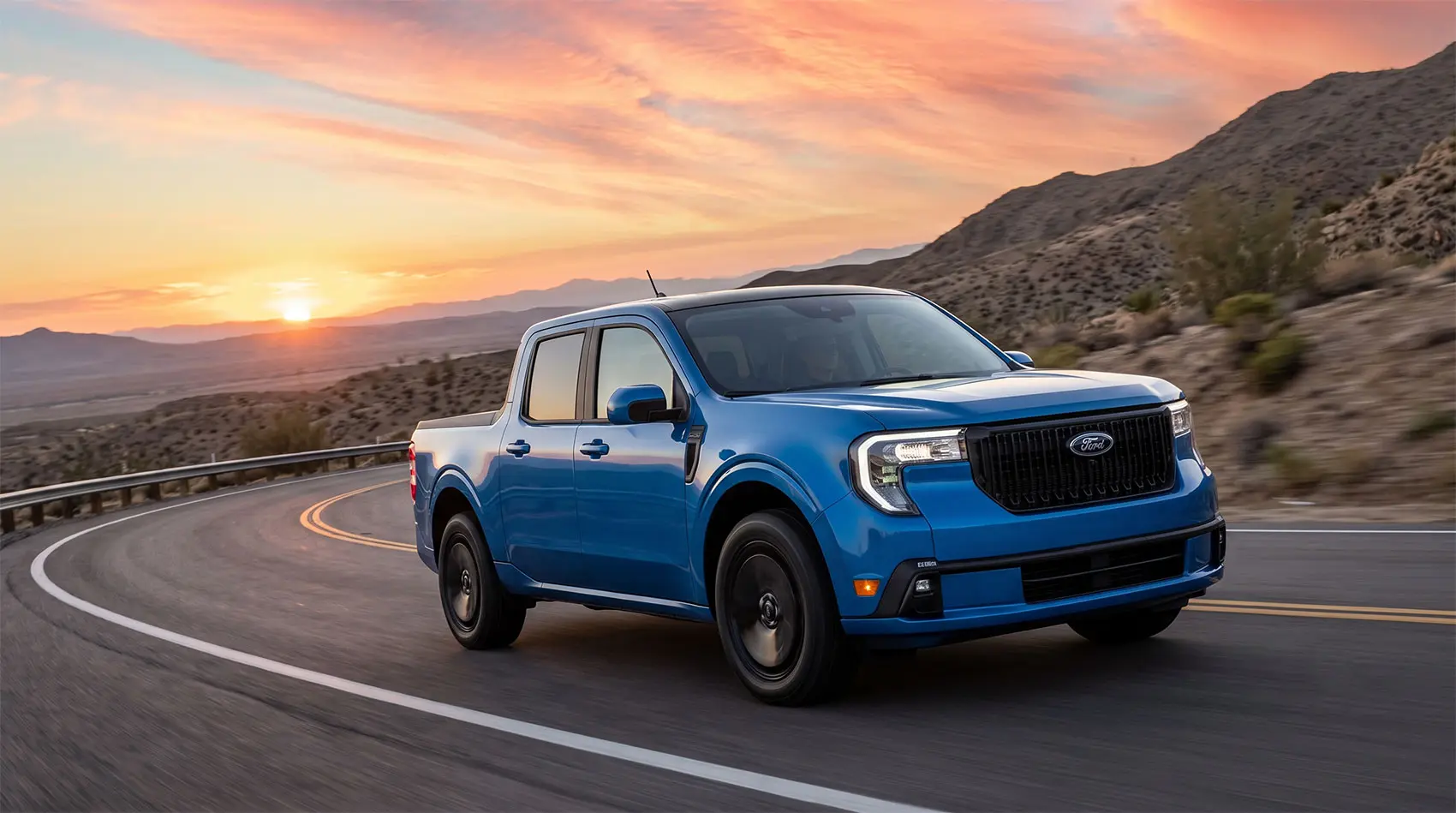
The landscape of the American pickup truck has shifted dramatically over the past decade. Once dominated by gargantuan, body-on-frame leviathans designed for heavy hauling and towing, the market has seen a resurgence of the "lifestyle" truck. Enter the Ford Maverick—a vehicle that successfully captured the hearts of suburbanites and urban explorers alike by offering the utility of a bed with the footprint of a sedan. However, Ford wasn't content with just a reliable, fuel-efficient hauler. They decided to tap into a nostalgic vein of automotive culture: the street truck.
The 2026 Ford Maverick Lobo is Ford’s unapologetic answer to the lowered, performance-oriented sport trucks of the 1990s. With its aggressive stance, lowered ride height, and unique aesthetic flair, the Lobo screams performance. But under the hood, the reality of its purpose-built intent meets the demands of modern driving. Equipped with the punchy 2.0L EcoBoost engine and a sophisticated all-wheel-drive system, the Lobo promises to be more engaging than its utilitarian siblings. Yet, the elephant in the room remains: in a world where hybrid Maverick models are celebrated for their incredible MPG, does the Lobo’s performance-focused approach destroy the very efficiency that made the Maverick nameplate a success?
This is not just a standard review; it is an investigation into the "fun-per-gallon" ratio. We are going to put the Lobo to the test, pushing it through city grids, open highways, and the occasional winding backroad, to see if the performance trade-offs hold up under real-world scrutiny. Does the Lobo live up to the hype, or is it a vanity project that sacrifices too much at the altar of performance? Let’s find out if this street truck is the compromise-free ride we’ve been waiting for or if the fuel pump is going to be your new best friend.
What Makes the Lobo Different?
To understand the Maverick Lobo’s fuel economy—or lack thereof—we must first peel back the layers of what makes this truck tick. The Lobo is not merely a styling exercise; it represents a fundamental recalibration of Ford’s compact truck platform. While the standard Maverick is engineered for the pragmatic needs of a DIY homeowner or an entry-level worker, the Lobo is tuned for the asphalt enthusiast. The most significant hardware change lies in its suspension geometry. Ford has lowered the ride height, stiffened the springs, and retuned the dampers. This reduces body roll and improves cornering precision, but it also alters the truck’s aerodynamic profile. By sitting lower to the ground, the Lobo theoretically cheats the wind better than a lifted, off-road-oriented Maverick. Yet, the added mass of performance-tuned hardware and unique cooling components creates a complex tug-of-war for efficiency.
Furthermore, the Lobo features a distinct transmission calibration. Rather than focusing on short-shifting into the highest gear for maximum fuel savings, the Lobo’s software is designed to hold gears longer, keeping the 2.0L EcoBoost engine right in the thick of its power band. This is a deliberate "performance-first" philosophy. Every time you accelerate, the vehicle is essentially asking whether you’d prefer a quick burst of torque over a more conservative fuel burn. The "Lobo" badge isn't just aesthetic; it’s a psychological marker. It signals to the driver that this vehicle is intended for spirited transit, not hypermiling. When you combine this aggressive tuning with the standard, high-traction all-wheel-drive system, you have a vehicle that feels glued to the road, but which also demands more energy from the engine to maintain that level of engagement. Ultimately, the Lobo is a study in trade-offs: you are paying for the privilege of a "street truck" experience, and the cost of that admission is inevitably tallied at the gas pump.
The Fuel Economy Test: Real-World Metrics
To truly determine if the Ford Maverick Lobo lives up to the hype, we bypassed the manufacturer's idealized projections and took it into the wild, the unpredictable, traffic-clogged urban grid, and the monotonous drone of the interstate. The 2.0L EcoBoost engine, while spirited, is subject to the immutable laws of physics. In heavy city driving, where the "stop-and-go" nature of the commute forces the turbocharger to work frequently, the fuel economy reflects the Lobo’s performance-tuned character. Unlike the hybrid model, which coasts through gridlock with minimal fuel consumption, the Lobo relies on a traditional combustion cycle that demands a steady supply of premium unleaded to maintain its responsiveness. Our tests showed that in dense urban environments, you shouldn't expect to see figures that threaten the efficiency records of their siblings. The trade-off is immediate: you get the punchy, instant acceleration that makes navigating tight city streets genuinely fun, but your fuel needle will move with noticeable purpose.
On the highway, the story changes slightly but remains consistent with the "street truck" identity. At steady cruising speeds, the engine settles into a comfortable rhythm, but the vehicle’s specific aerodynamic profile and gearing designed for agility rather than hypermiling mean it isn't the most efficient cruiser in the Ford lineup. We observed that while it holds its own, you are essentially trading a few miles per gallon for the stability and cornering grip afforded by the performance suspension. Interestingly, the drive modes offer the most significant variable in this equation. Engaging "Eco Mode" does dampen the throttle response and optimizes shift points for better conservation, but it also creates a conflict with the truck’s inherent character. If you find yourself constantly reaching for the "Eco" button to save fuel, you have to ask yourself why you bought the "Lobo" in the first place. The real-world metrics confirm that this truck is designed to consume fuel in exchange for engagement; it is a vehicle that rewards the driver for spending more, not for trying to spend less.
To further unpack the Lobo’s unique footprint, one must look at the unsprung weight and rolling resistance. The Lobo sits on a specific wheel-and-tire combination that prioritizes lateral grip and cornering stability over low rolling resistance. In typical highway conditions, this setup creates more friction with the pavement than the standard "all-season" rubber found on the base Maverick. While this makes the truck feel more planted during high-speed lane changes, it forces the 2.0L EcoBoost to work harder to maintain momentum. Furthermore, the inclusion of performance-oriented cooling components necessary to manage the heat generated during spirited driving adds a marginal amount of weight that affects the power-to-weight ratio. It is a classic engineering trade-off: you cannot have the high-performance handling of a sport truck without paying the price in drag and mass, both of which are enemies of fuel economy.
Maverick Lobo vs. The Competition (and Siblings)
When you step into the market for a compact truck, the Ford Maverick lineup already feels like a Swiss Army knife of options. You have the standard AWD model, which is the "jack-of-all-trades," and the Hybrid, which is the undeniable king of city-bound efficiency. So, where does the Lobo fit? To understand its place, you have to stop viewing it as a "truck" and start viewing it as a "sport-compact vehicle with an open bed." When compared to its siblings, the Lobo is clearly the outlier. While the standard AWD Maverick manages to strike a balance between capability and fuel economy, the Lobo prioritizes cornering dynamics, steering feel, and a planted stance.
If you are cross-shopping the Lobo against other compact trucks or even hot hatches, you’ll notice that the Lobo doesn't win on paper when it comes to fuel efficiency. If your primary goal is to save money at the pump, the Maverick Hybrid is the objectively superior choice. However, the Lobo isn't chasing the same demographic. It is targeting the buyer who wants the utility of a truck but misses the days of lowered, modified street machines that could carve up a backroad on a Saturday morning.
In this segment, the competition is slim. Most manufacturers have abandoned the "street truck" aesthetic, leaving Ford to cultivate a niche audience. The Lobo isn't competing with a Toyota Tacoma or even a Hyundai Santa Cruz for efficiency; it’s competing for the hearts of enthusiasts who prioritize the driving experience. The "fun-per-gallon" trade-off becomes clear when you realize that the Lobo’s performance-oriented suspension and transmission aren't just features; they are the core of its personality. Choosing the Lobo means accepting that you are paying a premium in fuel to support a vehicle that values agility and aesthetics over absolute maximum efficiency. It isn't a truck for the accountant; it's a truck for the enthusiast.
The Verdict: Is It Worth the Trade-off?
Deciding whether the 2026 Ford Maverick Lobo "lives up to the hype" depends entirely on your definition of a truck’s purpose. If you approach the Lobo with a spreadsheet and a calculator, obsessing over every decimal point of fuel economy, you will likely find yourself disappointed. It does not possess the hybrid efficiency that makes the base Maverick a darling of the fuel-conscious commuter. It is, by design, a less efficient vehicle because it is a more expressive one. Ford has effectively engineered a "fun tax" into the Lobo, and you pay that tax every time you pull up to the gas pump. However, to judge it solely on its fuel consumption is to miss the point entirely. The Lobo isn't trying to be a hybrid; it’s trying to be a return to form for enthusiasts who want a daily driver that actually feels connected to the road.
When you weigh the "fun-per-gallon" ratio, the Lobo begins to make a lot more sense. The performance-tuned suspension, the enhanced torque vectoring, and the lowered, aggressive aesthetic provide a driving experience that the standard Maverick simply cannot touch. For the driver who spends their weekends on backroads or just enjoys the aesthetic and mechanical engagement of a sport truck, the fuel economy penalty is a secondary consideration. It is a niche vehicle, yes, but it is a niche that has been underserved for decades. Is it worth the trade-off? If your commute is merely a chore and you want to inject some personality and engagement into your daily drive, the answer is a resounding yes. The Lobo isn't a compromise; it’s a choice a choice to prioritize the joy of driving over the monotony of maximum efficiency. It lives up to the hype, provided you understand exactly what the "hype" is meant to deliver.
Conclusion: The Lobo’s Legacy
The 2026 Ford Maverick Lobo isn't merely a trim level; it is a statement about where the compact truck market is heading. By blending the inherent practicality of the Maverick platform with the spirit of a street-focused performance vehicle, Ford has successfully captured a segment that has been largely dormant for decades. We set out to test whether this truck could balance its performance aspirations with the realities of fuel economy, and the results are telling. While the Lobo does indeed demand more fuel than its hybrid or standard AWD counterparts, it delivers a driving experience that feels purposeful and engaging. The slight penalty in MPG is a conscious trade-off for the heightened steering response, the planted feel through the corners, and the aggressive aesthetic that separates it from every other compact hauler on the road.
If you are a driver who prioritizes the mechanical "feel" of a vehicle, someone who values how a truck takes a turn or how it reacts to a throttle input, the Lobo makes a compelling argument for itself. It lives up to the hype by being exactly what it promised: a modern street truck. It doesn't apologize for its thirst, because it justifies that consumption with character. As we look at the broader automotive landscape, the Lobo stands out as a refreshing alternative to the "appliance-like" vehicles that dominate the market. It serves as a reminder that even in the age of electrification and hyper-efficiency, there is still room for a vehicle designed primarily to put a smile on the driver's face. Whether you see it as a weekend toy or a spirited daily driver, the Maverick Lobo manages to redefine the expectations of what a small truck can be.

Written by Maarukh Shahbaz
Published Jul 16, 2026 in Car Reviews.