The year 2026 has brought a long-awaited reality check to the global automotive market. For years, the debate between Electric Vehicles (EVs) and Petrol-powered cars was fueled by speculation, "early adopter" excitement, and fluctuating gas prices. But today, the dust has settled into a landscape of hard data. If you are standing in a dealership or scrolling through online listings, your question is likely no longer "Are EVs the future?" but rather: "Will an EV actually save me money on my Tuesday morning commute?"
To answer that, we have to move past the sticker price. In 2026, the global average price for a gallon of petrol sits around $3.30 to $3.70 in the U.S., while European drivers are seeing prices closer to $7.00 per gallon due to carbon taxation. Meanwhile, residential electricity averages roughly $0.18 per kWh in the States. On the surface, the math seems simple—electricity is cheaper than liquid fuel. However, the financial reality of 2026 is more nuanced.
Total Cost of Ownership (TCO) is the new gold standard for car buyers. It accounts for the purchase price, interest rates, insurance, and the rapidly changing used car market. While many federal tax credits for new EVs reached their sunset in late 2025, the secondary market is now flooded with reliable, three-year-old electric cars that are challenging the dominance of traditional internal combustion engines. This guide will dismantle the "EV premium" myth and look at the actual costs of maintenance, energy, and depreciation to determine which vehicle type deserves your hard-earned money for daily driving in 2026. Whether you are an apartment dweller relying on public plugs or a suburban homeowner with a garage charger, the "cost-effective" choice might surprise you.
The Fueling Face-Off (Daily Running Costs)
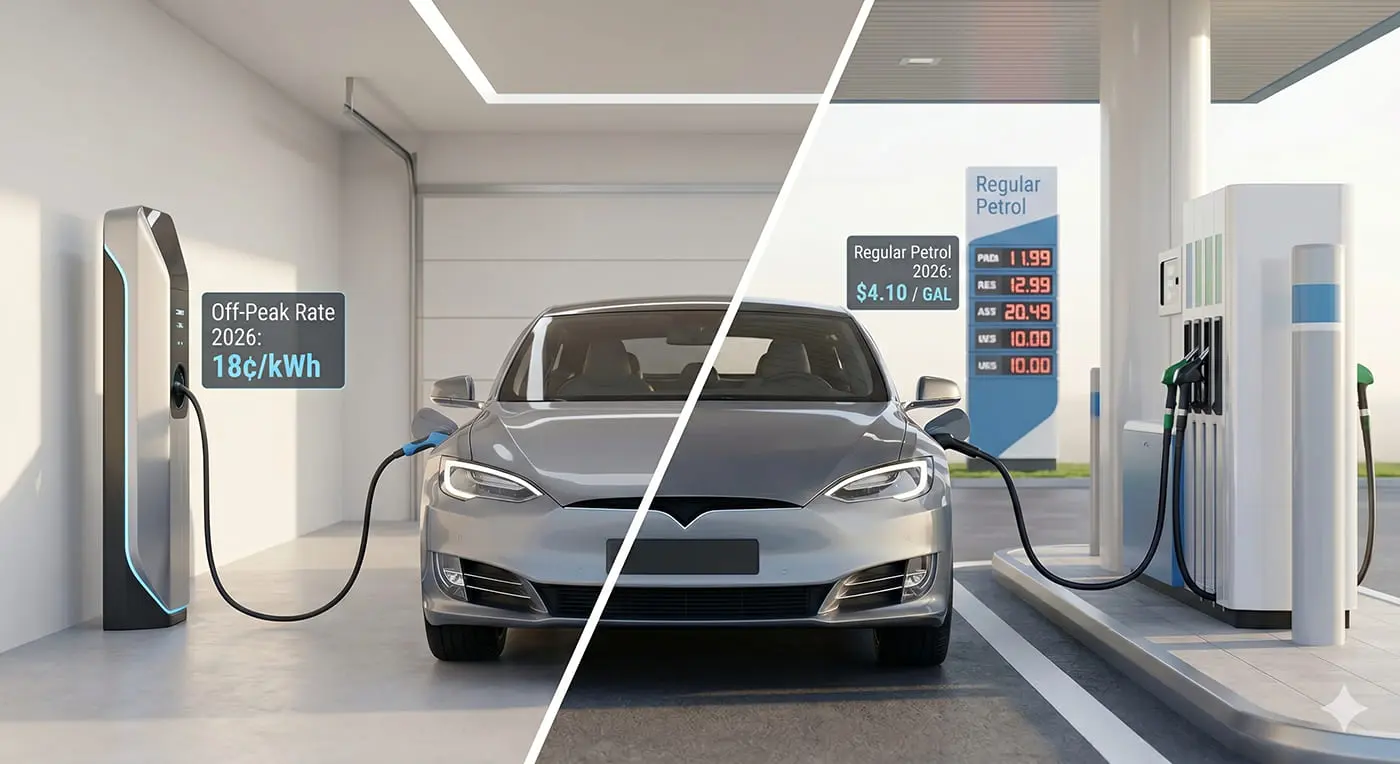
In 2026, the gap between the "pump" and the "plug" has widened into a chasm, but only if you know where to look. As of April 2026, the U.S. national average for a gallon of regular petrol has settled around $4.03 to $4.10. For a standard petrol car averaging 30 MPG, you are paying roughly 13 to 14 cents per mile just to keep the wheels turning.
The EV story, however, is a tale of two cities: Home Charging vs. Public Charging.
The Home Charging "Cheat Code"
If you can plug in your car at home, you are winning the financial war. The average U.S. residential electricity rate in 2026 is approximately 18.05¢ per kWh. A typical electric commuter car gets about 3 to 4 miles per kilowatt-hour. This brings your cost down to just 4.5 to 6 cents per mile.
-
The Monthly Math: If you drive 1,000 miles a month, you're spending $135 on petrol vs. about $50 on electricity. That is a $1,020 annual "raise" just for switching fuels.
The Public Charging Reality Check
For those without a driveway, the math gets tighter. Public DC Fast Chargers in 2026 often charge between 40¢ and 70¢ per kWh. At these rates, your cost per mile can jump to 15–20 cents, which actually makes an EV more expensive to "fuel" than a fuel-efficient petrol car.
2026 Cost Comparison Table
| Vehicle Type | Fuel Cost (Per Mile) | Monthly Cost (1,000 miles) |
| Petrol (30 MPG) | 13.5¢ | $135 |
| EV (Home Charging) | 5.2¢ | $52 |
| EV (Public Fast Charging) | 17.5¢ | $175 |
In 2026, the EV is the undisputed king of cost-effectiveness for homeowners. However, for apartment dwellers relying solely on fast chargers, a petrol hybrid remains the smarter financial play.
Maintenance – Where the EV Pulls Ahead
If fueling is where the EV wins the daily battle, maintenance is where it wins the war. In 2026, the data from millions of vehicles on the road is conclusive: electric vehicles cost between 30% and 50% less to maintain over their lifetime compared to petrol cars.
The secret lies in mechanical simplicity. A traditional internal combustion engine is a masterpiece of complexity, containing over 2,000 moving parts—pistons, valves, fuel injectors, and timing belts—all exploding thousands of times per minute. An electric motor, by contrast, has about 20 moving parts.
The "Never-Again" List
When you switch to an EV in 2026, you are essentially firing your mechanic for a long list of traditional services. Gone are the days of:
-
Oil Changes: Saving you roughly $60–$120 every six months.
-
Spark Plugs & Ignition Coils: No more rough idles or $400 tune-ups.
-
Transmission Repairs: Most EVs use a single-speed reduction gear that rarely, if ever, needs servicing.
-
Exhaust Systems: No mufflers to rust or catalytic converters for thieves to target.
The Regenerative Braking Bonus
One of the most surprising savings for new EV owners is the brakes. Because EVs use regenerative braking—using the motor to slow the car down and recoup energy—the physical brake pads are rarely used. In 2026, it is common to see EVs reach 100,000 miles on their original set of brake pads, a feat nearly impossible for a heavy petrol SUV.
The "EV Tax": Tires and Weight
It’s not all sunshine and savings, though. There is one area where EVs are consistently more expensive: Tires.
Because EVs carry heavy battery packs, they weigh about 20–30% more than their petrol counterparts. This extra mass, combined with the instant torque of electric motors, means tires wear out 15–30% faster. In 2026, a set of specialized "EV-rated" tires can cost $800–$1,100, and you might find yourself replacing them every 35,000 miles instead of 45,000.
2026 Annual Maintenance Estimates
| Service Item | Petrol Car (Avg) | Electric Car (Avg) |
| Routine Service | $600 - $800 | $150 - $300 |
| Brake Maintenance | $250 | $50 |
| Tire Replacement (Annualized) | $200 | $300 |
| TOTAL | $1,050 / year | $500 - $650 / year |
While you'll pay a bit more for rubber, the lack of engine drama saves the average 2026 driver over $500 a year in shop visits alone.
The "Invisible" Costs (Insurance & Depreciation)
When calculating cost-effectiveness in 2026, the numbers you don't see on the price tag are often the most impactful. While you save at the pump, two "invisible" factors—Insurance and Depreciation—can shift the financial scales significantly.
The Insurance Gap: A 2026 Reality
Insurance premiums for electric vehicles remain a point of contention. In 2026, insuring an EV typically costs 20% to 30% more than a comparable petrol vehicle. Why? It comes down to repair costs. Even though EVs have fewer moving parts, their bodies are often built with advanced materials or large structural castings to save weight.
-
Repair Complexity: A minor fender-bender that costs $2,000 on a petrol car might cost $4,500 on an EV if the sensors or battery housing are involved.
-
The "Total Loss" Threshold: Because battery packs represent such a high percentage of the car's value, insurance companies in 2026 are still more likely to "write off" an EV after an accident rather than pay for a complex battery repair.
Depreciation: The Great Market Shift
Depreciation is where the 2026 market has become truly fascinating. For years, EVs depreciated faster than petrol cars due to rapidly improving technology. However, in 2026, we are seeing a stabilization.
-
Petrol Cars: As many cities begin implementing "Low Emission Zones," the resale value of older petrol cars is starting to soften. People are wary of buying a car that might be banned from downtown in five years.
-
The Used EV Boom: A three-year-old EV in 2026 (model year 2023) is now a highly sought-after commodity. Battery health data is now transparently available to buyers, reducing the "dead battery" fear that used to tank resale prices.
The "EV Road Tax"
It is also worth noting that by 2026, many governments have realized they are losing revenue from gas taxes. To compensate, dozens of regions have introduced Annual EV Registration Fees. These can range from $150 to $400 per year. While this doesn't wipe out your fuel savings, it is a line item that petrol drivers don't have to face in the same way.
2026 "Hidden" Annual Costs (Estimates)
| Expense Category | Petrol Vehicle | Electric Vehicle |
| Annual Insurance | $1,600 | $2,050 |
| Registration/Fees | $100 | $350 |
| 5-Year Depreciation | 45% of value | 48% of value |
The "invisible" costs of owning an EV can add an extra $600–$800 per year in insurance and fees compared to a petrol car. To be truly cost-effective, your fuel and maintenance savings must exceed this "ownership tax."
The 2026 Use-Case Verdict
By now, it’s clear that neither the EV nor the petrol car is a universal winner. In 2026, the "cost-effective" choice depends entirely on your living situation and how many miles you cover. As of April 2026, the purchase price gap has narrowed significantly—in some regions, new EVs are actually retailing for about $800 less than comparable petrol models due to high manufacturer discounts and the influx of affordable brands like MG and Renault.
The Apartment Dweller’s Struggle
If you live in a high-rise without dedicated charging, the math is still tough. Relying on public DC fast chargers (averaging 53¢–77¢ per kWh in 2026) means your "fuel" cost is roughly 18¢–22¢ per mile. Compare that to a modern petrol hybrid that gets 50 MPG at $4.10/gallon, costing only 8¢ per mile.
-
Verdict: Stay with Petrol or a Hybrid until your building installs Level 2 plugs.
The High-Mileage Commuter
If you drive more than 12,000 miles a year and can charge at home overnight, the EV is a financial no-brainer. With off-peak electricity rates as low as 7¢ per kWh, you are saving nearly $1,500 a year on fuel and maintenance compared to a petrol equivalent.
-
Verdict: The EV will pay for its "invisible" costs (insurance/fees) within the first 6 months.
Total Cost of Ownership (TCO) Projections 2026
To give you the full picture, here is how the costs stack up over a typical ownership cycle, including fuel, maintenance, insurance, and fees.
| Ownership Period | Petrol Car (TCO) | Electric Car (TCO) | Savings with EV |
| 5 Years | $38,500 | $34,200 | $4,300 |
| 10 Years | $74,000 | $61,500 | $12,500 |
| 15 Years | $112,000 | $89,000 | $23,000 |
| Assumes 12,000 miles/year and 70% home charging. |
The 2026 Break-Even Point: For the average driver, the "break-even" point—where the running savings finally overtake the slightly higher insurance and registration costs—now occurs at approximately Year 3. After that, every mile you drive puts money back into your pocket.
Conclusion: Choosing Your Path
The debate between EV and petrol in 2026 is no longer about saving the planet—it’s about saving your bank account. As we’ve seen, the "winner" isn't a fixed car type, but rather a reflection of your specific lifestyle.
For the suburban homeowner or the commuter with workplace charging, the electric vehicle has become the ultimate financial tool. The combination of home-charging rates (averaging 18¢ per kWh) and the dramatic reduction in mechanical failures makes the EV an asset that pays you back over time. By the time you hit the three-year mark, the initial hurdles of higher insurance and registration fees are usually washed away by the sheer savings at the "pump."
Conversely, the petrol car remains a vital, cost-effective tool for those in high-density urban areas or those who frequently travel long distances through charging "deserts." In 2026, a high-efficiency petrol hybrid often provides a lower Total Cost of Ownership for drivers who must rely on expensive public fast chargers.
Final Verdict for 2026:
-
Choose an EV if: You drive over 10,000 miles a year, have access to a 240V home outlet, and plan to keep the car for at least 4 years.
-
Choose Petrol/Hybrid if: You live in an apartment without charging, do most of your driving on highways, or change cars every 2 years.
Future-proofing your garage in 2026 means looking past the shiny hood and into the spreadsheet. While petrol still has its place, the "plug" is increasingly becoming the most logical way to navigate the daily grind without breaking the bank.

Written by Kousar Shabbir
Published Apr 28, 2026 in Comparisons.