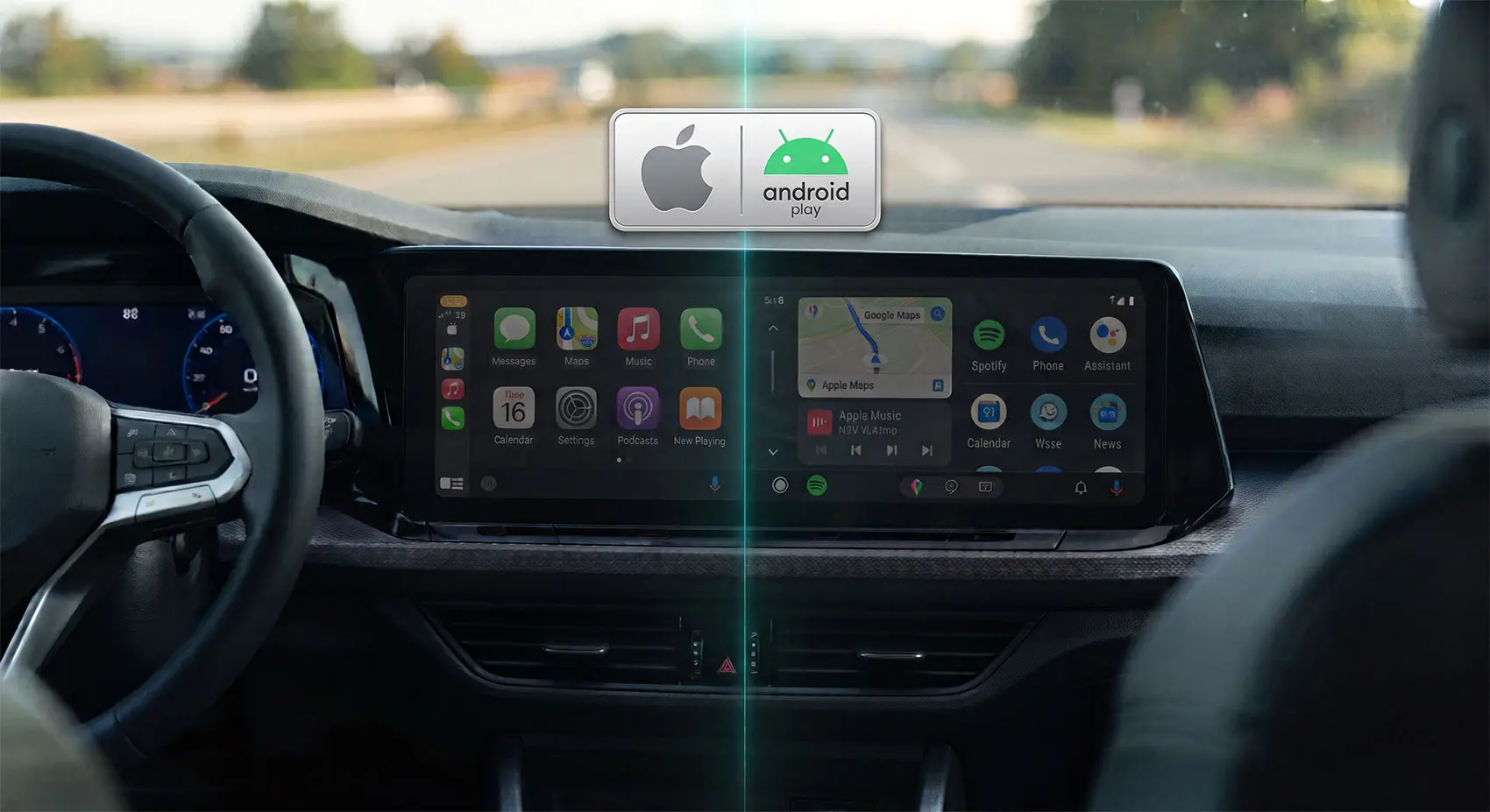
The automotive landscape has undergone a monumental shift, transforming modern vehicles into rolling software platforms where digital ecosystems matter just as much as horsepower and torque. In 2026, the dashboard has become the ultimate battleground for tech supremacy. Drivers no longer judge a car solely by its engine performance or suspension tuning; instead, the responsiveness of the infotainment screen, the fluidity of voice commands, and the seamless integration of smartphones dictate the overall driving experience. At the center of this revolution stand two titan operating systems: Apple CarPlay and Android Auto.
For over a decade, these two platforms have vied for control of our vehicle displays, continually evolving from simple screen-mirroring utilities into sophisticated, deeply integrated dashboard powerhouses. As we navigate through 2026, both Apple and Google have rolled out massive updates designed to take advantage of next-generation hardware, ultra-wide multi-screen displays, and advanced artificial intelligence. Apple CarPlay has expanded its footprint deeper into vehicle instrumentation clusters and climate controls, while Android Auto has refined its Coolwalk interface and leveraged the immense predictive capabilities of Google Assistant.
Choosing between Apple CarPlay and Android Auto in 2026 is no longer a trivial decision of aesthetic preference. It impacts your daily navigation accuracy, your audio streaming fidelity, your safety through distraction management, and how effortlessly your digital life transitions from your pocket to your steering wheel. Whether you are an embedded member of the Apple ecosystem looking for ultimate hardware synergy or an Android devotee valuing open-source flexibility and unmatched Google Maps intelligence, understanding how these platforms perform on modern 2026 head units is critical. In this comprehensive comparison, we examine every facet of Apple CarPlay and Android Auto to help you determine which system truly deserves prime real estate on your dashboard.
Evolution of In-Car Infotainment in 2026
The transformation of the modern vehicle dashboard over the past several years has been nothing short of revolutionary. We have officially moved past the era where a car's technological appeal was measured solely by the size of its center console screen or the number of speakers in the sound system. In 2026, vehicles operate as sophisticated software-defined machines (SDVs). This paradigm shift means the hardware inside your dashboard acts less like a simple digital radio and more like a high-performance computer terminal, requiring robust processing power, lightning-fast memory, and ultra-low-latency wireless communication standards to function without a hitch.
At the core of this hardware evolution is the widespread adoption of multi-screen and pillar-to-pillar display layouts by major automotive manufacturers. Modern 2026 head units frequently span across the entire dashboard, integrating the digital instrument cluster, the central infotainment display, and even a dedicated passenger screen into a single cohesive glass surface. This architectural leap presents unique challenges and opportunities for smartphone mirroring technologies. Apple CarPlay and Android Auto can no longer just project a single app onto a square box in the middle of the dash; they must dynamically scale across complex, ultra-wide aspect ratios, feed real-time telemetry data to custom gauge clusters, and manage split-screen multitasking effortlessly.
As wireless standards have matured with Wi-Fi 6E and emerging Ultra-Wideband (UWB) protocols becoming standard factory specifications in 2026 vehicles, the friction of physical cable connections has completely vanished for most premium models. Phones now securely pair the instant the driver opens the door, initializing the projection interface before the engine even turns over. This seamless synergy sets a high baseline for both Apple and Google, raising the stakes for ecosystem reliability, connection stability, and energy efficiency so that prolonged navigation sessions do not critically drain your smartphone battery.
Apple CarPlay: Features, Design, and 2026 Updates
Apple has long positioned CarPlay not merely as an app launcher, but as an immersive extension of the iOS ecosystem right on your dashboard. In 2026, Apple CarPlay has taken a massive leap forward, especially with the deeper rollout of next-generation features that integrate into the core instrumentation of modern luxury and mainstream vehicles alike. When your iPhone connects to a 2026 head unit, the transformation is instantaneous. Gone are the days of a generic rectangular grid; the interface now dynamically stretches to fill ultrawide curved dashboards, feeding high-definition graphics to digital speedometer clusters and central media displays simultaneously.
At the heart of the 2026 CarPlay experience is a significantly enhanced iteration of Siri. Powered by advanced on-device and cloud processing models, Siri in the car handles multi-intent commands with remarkable speed. You can effortlessly chain requests such as telling Siri to navigate to the nearest EV charging station, text your spouse an estimated time of arrival, and queue up a specific playlist all in a single, natural breath. The voice assistant also gains tighter contextual awareness, recognizing subtle environmental cues like low fuel or battery warnings and proactively offering relevant routing or service options.
Ecosystem synergy remains Apple’s greatest competitive moat. If you live inside the Apple ecosystem, CarPlay acts as a frictionless bridge. Your saved favorite locations in Apple Maps instantly sync from your Mac or iPhone to the car screen. Your active media queue, whether it is Apple Music, podcasts, or audiobooks, picks up precisely where you left off the moment you stepped out of your house. Furthermore, native integration with HomeKit allows drivers to trigger smart home routines like opening the garage door, disarming the security system, or turning up the thermostat straight from the dashboard before pulling into the driveway.
Security and distraction management have also been refined. Apple’s spatial audio integration provides directional audio cues for turn-by-turn navigation instructions, meaning the voice prompt sounds like it is coming from the specific side of the vehicle where you need to turn. The revamped notification center keeps incoming messages brief and legible, relying heavily on voice read-outs to keep your eyes locked firmly on the road ahead. For Apple power users, this level of seamless, secure integration makes CarPlay an indispensable daily driver.
Android Auto: The Coolwalk Experience and Google Ecosystem
While Apple CarPlay focuses on deep, polished ecosystem symmetry, Android Auto has doubled down on dynamic interface layout, unparalleled navigation accuracy, and cutting-edge artificial intelligence. At the center of the 2026 Android Auto experience is an upgraded evolution of the Coolwalk dashboard architecture, featuring full support for Material 3 Expressive design with dynamic animations, fluid wallpapers, and responsive widgets. Coolwalk’s primary strength lies in its relentless adaptability; regardless of whether your vehicle sports an ultrawide rectangular panel, a vertical portrait screen, or a custom square display, the interface dynamically resizes to display a main navigation card alongside active audio controls, real-time messaging tiles, and glanceable widgets.
The cornerstone of Android Auto remains Google’s unbeatable mapping engine. In 2026, Google introduced "Immersive Navigation" for Google Maps inside Android Auto, bringing a major visual overhaul featuring 3D building renderings, detailed lane structures, stop signs, and live camera-assisted lane guidance for tricky highway merges. Paired with community-driven alerts from Waze, Android Auto continues to set the benchmark for routing precision, real-time traffic updates, and ETA accuracy.
Under the hood, Google Assistant has been supercharged with Gemini AI intelligence on compatible devices. Rather than requiring rigid voice syntax, Gemini understands complex, conversational context. For instance, if you receive a text while driving asking where you want to meet for dinner, Gemini can search your messages, check your calendar availability, pull up recommendations along your current route, and formulate a response all through hands-free voice prompting. Furthermore, Android Auto in 2026 brings full-screen in-car video playback (such as 1080p YouTube streaming) when parked or charging an EV, which seamlessly drops back to an audio-only stream the moment you put the vehicle in drive.
Finally, Android Auto excels in hardware diversity. Because it is designed to work across thousands of Android device variants from flagship Google Pixel and Samsung Galaxy phones to budget-friendly models, the platform offers robust cross-brand versatility without locking drivers into a single manufacturer's hardware setup.
Head-to-Head Comparison: Key Performance Metrics
When evaluating Apple CarPlay and Android Auto side-by-side in 2026, the performance differences boil down to how each platform handles critical day-to-day driving metrics: wireless connection reliability, navigation intelligence, audio fidelity, and distraction mitigation. Both ecosystems have matured significantly, but their distinct engineering philosophies yield noticeably different experiences on the road.
- Wireless Connectivity and Boot-Up Speed: With Wi-Fi 6E and Ultra-Wideband (UWB) pairing coming standard on modern vehicles, connection lag has become a thing of the past for both platforms. Apple CarPlay establishes a secure handshake almost instantaneously as you open the driver's door, often displaying the home screen before you even shift out of park. Android Auto has drastically closed this gap, boasting a reliable sub-three-second boot time on modern head units. However, Apple maintains a slight edge in raw connection stability, particularly in congested urban environments prone to heavy radio frequency interference.
- Navigation and Real-Time Traffic: Navigation performance is a tie-breaker depending on user preference. Android Auto leverages the powerhouse combination of Google Maps and Waze, offering unmatched real-time crowdsourced hazard alerts, precise lane-level guidance, and 3D building renderings. Apple Maps, on the other hand, has evolved into a visually stunning, highly reliable alternative with detailed elevation data, stop signs, and traffic light placements. While Google Maps edges out slightly in global routing flexibility and raw data depth, Apple Maps offers cleaner typography and superior integration with spatial audio cues.
- Audio Quality, DSP Tuning, and Media Streaming: For audiophiles, audio output nuances matter. Apple CarPlay natively supports lossless audio streaming through Apple Music and deep spatial audio rendering, providing a cleaner, more dynamic sound stage when paired with high-end factory audio systems. Android Auto supports high-resolution streaming via Tidal and Qobuz effortlessly, but its internal digital signal processing (DSP) can sometimes compress dynamic range slightly depending on the hardware codec of the connected Android device.
- Safety and Distraction Management: Safety remains the ultimate priority. Apple’s stringent developer guidelines ensure that CarPlay apps maintain a clean, high-contrast, distraction-free interface layout. Android Auto’s Coolwalk design is equally focused on minimizing glance time, utilizing split-screen cards to keep primary navigation visible while interacting with secondary apps. Both platforms excel at hands-free voice control, though Google Assistant's deep contextual understanding gives Android Auto a slight advantage when dictating complex messages or searching for obscure points of interest on the fly.
Which One Should You Choose in 2026?
Choosing between Apple CarPlay and Android Auto in 2026 comes down to your personal tech ecosystem and driving priorities.
Choose Apple CarPlay If:
-
You live fully inside the Apple ecosystem (iPhone, Apple Watch, Mac).
-
You value lossless spatial audio via Apple Music and seamless HomeKit integration.
-
Your vehicle features a modern multi-screen architecture optimized for Apple's next-gen instrument cluster extensions.
Choose Android Auto If:
-
You prefer cross-device flexibility (Google Pixel, Samsung Galaxy, or open-source environments).
-
You rely on Google Maps and Waze for unmatched real-time routing accuracy and hazard warnings.
-
You want conversational AI assistance via Gemini and fluid Coolwalk split-screen multitasking.
Ultimately, both systems deliver a fast, safe, and immersive dashboard experience, meaning the right choice is simply the one that best matches your daily phone preference.
Conclusion
As we look across the automotive landscape in 2026, the ongoing rivalry between Apple CarPlay and Android Auto highlights how crucial software integration has become to the driving experience. Both systems have evolved far beyond simple smartphone mirroring tools, transforming into robust, context-aware digital co-pilots that manage everything from real-time navigation and high-fidelity audio to complex multi-intent voice communications.
Ultimately, your choice between the two will depend entirely on your personal device ecosystem and daily workflow preferences. Apple CarPlay remains the gold standard for iPhone users, offering unmatched hardware synergy, frictionless device continuity, and a deeply polished user interface that integrates seamlessly into modern multi-screen vehicle architecture. On the other hand, Android Auto stands tall as the champion of flexibility and intelligence, providing powerful cross-device compatibility, unmatched Google Maps routing accuracy, and conversational AI assistance via Gemini.
Whichever platform you choose, the standard of in-car technology in 2026 ensures that your commute will be safer, more connected, and vastly more entertaining than ever before.



Written by Kousar Shabbir
Published Jul 27, 2026 in Auto Tech.