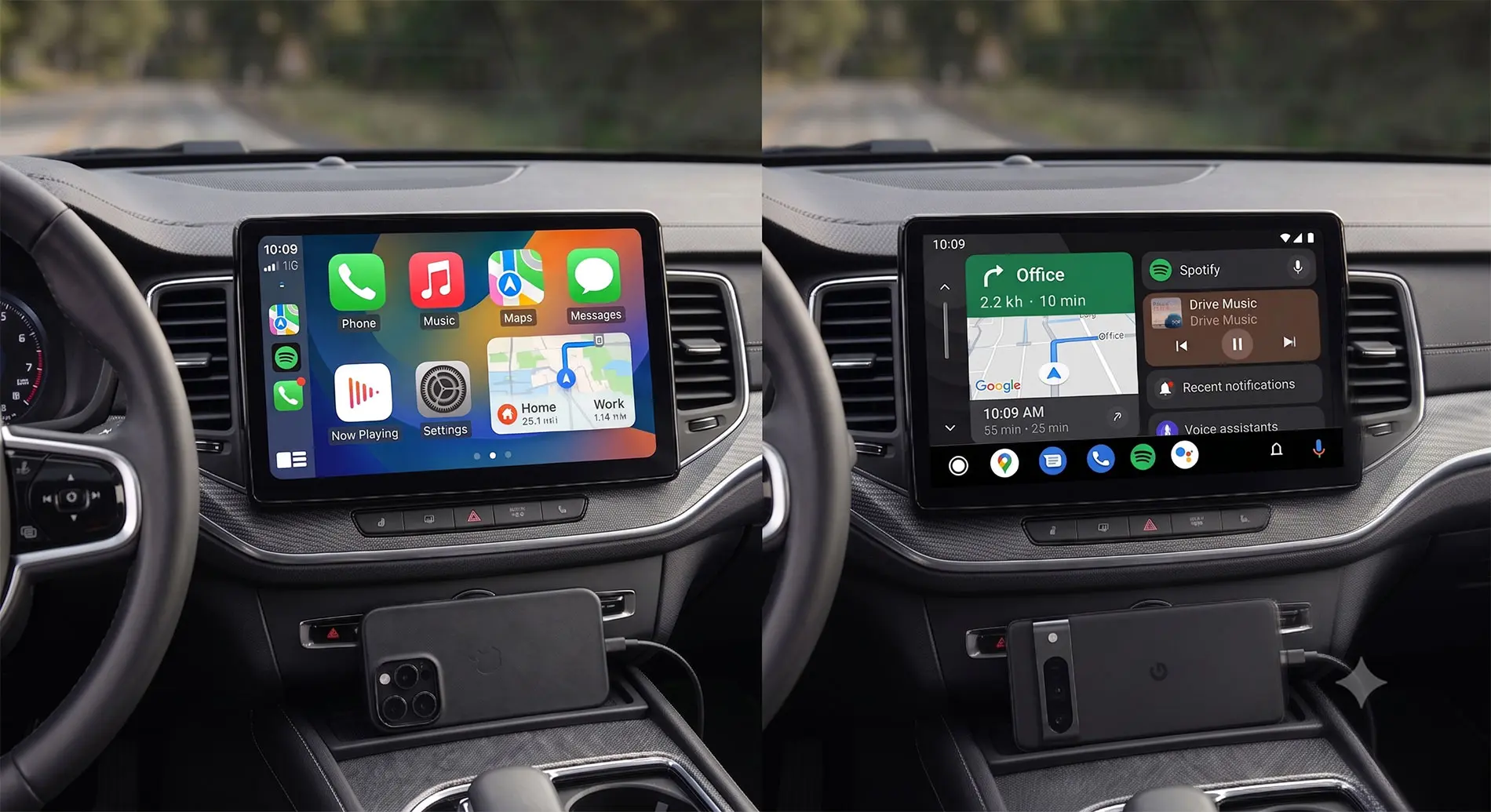
The dashboard of your vehicle has evolved from a simple FM radio and a manual climate control dial into the most sophisticated piece of real estate in your daily life. By 2026, the car has become an extension of our digital workspace, a private concert hall, and a high-speed navigation hub. As we navigate the roads this year, two giants have staked their claims on the center console: Apple CarPlay and Android Auto. For the modern driver, the choice is no longer just about which phone you keep in your pocket; it is about which ecosystem provides a seamless, distraction-free, and intelligence-driven experience behind the wheel.
The industry landscape in 2026 is defined by a shift toward deeper hardware integration. We are moving past the era of simple screen mirroring. Today, we are looking at predictive AI routing, ultra-fast wireless projection that feels as snappy as a native operating system, and deep vehicle data integration that allows your phone to talk directly to your car’s powertrain and diagnostic systems. As Apple pushes forward with its proprietary, hardware-locked "CarPlay Ultra" ecosystem and Google refines its open-platform dominance through Gemini-powered intelligence, the battle for the dashboard has never been more intense.
Choosing between them is a complex equation involving your smartphone preference, your vehicle’s infotainment hardware, and your personal tolerance for proprietary walled gardens versus open, flexible platforms. Is Apple’s polished, cohesive design still the king of user experience? Or has Android Auto finally overtaken its rival by leveraging the raw power of Google’s cloud-based AI to provide more helpful, context-aware information? In this guide, we will dissect the performance, the UI, the ecosystem lock-in, and the real-world utility of both systems to help you decide which one deserves the top spot on your dashboard in 2026.
The 2026 Landscape – CarPlay Ultra vs. Android Auto’s Open Ecosystem
The core philosophy separating these two titans in 2026 has never been more pronounced. Apple, staying true to its long-standing commitment to a "walled garden," has begun rolling out "CarPlay Ultra." This isn’t just an app on your phone anymore; it represents a deep, proprietary integration with the vehicle’s core hardware. In supported 2026 models, CarPlay Ultra takes control of the entire instrument cluster, handling everything from speedometer readouts to climate control and seat adjustments. The advantage here is the signature Apple polish—a cohesive, fluid interface that feels less like a secondary gadget and more like the car’s native brain. However, this comes at a cost: it requires specific hardware partnerships, meaning it is currently limited to a select tier of automakers. If you are an iPhone user, the experience is undeniably luxurious, offering a level of design consistency that makes other systems feel fragmented.
On the other side of the aisle, Android Auto continues its reign as the king of the open ecosystem. While Apple opts for deep, exclusive hardware integration, Google has doubled down on accessibility and ubiquity. Android Auto in 2026 feels remarkably "alive," primarily due to the deep integration of Google’s Gemini AI. Where CarPlay Ultra feels like a pristine, controlled environment, Android Auto feels like a highly capable assistant that adapts to your environment. Because it remains an open platform, it functions across a wider array of vehicle price points and infotainment setups. The strength of the Android approach is its flexibility—it excels at managing multiple data streams, from real-time traffic updates via Google Maps to context-aware notifications that sync seamlessly with your Android ecosystem.
Ultimately, the landscape is divided between Apple’s pursuit of a premium, unified "ultra" experience and Google’s pursuit of a universal, intelligence-first utility. For the average driver, the choice comes down to whether you prioritize the visual harmony and hardware-level integration of the Apple ecosystem, or the functional, AI-driven versatility that Android Auto brings to almost any vehicle on the road today.
Performance, Stability, and User Interface
In the fast-paced digital environment of 2026, performance isn't just about how quickly an app launches—it is about the latency of the entire experience. Wireless connectivity, which was once a luxury, is now standard, but it has brought new challenges. Both CarPlay and Android Auto have made massive strides in reducing the "lag" that historically plagued wireless projections. However, the difference in how they handle data remains a point of contention for power users. Apple’s CarPlay utilizes a highly optimized, proprietary stream that prioritizes visual fidelity and immediate touch response. When you tap an icon, the feedback is near-instant, providing that "native" feel that Apple is famous for. In 2026, this stability is further enhanced by tighter integration with iPhone’s UWB (Ultra-Wideband) chips, allowing for seamless, almost telepathic connection as soon as you enter the vehicle.
Android Auto, conversely, takes a more utilitarian approach. It is built to be a robust, "workhorse" interface. While it may occasionally exhibit slightly higher latency compared to the ultra-polished CarPlay, it makes up for this with superior multitasking. Android Auto’s "split-screen" mode now standard across all screen aspect ratios—is exceptionally efficient at showing navigation, media controls, and incoming messages simultaneously without feeling cramped. Stability-wise, Android Auto has seen significant improvements in handling "cold starts." Even if the infotainment system is rebooting or if your device has been through a firmware update, Android Auto remains remarkably resilient, reconnecting with minimal intervention.
When it comes to the UI, the divide is aesthetic versus functional. Apple sticks to its grid-based icon layout, which is undeniably intuitive but can become cumbersome if you have dozens of apps. Android Auto leans into a dashboard-style layout that is more dynamic, prioritizing what it believes you need to see at that moment like an upcoming calendar appointment or a suggested route based on traffic patterns detected by Google’s massive data network. For the driver who values a consistent, predictable, and visually stunning interface, CarPlay remains the gold standard. For the driver who values a system that anticipates their needs and manages information density more aggressively, Android Auto’s 2026 iteration is a masterclass in functional UI design.
Feature Deep-Dive – AI, Voice, and Third-Party Apps
In 2026, the battle for the dashboard is no longer just about maps and music; it is about intelligence. The integration of AI into these systems has fundamentally changed how we interact with our vehicles. Apple’s Siri, bolstered by the architectural improvements in iOS 27, has transitioned from a basic command-line assistant to a context-aware partner. Its integration within CarPlay Ultra allows for a more "conversational" flow. You aren't just saying, "Play music"; you are saying, "Find a playlist that matches my energy for this long drive," and Siri, understanding your personal library and location data, executes with high precision. The true power of the Apple ecosystem here is in its privacy-first stance the processing happens largely on-device, ensuring that your driving habits and destinations remain shielded from broader data harvesting.
Conversely, Android Auto is arguably the undisputed leader when it comes to raw AI capability, thanks to the deep-tissue integration of Google Gemini. Unlike Siri, which excels at local device control, Gemini-powered Android Auto thrives on its connection to the vast Google Knowledge Graph. If you ask a complex question about a destination, such as "Is this place still open, and do they have parking for a large SUV?" Android Auto pulls real-time, verified data with incredible speed. It acts more like a personal concierge than a simple voice assistant. Furthermore, Android Auto’s third-party app ecosystem remains more diverse. Because Google encourages an open environment for developers, you’ll find a broader range of specialized apps from niche podcast players to complex logistics tools that function with minimal friction.
For those who rely heavily on video and gaming during downtime (such as while waiting for an EV to charge at a station), both systems have made leaps. CarPlay Ultra allows for high-fidelity, synchronized video streaming across multiple vehicle displays, provided the car’s hardware supports it. However, Android Auto’s ability to "cast" from virtually any Android-compatible streaming app gives it an edge for users who prefer platform independence. Ultimately, if you want a system that is a private, efficient assistant, Apple’s 2026 voice and app ecosystem is stellar. If you want a system that is a gateway to the world’s most powerful information network, Android Auto is the clear choice.
The Verdict – Which is Better for Your Driving Style?
Determining the "best" infotainment experience in 2026 is less about the technical superiority of the code and more about the alignment between your digital habits and your vehicle usage. If your driving life is defined by consistency, aesthetic harmony, and a desire for a "zero-learning-curve" environment, Apple’s CarPlay Ultra is the definitive winner. It functions as a seamless extension of your iPhone, maintaining the design language and security protocols you are already accustomed to. For luxury EV owners whose vehicles offer deep hardware integration, CarPlay Ultra provides an unparalleled, integrated experience where the car itself feels like an extension of your mobile device. The privacy-first approach of Apple also remains a significant selling point for drivers who are wary of their location and habits being fed into a broader advertising ecosystem.
However, if your priority is functionality, information density, and the power of proactive intelligence, Android Auto is the superior choice for 2026. Because it acts as an interface for the Google Knowledge Graph, it is essentially a smart-assistant that happens to be mounted on your dashboard. Whether you are navigating complex urban traffic, looking for hyper-local business information, or managing a diverse set of apps that aren't strictly optimized for a walled garden, Android Auto offers a level of versatility that Apple cannot match. Its ability to leverage Google’s massive cloud data to provide real-time updates and context-aware suggestions—like finding an EV charging station that is not just "nearby," but currently has available ports and a high-speed rating—makes it a more potent tool for the modern, busy driver.
In the final analysis, the "best" system is the one that minimizes friction. If you live inside the Apple ecosystem and want a system that stays out of your way while looking beautiful, CarPlay is your path forward. If you live in a multi-platform household and demand a system that actively solves problems using the world’s most advanced AI, Android Auto is the clear victor. Both systems have matured beyond their early "projection" days; they are now sophisticated, essential components of the modern driving experience. The choice is yours: do you want the best designed experience, or the most capable one?
Conclusion
As we move through 2026, the rivalry between Apple CarPlay and Android Auto has reached a pinnacle of maturity. We have transitioned from basic smartphone mirroring to a world where our vehicles are becoming true participants in our digital lives. Both systems have successfully navigated the challenges of wireless connectivity, interface latency, and the integration of advanced voice-AI, offering drivers a level of safety and convenience that was unimaginable just a few years ago.
Apple has doubled down on the "ultra" experience—focusing on depth, hardware-level control, and visual consistency. By locking its ecosystem into the vehicle's core systems, Apple creates an atmosphere of premium luxury and predictability. It is the perfect companion for those who view their technology as an intuitive, high-end extension of their personal workspace. On the other hand, Google has leaned into the "universal" experience. By treating the dashboard as an intelligent, open terminal powered by Gemini, Android Auto provides unmatched utility and information-gathering power, proving that an open-platform strategy can be just as polished as a proprietary one.
Ultimately, both CarPlay and Android Auto have achieved their primary goal: making the driver feel more connected and informed while keeping their eyes on the road. The "best" infotainment system in 2026 isn't the one that wins on paper—it's the one that aligns with your life. Whether you prioritize the elegant cohesion of Apple or the powerful, data-driven intelligence of Google, you are currently living in the golden age of automotive connectivity. The dashboard is no longer just a place for dials and buttons; it is a gateway to your digital world, and both of these titans have made the journey significantly more rewarding.



Written by Maarukh Shahbaz
Published Jul 7, 2026 in Auto Tech.