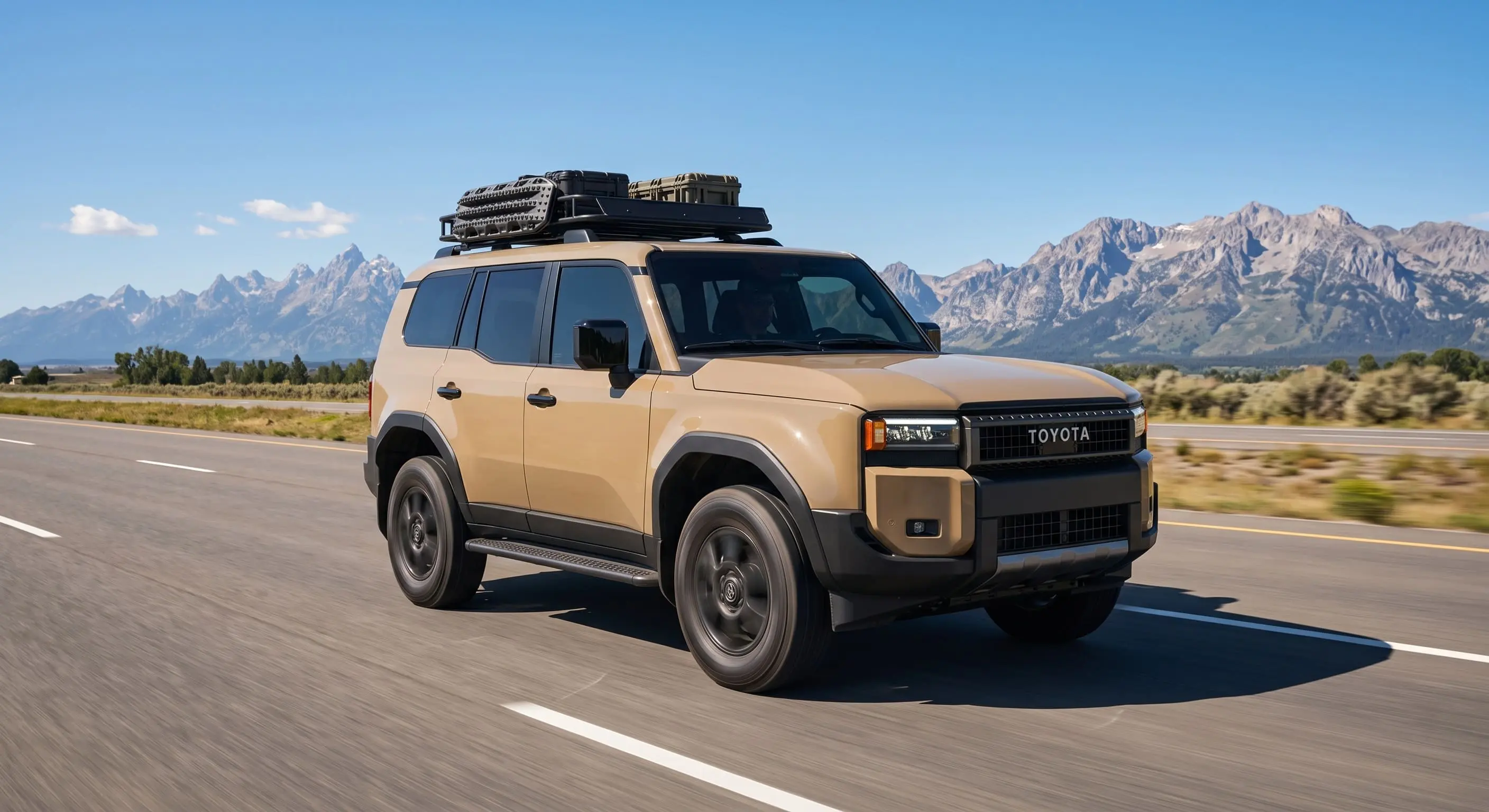
For decades, the Toyota Land Cruiser nameplate has earned a strong reputation among overland travelers, off-road enthusiasts, and expedition teams around the world. Its legacy has been built on durability, four-wheel-drive capability, and the ability to operate in demanding environments. In recent years, however, many traditional body-on-frame SUVs have increasingly emphasized luxury, comfort, and technology alongside their off-road capabilities. The 2026 Toyota Land Cruiser, part of the 250 Series in the U.S. market, takes a more capability-focused approach, combining a rugged body-on-frame platform and proven four-wheel-drive hardware with modern hybrid powertrain technology, safety systems, and everyday usability.
That positioning raises an important question for modern buyers. A family SUV increasingly needs to perform multiple roles: handle rough trails and challenging terrain while remaining comfortable on broken city streets, manageable in everyday traffic, and sufficiently refined for school runs and highway commutes. The Land Cruiser addresses these competing requirements with full-time four-wheel drive, low-range gearing, electronically controlled center and rear locking differentials, and available off-road technologies such as Crawl Control, while retaining the comfort and convenience expected from a modern SUV. The question is how well these capabilities translate into everyday driving.
To answer that question, this review examines the 2026 Toyota Land Cruiser across city driving, highway cruising, broken pavement, and demanding off-road conditions. We evaluate its hybrid powertrain, ride and suspension behavior, cabin ergonomics, road manners, fuel economy, and off-road capability to determine how effectively Toyota has balanced the Land Cruiser's traditional four-wheel-drive strengths with the demands of modern daily driving.
Powertrain & Performance: The i-FORCE MAX Hybrid
The biggest mechanical change in the 2026 Toyota Land Cruiser lies beneath its hood. The naturally aspirated 5.7-liter V8 used in the previous U.S.-market 200 Series has been replaced by Toyota's i-FORCE MAX hybrid powertrain, which combines a 2.4-liter turbocharged four-cylinder engine with an electric motor integrated into the transmission and an 8-speed automatic gearbox. The system uses a nickel-metal-hydride battery pack and produces a combined 326 horsepower and 465 lb-ft of torque. Toyota lists the battery capacity at 1.87 kWh.
-
- Throttle Response & Low-End Punch: In city driving, the hybrid system's electric assistance helps provide strong initial response and useful low-speed torque. Rather than relying solely on the turbocharged engine, the electric motor contributes immediate torque when pulling away from a stop, giving the Land Cruiser responsive acceleration for a vehicle of its size and weight. However, independent testing has found that the electric assistance can vary as the relatively small hybrid battery's available charge changes.
- Highway Passing Power & 0–60 Acceleration: In Car and Driver's instrumented testing, the Land Cruiser First Edition reached 60 mph in 7.7 seconds. That is respectable rather than sports-car quick, but the hybrid system provides useful mid-range response for highway merging and passing. Car and Driver recorded a 4.7-second 50–70-mph acceleration time, demonstrating that the powertrain remains capable when additional speed is needed.
- Real-World Fuel Economy vs. EPA Ratings: The 2026 Land Cruiser carries EPA ratings of 22 mpg city, 25 mpg highway, and 23 mpg combined. In Car and Driver's testing, the Land Cruiser returned 20 mpg overall and 21 mpg during a 75-mph highway fuel-economy test, showing that real-world consumption can fall below the official ratings depending on driving conditions and speed. Even so, the hybrid powertrain represents a substantial efficiency improvement over the previous V8-powered Land Cruiser generation.
Pavement Manners: Daily Driver Dynamics & Urban Commuting
While the Land Cruiser nameplate was forged in remote deserts and mountain passes, the reality of modern ownership is that most 250 Series models will spend much of their lives navigating city streets, suburban roads, and highways. The 2026 Land Cruiser uses Toyota's modern TNGA-F global truck platform, which also underpins models such as the Tundra, Sequoia, and Tacoma. Its high-strength boxed ladder frame is more rigid than the outgoing 200 Series architecture, with laser-welded construction used to reinforce key structural areas while supporting improved ride comfort and on-road manners.
-
- Suspension Compliance & Ride Quality: Up front, an independent double-wishbone suspension with twin-tube shocks works with a multi-link rear suspension and coil springs to balance off-road articulation with road manners. The TNGA-F platform and revised suspension design give the Land Cruiser a relatively composed ride over broken pavement, while independent testing has described its ride as smooth and cushy. Nevertheless, its body-on-frame construction and substantial off-road hardware remain noticeable over particularly severe road imperfections.
- Cabin Acoustics & Noise Isolation: The Land Cruiser is reasonably refined at highway speeds for an off-road-focused, body-on-frame SUV. Independent testing has found it significantly quieter than vehicles such as the Ford Bronco and Jeep Wrangler, although it does not provide the level of acoustic isolation associated with more road-focused luxury SUVs. The upright body and large exterior surfaces can also produce some wind and road noise at higher speeds.
- Urban Agility, Steering & Visibility: Electric power steering helps reduce steering effort during low-speed maneuvering, making parking and tight urban turns easier. The Land Cruiser's high seating position, squared body profile, and repositioned A-pillar provide good outward visibility, with Toyota specifically highlighting the design's improved sightlines for trail driving. Standard Blind Spot Monitor technology provides additional assistance when changing lanes or maneuvering around surrounding traffic.
Interior Ergonomics, Practicality & Family Comfort
Step inside the 2026 Toyota Land Cruiser, and its cabin emphasizes functionality as much as comfort. Rather than relying exclusively on glossy trim and touchscreen interfaces, Toyota retains a substantial number of physical controls for frequently used functions. The overall design combines durable materials, straightforward ergonomics, and modern technology in a layout intended to work equally well for daily family use and extended off-road travel.
- Seating Comfort & Passenger Room: The front seats offer power adjustment on applicable U.S. configurations and provide a supportive driving position suited to long highway journeys. The second row provides useful space for adult passengers and child-seat installations, although rear legroom is more modest than that of larger three-row SUVs. In the U.S. market, the 250 Series is configured as a two-row, five-passenger SUV, allowing Toyota to devote the available interior volume to rear-seat and cargo practicality rather than adding a third row.
- Infotainment & Ergonomic Controls: The entry-level Land Cruiser 1958 uses an 8-inch Toyota Audio Multimedia touchscreen, while the higher Land Cruiser grade receives a larger 12.3-inch display. Both configurations support wireless Apple CarPlay and Android Auto. Toyota also retains physical controls for important climate, drive-mode, and four-wheel-drive functions, making frequently used features easier to access without navigating through touchscreen menus.
- Cargo Space & Battery Packaging: The hybrid battery is packaged beneath the rear cargo area, allowing the Land Cruiser to retain a practical two-row cargo compartment. Toyota lists approximately 37.5 cubic feet of cargo capacity behind the second row, providing useful room for luggage, camping equipment, groceries, and family gear. The second-row seats use a 60/40 split-folding configuration, allowing the cargo area to be expanded when larger items need to be carried.
Off-Road Capability: Trail Hardware Put to the Test
When the asphalt ends and technical terrain begins, the 2026 Toyota Land Cruiser demonstrates why serious off-road capability remains central to its design. Built around standard full-time four-wheel drive and a two-speed transfer case with high- and low-range gearing, the 250 Series arrives from the factory with substantial trail hardware. Its combination of locking differentials, traction-management systems, and dedicated low-speed controls allows it to tackle demanding terrain without requiring immediate aftermarket modifications.
- Locking Differentials & Stabilizer Disconnect Mechanism (SDM): Every 2026 Land Cruiser comes standard with center and electronically locking rear differentials, allowing the system to improve traction when wheel slip occurs on uneven or low-grip surfaces. The available front Stabilizer Disconnect Mechanism (SDM) adds another layer of trail capability by disconnecting the front stabilizer bar at the push of a button. This increases front suspension articulation and helps the front tires maintain contact with the ground as the vehicle traverses uneven terrain. Because SDM is an available feature rather than standard across every U.S. configuration, its availability depends on the selected grade.
- Multi-Terrain Select (MTS) & Crawl Control: On equipped models, Toyota's Multi-Terrain Select system operates in both 4WD-High and 4WD-Low and provides terrain-specific settings for Mud, Dirt, and Sand. The system adjusts traction-control behavior to help manage wheel spin according to the surface. Complementing it is standard CRAWL Control, which functions as a low-speed off-road cruise-control system with five selectable speed settings. By automatically managing throttle and braking inputs, CRAWL Control allows the driver to concentrate primarily on steering while negotiating difficult terrain. Downhill Assist Control is also standard and helps regulate vehicle speed during steep descents.
- Trail Clearance & Off-Road Geometry: The 250 Series provides useful off-road geometry, with an approach angle of up to 31.0 degrees, a maximum breakover angle of 25.0 degrees, and a departure angle of 22.0 degrees. Ground clearance reaches 8.7 inches, helping the Land Cruiser negotiate rocks, ruts, and uneven trail surfaces while reducing the likelihood of underbody contact. For particularly demanding terrain, Toyota offers high-strength steel skid plates and rock rails as additional protection rather than making a full-coverage steel skid-plate package standard across the entire lineup.
Trim Comparison: Land Cruiser 1958 vs. Land Cruiser
For 2026, Toyota simplifies the U.S.-market 250 Series lineup to two primary grades: the Land Cruiser 1958 and the Land Cruiser. Both share the same fundamental off-road architecture, including the i-FORCE MAX hybrid powertrain, full-time four-wheel drive, and standard center and rear locking differentials. The key differences center on styling, interior equipment, technology, and available off-road features.
- Land Cruiser 1958 — The Heritage Choice: Positioned as the more affordable entry point, the 1958 grade pays homage to Toyota's 1958 U.S. Land Cruiser introduction with round LED headlights, a heritage-inspired grille, and cloth upholstery. It uses the same 326-hp i-FORCE MAX hybrid powertrain and full-time 4WD system as the higher grade, along with standard center and rear locking differentials. Inside, an 8-inch Toyota Audio Multimedia touchscreen provides the core infotainment functions. The 1958 does not include the available front Stabilizer Disconnect Mechanism or the heated and ventilated front seats found on the higher grade, making it an appealing choice for buyers who prioritize fundamental Land Cruiser capability over additional luxury features.
- Land Cruiser — The Premium Balance: The higher Land Cruiser grade replaces the 1958's retro-style headlights with a more contemporary rectangular LED headlight design and upgrades the cabin with SofTex-trimmed seating, heated and ventilated front seats, and a 12.3-inch Toyota Audio Multimedia touchscreen. It also provides access to additional off-road equipment, including the available front Stabilizer Disconnect Mechanism (SDM) and Multi-Terrain Select. For buyers who want the Land Cruiser's traditional trail capability while spending more time commuting, touring, and carrying family passengers, this grade offers the more comprehensive combination of comfort, technology, and off-road equipment.
- Which One Should You Choose? The 1958 makes the most sense for buyers who prefer the retro styling and want the essential Land Cruiser hardware at a lower entry price. The higher Land Cruiser grade is better suited to buyers who value upgraded cabin comfort, larger infotainment technology, heated and ventilated seats, and access to additional off-road equipment. Because both grades share the same core hybrid powertrain and four-wheel-drive architecture, choosing between them is primarily a matter of equipment, styling, and intended use rather than a fundamental difference in drivetrain capability.
The Direct Rivalry: Land Cruiser vs. Lexus GX 550 & 4Runner
With Toyota's TNGA-F global truck platform underpinning several of its modern body-on-frame SUVs, prospective buyers face an interesting family rivalry. The 2026 Land Cruiser occupies a distinctive position between the more utility-focused Toyota 4Runner and the more luxurious Lexus GX 550, creating different value propositions across performance, refinement, space, towing, and off-road capability. The sixth-generation 4Runner offers a broader range of configurations, including both part-time and full-time four-wheel-drive systems, while the GX adds a more premium cabin and substantially greater towing capacity on selected grades.
- Land Cruiser vs. Lexus GX 550 — Hybrid Efficiency vs. Twin-Turbo V6 Power: The Lexus GX 550 and Land Cruiser share Toyota/Lexus's modern body-on-frame engineering philosophy and a 112.2-inch wheelbase, but they are distinct vehicles built on different platform designations—the Land Cruiser uses Toyota's TNGA-F platform, while the GX uses Lexus's GA-F architecture. The GX 550 uses a 3.4-liter twin-turbocharged V6 producing 349 horsepower and 479 lb-ft of torque, paired with a 10-speed automatic and full-time 4WD. Select GX grades can tow more than 9,000 pounds, while others have lower ratings depending on configuration. The GX also offers seating for up to seven on applicable grades, compared with the Land Cruiser's standard five-passenger configuration. The Land Cruiser counters with its 326-hp i-FORCE MAX hybrid powertrain, 23-mpg EPA-estimated combined fuel economy, and lower starting price, making it the more efficiency-focused choice for buyers who still want serious body-on-frame off-road capability.
- Land Cruiser vs. Toyota 4Runner — Full-Time 4WD vs. Multiple Drivetrain Choices: The 2026 4Runner offers the same 326-hp, 465-lb-ft i-FORCE MAX hybrid powertrain on applicable grades, but its drivetrain lineup is more varied. Depending on grade, the 4Runner is available with 2WD, part-time 4WD, or full-time 4WD. Limited and Platinum configurations offer full-time 4WD, while many other 4WD grades use a part-time system with a two-speed transfer case. The Land Cruiser takes a simpler approach: full-time 4WD is standard across the lineup, along with standard center and rear locking differentials. This gives the Land Cruiser a consistent four-wheel-drive configuration regardless of grade, while the 4Runner provides buyers with a wider choice of drivetrain layouts and body configurations, including seating for up to seven.
- Key Compromises & Structural Distinctives: Choosing the Land Cruiser means accepting a five-passenger, two-row configuration and a 6,000-pound maximum towing capacity, which is lower than the towing capability available from selected GX grades. In return, the Land Cruiser provides a high-strength boxed frame, standard full-time 4WD, standard center and rear locking differentials, and compact dimensions suited to technical trails. Its combination of hybrid efficiency, traditional off-road hardware, and distinctive retro-inspired styling gives it a different character from both the more configurable 4Runner and the more luxurious GX 550.
Conclusion & Final Verdict
The 2026 Toyota Land Cruiser 250 Series represents a deliberate shift toward a more focused interpretation of the nameplate, combining Toyota's TNGA-F body-on-frame architecture with a standard i-FORCE MAX hybrid powertrain and full-time four-wheel drive. With326 horsepower, 465 lb-ft of torque, and an EPA-estimated 23 mpg combined, it delivers a combination of off-road hardware and fuel efficiency that is unusual among traditional body-on-frame 4x4s.
On pavement, the Land Cruiser's full-time four-wheel-drive system, modern chassis, and relatively compact dimensions make it well suited to daily commuting, highway travel, and family use. Away from the pavement, standard center and rear locking differentials, CRAWL Control, and available features such as the Stabilizer Disconnect Mechanism (SDM) and Multi-Terrain Select give it substantial capability on demanding trails. The trade-offs are equally clear: its five-passenger, two-row configuration and 6,000-pound maximum towing capacity make it less suitable for buyers who need maximum passenger or towing capacity.
For buyers who need a third row or substantially greater towing capacity, alternatives such as the Lexus GX 550 or Toyota Sequoia may make more sense. But for someone who wants a relatively compact, body-on-frame SUV that combines genuine off-road hardware with modern hybrid efficiency, practical family space, and distinctive retro-inspired styling, the Land Cruiser occupies a compelling middle ground.
If your priority is an SUV that can handle demanding trails on the weekend while remaining comfortable and efficient enough for the weekday commute, the 2026 Toyota Land Cruiser is one of the strongest all-around choices in its segment. It does not eliminate the compromises inherent to a rugged body-on-frame 4x4, but it strikes a thoughtful balance between trail capability, everyday usability, efficiency, and heritage-inspired design.