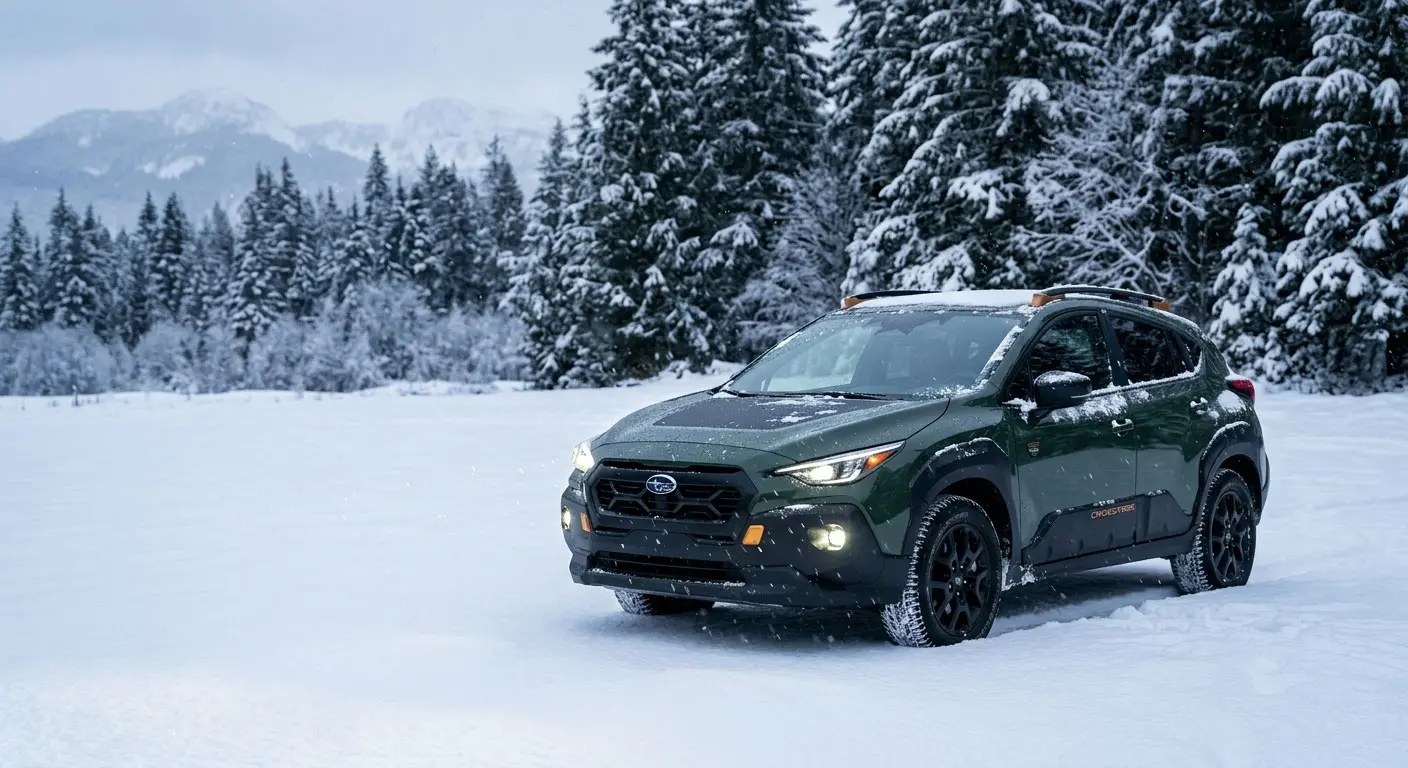
The subcompact SUV segment has long been defined by a balance between urban practicality and light adventure capability. As we move into 2026, the Subaru Crosstrek continues to stand out by leaning more strongly into capability in challenging weather conditions, particularly for drivers in colder regions such as the Rocky Mountains and the Northeastern United States. In these environments, where snow, slush, and ice are part of everyday driving, the Crosstrek has built a reputation as one of the more dependable options in its class. While many competitors offer all-wheel drive as an optional feature or an on-demand system, Subaru’s standard Symmetrical All-Wheel Drive remains a core part of its identity, delivering consistent traction across all four wheels in varying road conditions.
What makes the 2026 Crosstrek especially relevant is the continued refinement of its overall package rather than any dramatic reinvention. Subaru has focused on improving stability, ride comfort, and efficiency while maintaining the predictable, confidence-inspiring driving dynamics the model is known for. Depending on the market, the available Boxer engine—paired in some regions with Subaru’s e-BOXER hybrid system—aims to balance fuel efficiency with everyday usability. The result is a vehicle that prioritizes steady performance and control, particularly in low-grip environments such as snow-covered or icy roads.
In addition, the 2026 model benefits from incremental updates to driver-assistance systems and cabin usability. Features such as improved low-visibility camera performance, enhanced traction and stability control calibration, and a more intuitive infotainment interface contribute to a more reassuring cold-weather driving experience. While no system can eliminate the challenges of severe winter conditions, these refinements help improve confidence and convenience during daily use. In this review, we will explore how the 2026 Subaru Crosstrek continues to position itself as one of the more capable and dependable choices in the subcompact SUV segment for drivers who regularly face winter driving conditions.
The Engineering of Ice and Snow — Symmetrical AWD & X-MODE
When it comes to winter performance, many modern crossovers use on-demand all-wheel drive systems that primarily operate in front-wheel drive under normal conditions and redistribute torque only when wheel slip is detected. While these systems are effective, they are inherently reactive, meaning a brief loss of traction often occurs before intervention. The Subaru Crosstrek takes a different approach with its Symmetrical All-Wheel Drive system, which continuously distributes power to all four wheels. This full-time setup provides more consistent traction delivery and a stable, balanced drivetrain feel, particularly useful on low-grip surfaces like snow, slush, and ice.
A key advantage of this system is its mechanical layout. The Boxer engine’s flat configuration helps keep the center of gravity lower than many conventional SUV designs, contributing to improved stability. Combined with a longitudinally balanced drivetrain, this setup supports predictable handling when road conditions become uneven or slippery, such as during cornering on packed snow or melting ice.
Complementing the AWD system is Subaru’s X-MODE, an integrated traction management system designed specifically for low-friction surfaces. Rather than being a simple “snow mode,” X-MODE adjusts engine output, transmission behavior, throttle response, and braking control to help maximize traction. In most trims, it includes a Snow/Dirt setting, while higher trims offer Dual-Function X-MODE with an additional Deep Snow/Mud mode. This mode allows a controlled degree of wheel spin to help the tires maintain forward momentum in deeper snow or loose terrain where constant traction alone may not be sufficient.
The Crosstrek also incorporates Active Torque Vectoring, which works by subtly applying brake force to the inside front wheel during cornering. This helps reduce understeer and improves steering precision, especially on slippery surfaces such as black ice or wet pavement. While it does not physically “push” the car through corners, it enhances stability by improving how torque is distributed during turns.
Together, these systems create a driving experience that feels composed and predictable in winter conditions. Whether navigating steep inclines in heavy snowfall or descending icy roads, the Crosstrek’s combination of full-time AWD, traction management, and stability assistance helps maintain control and confidence in environments where road grip is constantly changing.
Ground Clearance: Why 8.7 Inches Matters
In the subcompact SUV segment, ground clearance often determines how confidently a vehicle can handle winter roads. The 2026 Subaru Crosstrek maintains approximately 8.7 inches of ground clearance, a figure that places it among the more capable vehicles in its class. While rivals such as the Honda HR-V sit closer to 7 inches, others like the Toyota Corolla Cross AWD offer slightly less or comparable clearance depending on configuration. In heavy snow conditions, even small differences in ride height can affect whether a vehicle clears packed snow or becomes stuck due to underbody contact.
This level of clearance is not just about moving through snow—it also helps protect critical components underneath the vehicle. The Crosstrek’s underbody design is engineered to reduce snow buildup and resistance when driving through slush or deep accumulation, minimizing drag and improving forward momentum in winter conditions. For drivers in rural or mountainous regions, the available Crosstrek Wilderness trim increases clearance to 9.3 inches and adds protective elements such as front skid plates to help guard against rough terrain, ice chunks, and deep ruts.
Importantly, this added height does not come at the cost of stability. Built on the Subaru Global Platform, the Crosstrek keeps major mechanical components positioned low within the chassis, helping maintain a lower center of gravity than many taller SUVs. As a result, even with its elevated ride height, the vehicle remains composed on highways, stable in crosswinds, and predictable on slippery pavement. This balance between usable ground clearance and controlled handling is a key reason the Crosstrek performs confidently in challenging winter environments.
Winter Comfort and Cabin Tech — The “Glove-Friendly” Test
When temperatures drop well below freezing, the cabin of a vehicle becomes more than just a space—it becomes a refuge. For 2026, the Subaru Crosstrek continues to emphasize usability in harsh conditions, with a cabin layout designed to remain intuitive even when the driver is wearing thick winter gloves. Central to this experience is Subaru’s available 11.6-inch vertical Starlink touchscreen, which uses a simplified, high-contrast interface with large icons for easier interaction on the move.
Despite the shift toward large digital displays, Subaru still preserves key physical controls for everyday usability. Functions such as volume adjustment and essential climate shortcuts remain accessible through tactile inputs, reducing the need to rely entirely on touchscreen menus—an advantage when driving on icy or snow-covered roads where attention needs to stay on the environment.
The available Cold Weather Package remains one of the Crosstrek’s most practical features for winter climates. It typically includes heated front seats with multiple intensity levels, a heated steering wheel, and in many trims, a windshield wiper de-icer that helps reduce ice buildup at the base of the windshield during snowfall. These features are designed to improve comfort and visibility during repeated cold starts and ongoing winter driving.
In addition, remote functionality through MySubaru allows drivers to start the vehicle and activate climate control before entering the car. This helps warm the cabin and reduce windshield frost buildup in advance, depending on configuration and subscription services. While not a substitute for a garage, it adds convenience during harsh mornings when time and comfort matter most.
Together, these interior and technology features reflect a practical, user-focused approach to winter usability. Rather than relying on complexity, the Crosstrek prioritizes straightforward controls and cold-weather convenience features that make everyday winter driving more manageable.
Subaru EyeSight: Safety in Low-Visibility Winter Conditions
In winter, driving often becomes a challenge of reduced visibility caused by snowfall, fog, and glare from reflective surfaces. The 2026 Subaru Crosstrek is equipped with Subaru EyeSight Driver Assist Technology, which functions as a driver assistance system designed to enhance awareness in these conditions. It uses a pair of forward-facing cameras mounted near the rearview mirror to monitor traffic movement, lane markings, and potential hazards ahead.
EyeSight’s strength lies in its ability to support key driving tasks such as adaptive cruise control, lane centering assistance, and pre-collision braking. When approaching a slower or stationary vehicle, the system can provide visual and audible alerts and, if necessary, apply braking assistance to help reduce or avoid impact. While it is not a replacement for driver attention, it is designed to act as an additional layer of support in situations where visibility or reaction time may be reduced.
The Pre-Collision Braking system is especially useful in winter traffic conditions, where stopping distances naturally increase due to reduced tire grip. It responds to detected obstacles ahead and assists in applying braking force when a potential collision risk is identified. However, the driver remains fully responsible for controlling the vehicle, particularly on icy or unpredictable surfaces.
The 2026 Crosstrek also offers Adaptive Cruise Control with Lane Centering, which helps maintain a set following distance and keeps the vehicle centered within visible lane markings. On highways where markings may be partially obscured by snow, the system can still assist by tracking available lane information and the movement of vehicles ahead, although performance depends heavily on road clarity and weather conditions.
Overall, EyeSight is designed to reduce driver workload and enhance safety awareness rather than replace driver judgment. In winter conditions especially, it serves as a helpful assistance system that supports—but does not override—the driver’s control of the vehicle.
Performance and Efficiency: The e-BOXER Hybrid in Sub-Zero Temps
The introduction of the e-BOXER Hybrid powertrain in the 2026 Crosstrek has raised many questions for winter drivers. Traditionally, cold weather is the enemy of battery efficiency, but Subaru has implemented several engineering solutions to ensure the 2026 model remains reliable when the mercury drops. The system uses a specialized thermal management loop that utilizes waste heat from the 2.0L Boxer engine to keep the lithium-ion battery pack within its optimal operating temperature. This ensures that even on a -20°C morning, you still have the benefit of electric torque assist when pulling out of a snowy parking spot.
One of the distinct advantages of the hybrid system in winter is the immediate torque delivery. When you are trying to move a vehicle from a standstill on a slippery incline, the electric motor provides instant, smooth power before the gasoline engine even reaches its power band. This reduces the likelihood of "digging" into the snow through aggressive wheel spin. Furthermore, the regenerative braking system has been recalibrated for 2026 to work in harmony with the ABS on slick surfaces, ensuring that the act of charging the battery doesn't compromise the vehicle's braking feel on ice.
While hybrid fuel economy typically takes a hit in winter due to increased heater usage and longer engine warm-up times, the 2026 Crosstrek e-BOXER still manages to outperform its purely gasoline-powered predecessors. By using an electric heater core, the cabin begins to warm up almost instantly, reducing the need for the gasoline engine to run at high RPMs just to generate heat. This results in a more comfortable cabin and a more efficient commute, proving that the move to electrification hasn't dampened the Crosstrek's "go-anywhere, anytime" spirit.
Conclusion: Why the 2026 Crosstrek Remains a Leading Winter Choice
As the automotive industry continues to move toward electrification and increasingly software-driven systems, the 2026 Subaru Crosstrek maintains its appeal by focusing on proven mechanical capability and real-world usability. In winter driving conditions especially, it remains one of the more confident choices in the subcompact SUV segment. While competitors such as the Toyota Corolla Cross and Mazda CX-30 have made significant improvements in interior technology and overall refinement, Subaru continues to emphasize full-time Symmetrical All-Wheel Drive and up to 8.7 inches of ground clearance (9.3 inches in the Wilderness trim), both of which contribute to its strong reputation in snow-prone regions.
Depending on the market, the Crosstrek is also offered with a hybrid-assisted powertrain, designed to improve efficiency while maintaining smooth, predictable low-speed torque delivery. In winter conditions, this type of power delivery can help improve drivability on slippery inclines by offering more controlled initial acceleration compared to traditional internal combustion setups. However, engine availability, output, and efficiency figures vary by region and configuration.


Written by Kousar Shabbir
Published May 5, 2026 in Car Reviews.