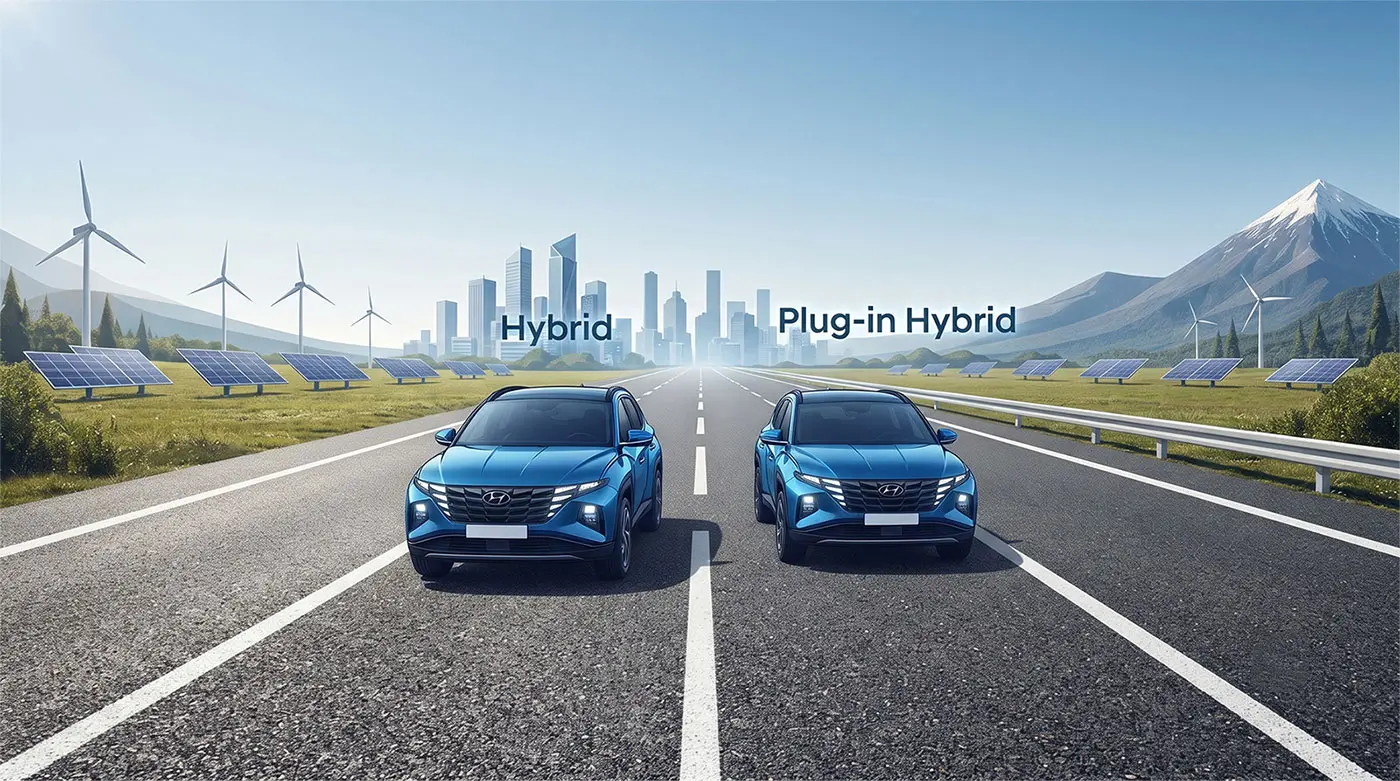
The automotive landscape of 2026 feels like a crossroads. As a driver, you are likely feeling the pressure of shifting fuel costs, evolving environmental regulations, and the constant, high-speed marketing push toward electrification. If you are currently shopping for your next daily commuter vehicle, you’ve undoubtedly been confronted with the acronym soup of the modern showroom: HEV (Hybrid Electric Vehicle) versus PHEV (Plug-in Hybrid Electric Vehicle). On the surface, the choice seems straightforward one requires you to find a charger, and the other doesn’t. But for the average daily commuter, the decision is rarely just about convenience; it is a complex calculation of upfront capital, long-term operational costs, and the harsh reality of real-world battery performance.
Choosing between a standard hybrid and a plug-in hybrid in 2026 is no longer just about "going green." It is an investment decision. The plug-in hybrid promises the allure of electric-only driving, potentially turning your daily office run into an emission-free event. Yet, that promise comes with a higher price tag and the logistical burden of charging. Conversely, the traditional hybrid remains the reliable, "set-it-and-forget-it" workhorse of the industry. As we navigate the complexities of 2026, many drivers are questioning whether the extra range and technology of a PHEV actually pay off, or if it is simply an expensive middle ground that creates more headaches than savings. In this guide, we will cut through the manufacturer-spec marketing to analyze the true value proposition of these two technologies for the daily driver. We will examine how your specific commute distance, charging access, and even the local climate dictate which vehicle will actually save you money, rather than just costing you more at the point of sale.
Understanding the Tech: How They Actually Compare in 2026
In 2026, the technical divide between the Hybrid Electric Vehicle (HEV) and the Plug-in Hybrid Electric Vehicle (PHEV) has never been sharper. At their core, both systems utilize a combustion engine paired with an electric motor and a battery pack to improve fuel economy. However, the operational philosophy is fundamentally different. The HEV is designed for seamless, automated efficiency. It uses regenerative braking the process of capturing energy during deceleration to keep a small battery topped off, which then assists the engine during acceleration or light cruising. There is no external charging required; the vehicle manages the energy flow entirely behind the scenes. This simplicity is its greatest strength, particularly for commuters who have neither the time nor the infrastructure to manage daily plug-in rituals.
Conversely, the PHEV is a bridge technology designed for a world transitioning to full electrification. It features a significantly larger battery and, crucially, an onboard charging port. When plugged into a home wallbox or a public charger, the PHEV can store enough energy to cover 30 to 50 miles on electricity alone. On paper, this is the "holy grail" for the daily commuter: if your office is within that electric-only radius, you could potentially drive to and from work without ever waking the gasoline engine. However, this comes with an "efficiency penalty." After the usable EV charge is depleted, the vehicle operates like a conventional hybrid while carrying a larger battery.
Furthermore, we must address the "truth-in-advertising" gap that has plagued 2026 industry reports. Manufacturers often advertise stellar "miles per gallon equivalent" (MPGe) figures based on the assumption that the driver charges the vehicle every single day. If you don't if you treat a PHEV like a gas car and rarely plug it in you are actually burning more fuel than if you had simply purchased a standard, lighter-weight HEV. In 2026, the tech has advanced, but physics has not. A heavier car with an empty battery will always consume more energy to move than a lighter, optimized hybrid. Therefore, the "better" technology is not the one with the higher range capability, but the one that aligns with your actual charging behavior.
The Economics of the Daily Commute
When you strip away the marketing, the decision between an HEV and a PHEV boils down to one fundamental metric: your daily mileage. If your daily commute is under 40 miles, a PHEV can theoretically operate almost entirely as an electric vehicle. In this specific scenario, the "Total Cost of Ownership" (TCO) calculation can tilt in favor of the plug-in model. By utilizing off-peak electricity rates to charge at home overnight, you avoid the daily volatility of gasoline prices. Over the course of a year, the fuel savings can be substantial, eventually offsetting the higher initial purchase price and the cost of installing a home Level 2 charging station. However, this math requires discipline. You must be religious about plugging in; if you skip charging for a few days, the economic advantage quickly evaporates, and you are left paying for a heavy, expensive battery you aren't utilizing.
For the vast majority of commuters whose round-trip exceeds 40 to 50 miles, the economics become far less favorable for the PHEV. Once the battery range is exhausted, the vehicle reverts to standard hybrid operation. Because you are carrying the extra weight of that larger battery, your fuel efficiency might actually be lower than that of a purpose-built HEV. Furthermore, consider the "charging friction." If you lack a home charger and must rely on public charging infrastructure, the time and cost associated with frequent stops can quickly negate any financial benefit. The HEV, by contrast, offers predictable, consistent operating costs. You never worry about range, you never worry about charging, and you avoid the "premium" price tag attached to PHEV technology.
Finally, do not overlook maintenance costs, which are often cited as a hidden variable in the 2026 TCO analysis. Modern HEVs, like the latest Toyota or Honda hybrid systems, are among the most reliable vehicles on the road, with massive production volumes leading to lower repair costs. PHEVs are inherently more complex—they feature sophisticated thermal management systems for the larger battery and power electronics that add another layer of potential failure points. While most 2026 models come with solid warranties, the long-term out-of-warranty costs for a PHEV system can be intimidating. If your primary goal is a low-stress, low-maintenance daily commuter, the HEV is, mathematically and mechanically, the safer, more economical bet for the average driver.
The 2026 Factor: Regulations, Tax Credits, and Resale
The decision to purchase a PHEV in 2026 is heavily influenced by the shifting regulatory landscape. Governments worldwide are tightening emissions standards, with policies like the Euro 6e-bis (and similar regional updates) putting immense pressure on automakers to transition away from pure internal combustion. These regulations are indirectly boosting the appeal of PHEVs in the eyes of regulators, often resulting in favorable tax credits and registration incentives. For the consumer, this can significantly lower the effective "out-the-door" price, making a PHEV more competitive against a standard HEV. If you live in an urban area where congestion charges or low-emission zone fees apply, a PHEV might be your ticket to avoiding these daily taxes, effectively paying for its own price premium within a few years of urban commuting.
However, keep a sharp eye on resale value. The 2026 secondary market is beginning to show a clear trend: the rapid advancement of solid-state battery technology and longer-range EVs is causing older, short-range PHEVs to depreciate faster than expected. While an HEV's reliability and simplicity remain a "safe" bet for long-term resale, a PHEV’s value is tethered to the health and range capability of its battery pack. If you plan to trade your car in after 3–5 years, the resale floor for a PHEV might be higher due to its "electric" branding, but the uncertainty surrounding battery degradation in older plug-in models is a risk factor you cannot ignore.
Then there is the "Cold Weather" variable a critical consideration for 2026. If your commute takes you through harsh winters, you need to understand that both HEVs and PHEVs suffer significant efficiency drops when temperatures plummet. A PHEV’s electric-only range can shrink by up to 40% in freezing conditions, forcing the gasoline engine to kick in much earlier than it would in summer months. If you live in a region with long, brutal winters, the "electric-only" advantage of the PHEV is often rendered moot for several months of the year. In these climates, the standard HEV’s engine-centric heating and drivetrain management often prove more consistent and less prone to the range-anxiety-inducing performance dips seen in plug-in models.
Final Verdict: Which One Should You Buy?
To make the final decision, we must synthesize the variables of commute distance, charging infrastructure, and financial appetite into a simple "Commuter’s Matrix." If your daily commute is consistently under 40 miles and you have a dedicated home charging setup, the Plug-in Hybrid (PHEV) is the clear winner for 2026. It offers you the ability to navigate your professional life largely on electricity, providing a sense of environmental responsibility and daily fuel cost avoidance that a standard Hybrid (HEV) simply cannot match. Even with the higher upfront cost, the cumulative savings on fuel, combined with potential tax incentives, make this the superior choice for the "disciplined" commuter who treats charging like a nightly habit rather than a chore.
However, if your daily commute is variable or consistently exceeds 40 miles, or if you rely on public charging, the HEV becomes the superior tool. It eliminates the "charging anxiety" that plagues the PHEV owner and provides a more predictable, lower-stress ownership experience. In this scenario, the HEV’s efficiency gained through decades of engineering refinement is arguably more valuable than the theoretical "electric range" of a plug-in. You are buying a vehicle that is lighter, less complex, and engineered to be efficient without requiring constant intervention.
Ultimately, the best vehicle for you is the one that fits into your life without requiring you to change your habits to accommodate the technology. Do not buy a PHEV for the "idea" of electric driving if your routine does not support it; you will simply end up driving a heavier, more complex car that burns more fuel than necessary. Test-drive both, paying close attention to how the transition between electric and combustion power feels, and honestly assess your access to a charger. In 2026, the technology is excellent, but the "best" car is the one that aligns with your reality, not the marketing brochure. Choose wisely, and remember: true efficiency comes from consistency, not just a battery.
Conclusion
In the final assessment, the battle between the 2026 Hybrid and Plug-in Hybrid is not merely a choice between two powertrains; it is a diagnostic test of your lifestyle and infrastructure. We have moved past the era where electrification was a one-size-fits-all solution. Today, the "best" car is defined by the synergy between your daily mileage, your access to home charging, and your tolerance for the minor complexities of modern battery management. If you are the disciplined commuter who values the ability to drive emission-free on a daily basis and you have the infrastructure to support it the PHEV offers a sophisticated, future-forward experience that rewards your consistency. However, for the driver who prioritizes set-and-forget simplicity, uncompromised trunk space, and lower long-term maintenance costs, the traditional HEV remains the undefeated champion of the daily commute.
As you head to the dealership, do not be swayed solely by the high-tech appeal of the "plug-in" badge. Look at your daily routine through a cold, objective lens. If you find yourself in the "under 40-mile" daily commute bracket, the PHEV is an investment that can pay dividends in fuel savings and reduced environmental impact. If you are a long-distance driver, or if charging access remains a logistical hurdle, lean into the refined reliability of the HEV. Both technologies have reached a pinnacle of engineering excellence in 2026, meaning there is effectively no "wrong" choice—only the choice that is right for your specific needs. Take the time to test-drive both in conditions that mimic your real-world route, and you will find that the perfect commuter vehicle is the one that seamlessly integrates into your life, rather than one that forces you to change for it.



Written by Maarukh Shahbaz
Published Jul 11, 2026 in Car Reviews.