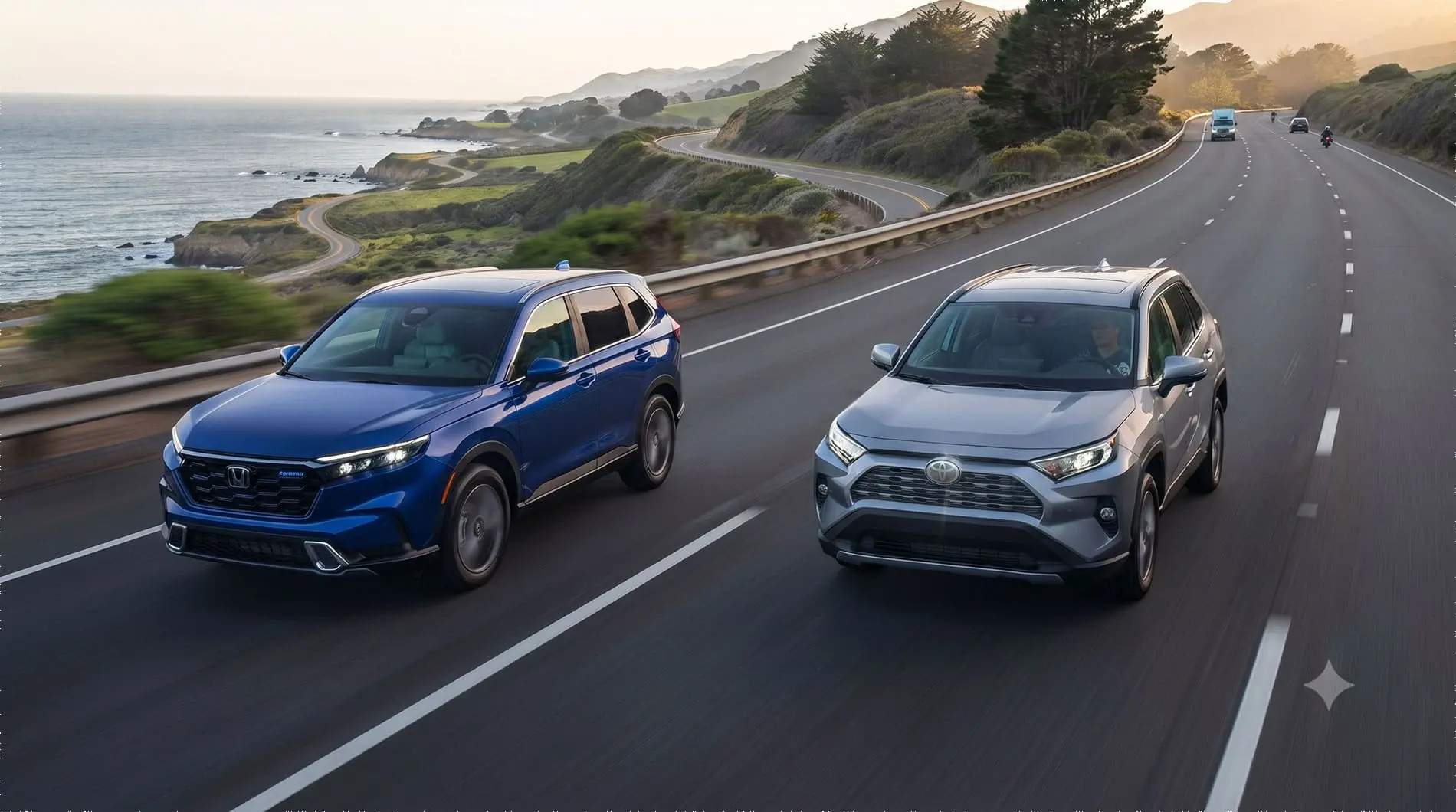
The compact SUV segment has long been a battleground of incremental updates, but the landscape is fundamentally shifting. For years, the choice between the Honda CR-V and the Toyota RAV4 came down to minor personal preferences: did you prefer Honda's slightly crisper driving dynamics, or did you lean toward Toyota's ironclad reputation for rugged, hybrid utility? This matchup takes an entirely different turn, transforming a predictable rivalry into a structural clash of philosophies.
Toyota has completely overhauled its best-seller, unveiling a heavily revised, redesigned generation of the RAV4. In a historic move, Toyota has entirely retired the traditional gas-only powertrain, forcing the entire lineup to go exclusively hybrid or plug-in hybrid (PHEV). Driven by the new 5th-Gen Toyota Hybrid System, it sharpens its tech offerings, updates its cabin infrastructure, and repositions its performance numbers to directly threaten the status quo.
Conversely, Honda approaches the market with the confidence of refined maturity. Rather than tearing down an award-winning foundation, the CR-V Hybrid doubles down on tactical enhancements. It introduces the rugged, all-terrain TrailSport trim to appeal to outdoor enthusiasts and elevates its technological baseline with larger standard infotainment touchscreens and re-engineered low-speed all-wheel-drive traction management. It is a battle of a highly ambitious, tech-forward overhaul against a benchmark chassis polished to a near-flawless gleam.
If you are standing in a dealership lot trying to determine which electrified crossover deserves your hard-earned capital, the answer is no longer a simple coin flip. Winning the compact SUV crown depends heavily on how your daily driving demands balance absolute open-highway efficiency against premium, tactile cabin refinement. Let's break down exactly how these two titans stack up across real-world testing loops, performance dynamics, and daily ergonomics.
The 2026 Generational Shift: All-New vs. Refined
When evaluating these vehicles, it is essential to understand that they are operating on completely different product timelines. Toyota has chosen this model year to usher in a radical generational leap for the RAV4. This isn't a mere facelift; it is a ground-up reimagining of how their flagship crossover functions. By migrating exclusively to the 5th-Generation Toyota Hybrid System and completely eliminating the standalone internal combustion engine from the order sheets, Toyota has structurally committed to an electrified future. This architecture repositions the vehicle's battery placement lower within the frame, lowering the center of gravity while optimizing the gas-electric transition logic via a completely overhauled power control unit.
Honda, conversely, is playing a game of surgical precision. Rather than discarding a highly successful platform, they have opted for a deeply calculated series of engineering refinements. The focus here is on addressing very specific customer feedback points from previous years. The technological baseline has been elevated, replacing the aging smaller infotainment displays with standard high-definition screens, while structurally reinforcing the front subframe to reduce NVH (Noise, Vibration, and Harshness) levels during heavy acceleration. Furthermore, the expansion of the TrailSport trim across the hybrid lineup signals Honda's intention to steal away buyers who previously viewed the RAV4 as the sole choice for light off-road excursions.
This structural divide alters the entire purchasing dynamic. Buying the RAV4 means investing in a cutting-edge, first-year generation layout built from the ground up to maximize electronic powertrain integration. Choosing the CR-V Hybrid means buying into a thoroughly vetted, peak-maturity chassis where every minor engineering wrinkle has been systematically ironed out over years of production.
Performance Dynamics and Hybrid Powertrains
The engineering logic separating these two crossovers becomes instantly clear the moment you depress the accelerator. The redesigned Toyota RAV4 drops its legacy internal combustion engine entirely, relying on the 5th-Generation Toyota Hybrid System. This architecture pairs a 2.5-liter four-cylinder Atkinson-cycle engine with robust electric motors, generating 226 combined horsepower in front-wheel-drive variations and climbing to 236 horsepower on all-wheel-drive configurations. Toyota utilizes a highly responsive electronically controlled continuously variable transmission (eCVT) that manages the power blend cleanly, minimizing the clumsy, delayed rubber-band transitions that plagued older hybrid generations.
Honda, by contrast, relies on a distinct mechanical philosophy. The CR-V Hybrid utilizes an innovative dual-motor setup paired with a 2.0-liter four-cylinder engine, producing a combined 204 horsepower and an impressive 247 lb-ft of torque directly from the electric traction motor. Because the electric drive motor handles the vast majority of propulsion duties across lower and mid-range speeds, the CR-V leaves intersections with an immediate, smooth torque delivery that makes it feel much closer to a pure electric vehicle around town.
-
Urban Agility: The CR-V shines in gridlock, utilizing immediate electric power delivery to jump smoothly between lanes without waiting for an engine to kick in.
-
The Noise Factor: When pushed to its absolute limits during high-speed highway merging, the CR-V engine can sound noticeably buzzy and high-pitched under load. The RAV4’s larger displacement 2.5-liter unit operates at lower RPM ceilings under heavy load, providing a more relaxed acoustic profile during aggressive hill climbs.
Real-World Efficiency: The MPG Showdown
When it comes to hybrid vehicles, EPA figures provide a useful benchmark, but real-world driving conditions ultimately determine how efficient these SUVs feel in daily use. Both the Toyota RAV4 Hybrid and the Honda CR-V Hybrid deliver strong fuel economy, though their results vary slightly depending on drivetrain configuration and driving conditions.
The Toyota RAV4 Hybrid is rated by the EPA at up to 41 MPG in the city, 38 MPG on the highway, and about 40 MPG combined, depending on trim and drivetrain configuration. The Honda CR-V Hybrid, meanwhile, is rated at up to 43 MPG city, 36 MPG highway, and 40 MPG combined in front-wheel-drive form, while all-wheel-drive versions typically return around 40 MPG city and 34 MPG highway with a slightly lower combined figure.
Real-World Highway Testing Loops
While city numbers remain neck-and-neck—with Honda holding a slight edge in dense stop-and-go gridlock due to its aggressive electric traction motor tuning—the open road tells a completely different story. In controlled 75-mph highway efficiency tests, the RAV4 consistently demonstrates a significant advantage.
-
The Toyota Advantage: Thanks to the 5th-Generation Toyota Hybrid System's streamlined power control unit and lower engine RPM ceilings at high cruising speeds, the RAV4 frequently beats its EPA highway estimate, delivering a reliable 37 to 39 real-world highway MPG.
-
The Honda Drop: The CR-V Hybrid tends to struggle at sustained 75-mph speeds. Because its smaller 2.0-liter engine must work harder to stay in its direct-drive lock-up gear, real-world highway testing loops usually net between 31 and 33 MPG.
Environmental Performance Factors
Battery thermal management plays a massive role in seasonal efficiency. Toyota’s updated lithium-ion battery packs in the 5th-Gen system feature improved heating and cooling efficiency, meaning the RAV4 experiences far less fuel economy degradation during harsh winter months. Honda’s system is incredibly competent, but its reliance on heavy active engine power to generate cabin heat during cold spells causes its real-world urban efficiency to drop slightly faster than Toyota's optimized setup.
Cabin Ergonomics, Comfort, and True Cargo Space
Stepping inside both vehicles reveals two completely contrasting environments for a daily commute. Honda treats the CR-V Hybrid interior with premium architectural design, utilizing their signature metal honeycomb mesh accent that seamlessly conceals the air vents across the dashboard. It feels upscale, uncluttered, and highly tactile. Physical climate control knobs with satisfying mechanical clicks line the center stack, ensuring you never have to dive through a digital menu just to adjust your fan speed.
Toyota’s approach in the redesigned RAV4 focuses heavily on rugged, utility-driven tech integration. The dashboard features larger, high-definition infotainment screens up to 12.3 inches that stand proud of the dash, utilizing Toyota’s latest lightning-fast multimedia software interface. However, despite the massive digital upgrade, the RAV4 cabin continues to rely on noticeably harder plastics along the lower door panels and center console trim pieces compared to the soft-touch materials standard across the CR-V line.
The True Usability of Cargo Space
When you look strictly at the spec sheet, the numbers tell one story, but real-world loading tells another.
| Feature | 2026 Honda CR-V Hybrid | 2026 Toyota RAV4 Hybrid |
| Seats Up Cargo Volume | 39.3 cubic feet | 37.5 cubic feet |
| Seats Folded Cargo Volume | 76.5 cubic feet | 69.8 cubic feet |
| Load Floor Profile | Ultra-low lift-over height | Marginally higher ground-clearance lip |
| Rear Legroom | 41.0 inches (Class-leading) | 37.8 inches |
While the CR-V wins the raw capacity battle on paper, its true dominance lies in ergonomics. The CR-V features an ultra-low rear load floor, making it significantly easier to lift heavy objects or dog crates into the back. Additionally, the second-row seats fold entirely flat with a single pull-lever. The RAV4’s rear seats fold down but leave a minor, angled incline in the floor layout, which can occasionally frustrate your attempts to slide large, flat-packed furniture boxes deep into the cargo hold.
Safety Tech and Driver Assistance Suites
When you are logging serious miles on the interstate, a vehicle's driver-assistance technology shifts from a luxury to an absolute necessity. Both Honda and Toyota treat safety as a foundational pillar, making their respective suites standard equipment across all trim levels. Honda equips the CR-V Hybrid with Honda Sensing®, while Toyota combats it with Toyota Safety Sense (TSS) inside the redesigned RAV4.
Adaptive Cruise Control & Lane-Centering Accuracy
While both systems read the road through an array of radar sensors and forward-facing cameras, their software tuning results in a vastly different behavior pattern when managing real-world highway traffic.
-
The Honda Sensing® Experience: The CR-V’s adaptive cruise control is highly praised for its linear braking and smooth acceleration characteristics. It mimics a human driver remarkably well, avoiding panic-braking when another vehicle cuts into your lane. Furthermore, its lane-centering system functions with rock-solid consistency, gently guiding the vehicle along the absolute middle of the lane without constantly bouncing back and forth between the painted road lines.
-
The Toyota Safety Sense (TSS) Experience: The updated TSS suite inside the RAV4 brings faster computing power and broader detection angles. It is exceptionally proactive at identifying pedestrians, bicyclists, and even guardrails in low-light environments. However, on long, sweeping highway bends, Toyota’s lane-tracing software can still feel slightly overactive, making micro-adjustments to the steering wheel that feel a bit more nervous than Honda’s fluid inputs.
Where Toyota reclaims major ground is in its low-speed proactive driving assist. As you approach a slower vehicle or a tight corner in urban environments, the RAV4 subtly pre-charges its braking system and smoothly decelerates before you even lift your foot off the accelerator. It is an incredibly smart piece of proactive safety engineering that rapidly builds driver confidence in dense city traffic.
Warranty, Projected Reliability, and Residual Values
Beyond immediate cabin room and trip metrics, the long-term cost of ownership plays an identical role in determining which compact hybrid crossover claims economic superiority. Both Japanese automakers hold an iconic reputation for durability, but their warranty structures and system complexities differ under closer inspection.
Beyond immediate cabin room and trip metrics, the long-term cost of ownership plays an identical role in determining which compact hybrid crossover claims economic superiority. Both Japanese automakers hold an iconic reputation for durability, but their warranty structures and system complexities differ under closer inspection.
Long-Term Battery and Mechanical Protection
While standard comprehensive powertrain metrics match perfectly down to the mile, Toyota extends a significant advantage regarding its high-voltage battery architecture. The RAV4 Hybrid features a 10-year or 150,000-mile battery warranty, offering unparalleled reassurance to second or third owners down the line. Honda restricts its dedicated hybrid battery warranty to 8 years or 100,000 miles, which is highly competitive but falls short of Toyota's definitive marketplace pledge.
Maintenance Frameworks and Resale Projections
From a maintenance standpoint, both brands offer complimentary scheduled maintenance windows during initial ownership phases (Toyota Care provides 2 years or 25,000 miles, while Honda Service Pass covers 2 years or 24,000 miles).
However, historically derived depreciation models indicate that the all-new generational architecture of the RAV4 gives it an initial edge in five-year residual value retention. Because the 2026 model marks the starting line of a fresh design generation, it will naturally look and feel contemporary for a longer duration than the CR-V, which will approach its scheduled redesign cycle sooner.
Conclusion
Declaring an absolute victor in this legendary compact SUV rivalry comes down to identifying which engineering philosophy aligns with your driving environment. Neither of these hybrid titans fails to deliver on their core promises, but they excel in fundamentally different arenas.
The 2026 Honda CR-V Hybrid is the champion of the daily commute and cabin ergonomics. If your routine involves weaving through urban gridlock, drop-off lanes, and tight parking structures, the CR-V's immediate, electric-feeling torque delivery and superior outward visibility make it an absolute joy to pilot. Its interior feels premium and uses logical physical control layouts, while its class-leading rear legroom and low-profile cargo floor provide unparalleled real-world utility for families and daily cargo hauling.
The 2026 Toyota RAV4 Hybrid, powered by its completely redesigned 5th-Gen Hybrid generation, takes the crown for open-highway road warriors and efficiency purists. If your lifestyle demands long interstate trips at sustained 75-mph speeds, or if you navigate harsh winter climates where thermal battery efficiency drops, Toyota’s engineering holds a massive advantage. It systematically outperforms the CR-V on the highway loop, delivering undeniable fuel savings while offering a highly proactive safety suite that builds deep driver confidence.

Written by Maarukh Shahbaz
Published Jul 2, 2026 in Comparisons.