Few sights cause an immediate sinking feeling quite like a sudden amber warning light glowing on your instrument cluster before your morning coffee has even kicked in. You step outside into the brisk morning air, start the engine, and there it is: the unmistakable horseshoe-shaped icon framing an exclamation mark. The Tire Pressure Monitoring System (TPMS) warning has triggered. Your immediate instinct might be dread—imagining a hidden nail picked up during yesterday’s commute, a slow bead leak, or the prospect of changing a flat on a freezing driveway.
Fortunately, in the vast majority of autumn and winter mornings, this dashboard alert doesn't mean your tire has suffered catastrophic damage or picked up road debris. Instead, you are witnessing a routine, universal demonstration of basic thermal physics happening inside your wheels. When ambient temperatures plummet overnight, the air trapped inside your tires naturally contracts. Because the total volume within the sealed rubber tire remains essentially fixed, this drop in thermal energy causes a corresponding drop in internal pounds per square inch (PSI). Once that pressure dips below your vehicle manufacturer’s pre-calibrated safety threshold—typically around 25% below the recommended factory cold specification—your car’s onboard computer promptly raises the alarm.
Understanding why this happens is essential not just for peace of mind, but for safety and long-term vehicle maintenance. Driving on significantly under-inflated tires compromises winter traction, increases stopping distances on slick roads, accelerates tread wear, and decreases fuel efficiency. In this comprehensive guide, we will break down the science governing seasonal pressure loss, clarify the difference between direct and indirect sensor systems, address the popular nitrogen debate, and walk you through the exact steps to check, inflate, and reset your tire pressure accurately in freezing temperatures.
The Physics: Why Temperature Dictates Tire Pressure
To understand why your dashboard warning illuminates on chilly mornings, you have to look at the basic laws of thermal physics—specifically, Gay-Lussac’s Law. This principle states that the pressure of a given mass of gas is directly proportional to its absolute temperature when the volume remains constant. Inside an automotive tire, the volume is essentially fixed by the rigid steel belts and vulcanized rubber construction. As air molecules grow colder, they lose kinetic energy, slow down, and take up less effective space, exerting fewer impacts against the interior tire walls. This reduction in kinetic activity causes the measurable air pressure (PSI) to drop without any air actually leaking out of the wheel.
A universally accepted automotive rule of thumb is that for every 10°F (approximately 5.6°C) drop in ambient temperature, a tire loses roughly 1 to 2 PSI. If you filled your tires to 32 PSI on an unseasonably warm autumn afternoon at 70°F, a sudden cold front dropping nighttime temperatures to 20°F causes an overnight drop of approximately 5 PSI. Because automotive Tire Pressure Monitoring Systems typically trigger when a tire falls 20% to 25% below the recommended cold placard specification, that 5 PSI drop is often just enough to trip the sensor wire and illuminate the dashboard warning.
This phenomenon explains the frequent scenario of the "disappearing" warning light during an early winter commute. Drivers often notice the TPMS indicator glowing brightly when pulling out of their driveway at 7:00 AM, only to see it extinguish after 10 or 15 minutes of highway driving. As the tire rolls against the pavement, internal friction and sidewall flexing generate significant heat. This heat warms the trapped air, raises the internal PSI back above the critical threshold, and satisfies the sensor. However, relying on driving friction to clear the light is deceptive: once the vehicle sits parked and cools down, the tire returns to an under-inflated, unsafe state.
Direct vs. Indirect TPMS: Why Your Car Might Be Confused
Not all tire pressure monitoring systems function the same way, and understanding the technology installed in your vehicle can help clarify why your warning light reacts the way it does during sudden cold snaps. Modern passenger vehicles generally use one of two architectures: Direct TPMS or Indirect TPMS. While both serve the crucial goal of alerting you to pressure loss, their mechanical methods and cold-weather behaviors differ significantly.
-
Direct TPMS (In-Wheel Physical Sensors): Direct systems use dedicated, battery-powered electronic sensor units mounted inside each wheel assembly, typically integrated into the valve stem. These sensors take real-time, physical measurements of both air pressure and internal temperature, transmitting radio frequency (RF) data packets to the vehicle's central computer.
-
Cold Weather Behavior: Direct systems measure the actual reduction in physical air pressure instantly upon startup. If ambient freezing temperatures drop your tire from 32 PSI to 25 PSI overnight, a direct sensor registers this exact deficit before the vehicle even moves an inch. Many modern vehicles with digital instrument clusters display exact, per-tire PSI numbers on screen, showing you precisely which corner has dropped below spec.
-
-
Indirect TPMS (ABS Wheel-Speed Calculations): Indirect systems do not use dedicated pressure sensors inside the tire. Instead, they rely on the existing anti-lock braking system (ABS) and electronic stability control (ESC) wheel-speed sensors. When a tire loses significant pressure, its overall rolling diameter decreases slightly, forcing that specific under-inflated wheel to spin at a faster rate than the others to cover the same distance. The ABS module detects this rotational discrepancy and triggers the dashboard indicator.
-
Cold Weather Behavior: Indirect systems require the car to be moving for several minutes to calculate rotational differences. However, winter weather presents unique challenges for indirect setups. If extreme cold lowers the pressure equally across all four tires (for instance, dropping all four by 4 PSI), their relative rotational speeds remain uniform. As a result, an indirect system may fail to warn you of uniform under-inflation until you hit rough road surfaces, drive at sustained highway speeds, or experience uneven tire grip on slush and ice.
-
-
Deciphering the Light: Solid vs. Flashing Alert: Another critical diagnostic element in cold weather is how the TPMS light behaves when you switch on the ignition:
-
Solid Light: If the light illuminates and remains steadily on, the system has detected that one or more tires are genuinely low on pressure.
-
Flashing Light (60 to 90 seconds, then solid): If the horseshoe indicator flashes for about a minute upon startup before staying continuously lit, the vehicle is signaling a system diagnostic fault rather than a simple pressure drop. Extreme cold frequently exposes weak or dying internal coin-cell lithium batteries within aging direct sensors (which generally last 5 to 10 years), or cold temperatures can disrupt RF communication between the wheel and the receiving module.
-
Is It Safe to Drive with the Low Tire Pressure Light On in Winter?
When that amber warning appears on a sub-zero morning, the most immediate, practical question every motorist faces is simple:Can I make it to work, or am I risking a catastrophic blowout? The answer depends largely on whether the light is responding to normal thermal contraction or an active, structural leak, but driving on under-inflated tires in winter conditions introduces serious safety hazards that should never be ignored.
Operating a vehicle with low tire pressure fundamentally alters the tire's contact patch—the critical footprint of rubber meeting the pavement, snow, or ice. In an under-inflated tire, the center of the tread lifts slightly, transferring the vehicle's weight unevenly onto the outer shoulders. On dry pavement, this creates sluggish steering response, excessive body roll during cornering, and significantly longer braking distances. On winter roads coated with packed snow, slush, or black ice, the consequences are amplified: the sipes and tread grooves designed to evacuate water and bite into snow collapse under abnormal stress, drastically increasing the likelihood of unrecoverable skids and hydroplaning.
Beyond handling dynamics, running low on pressure causes internal mechanical damage to the tire itself. Air pressure supports the vehicle's load; when pressure drops, the tire's sidewalls must flex excessively to compensate. At highway speeds, this continuous, exaggerated flexing generates intense internal friction and thermal stress—even in sub-freezing air. Over time, this heat degrades the rubber compounds and weakens internal steel belts, setting the stage for sudden sidewall failure or complete tread separation down the road. Furthermore, chronic under-inflation leads to premature shoulder wear, turning a set of premium all-season or winter tires into costly scrap well before their mileage rating expires.
When is it safe to proceed?
-
The Acceptable Margin: If a manual gauge confirms your tires have only dropped by 3 to 5 PSI due to an overnight freeze (e.g., resting at 28 PSI instead of a recommended 32 PSI), the vehicle is generally safe for a low-speed, cautious drive to the nearest service station or home garage compressor to top off. Keep speeds moderate and avoid aggressive cornering or abrupt stops.
-
The Hard Stop: If your tire has fallen 10 PSI or more below specification, sits visibly flat or compressed against the rim, or if the steering pulls sharply to one side,do not drive on it. Rolling on a severely flat tire will pinch the sidewall between the road surface and the aluminum wheel lip, instantly ruining both the tire casing and the rim. In this scenario, inflate the tire on-site using a portable 12-volt inflator or mount your spare.
Step-by-Step: How to Properly Check and Adjust Tire Pressure in Freezing Temperatures
To ensure your tires are safe and operating efficiently during the winter months, checking and adjusting their pressure correctly is essential. Cold weather can distort pressure readings if standard protocols aren't followed carefully.
1. Always Measure "Cold" PSI
Automobile manufacturers specify recommended tire pressures based on a "cold" reading. In automotive terms, a tire is considered cold when the vehicle has been stationary for at least three hours, or driven less than one mile at moderate speed.
-
Why this matters: Driving heats up the air inside the tire via friction, temporarily raising the pressure by 3 to 5 PSI. If you adjust pressure on warm tires, you risk significantly under-inflating them once they cool back down to freezing ambient temperatures.
-
The Garage Factor: If your vehicle is parked in an attached or heated garage, remember that the pressure inside the garage will be higher than outside. For every 10°F difference between your garage and the outdoors, add approximately 1 PSI to your target to compensate for the drop that will occur as soon as you roll into the freezing outside air.
2. Locate the Correct Manufacturer Specification
Never use the PSI number molded onto the tire sidewall. That value represents the maximum permissible pressure the tire can structurally endure, not the operational baseline for your vehicle's weight and suspension geometry.
-
Always reference the vehicle placard located on the driver’s side door jamb (B-pillar), inside the fuel filler door, or in the owner's manual.
-
Note whether front and rear specifications differ, as many passenger vehicles, trucks, and SUVs require different values depending on axle load distribution.
3. Step-by-Step Measurement and Inflation Process
-
Step 1: Remove the Valve Cap. Keep it in a secure spot, as metal and plastic caps prevent road salt, slush, and debris from contaminating the internal Schrader valve mechanism.
-
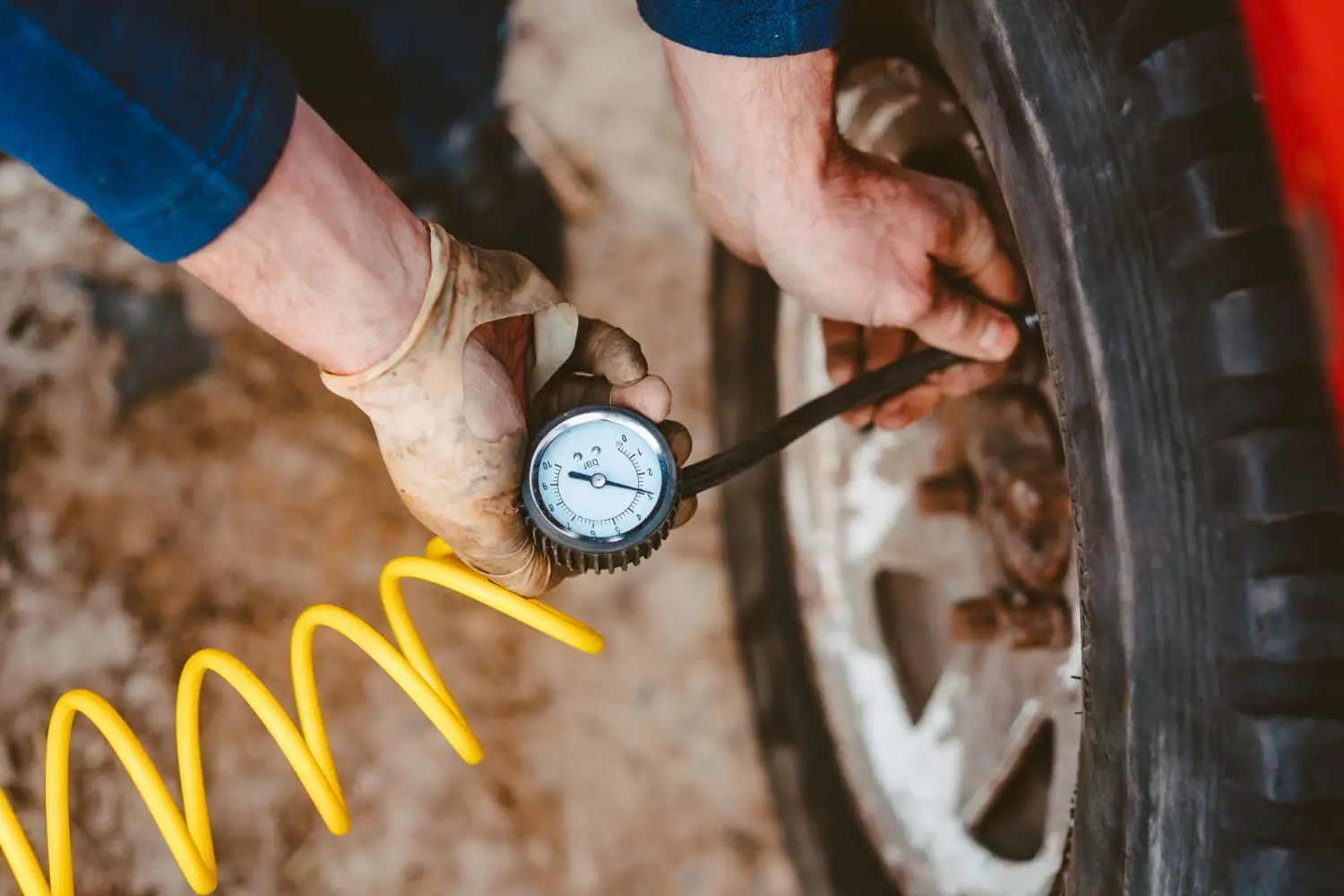
Step 2: Take the Initial Reading. Press a reliable gauge (digital or dial types provide far better accuracy than traditional spring-loaded pencil gauges in cold weather) firmly and squarely onto the valve stem until the hissing sound stops. Note the current PSI.
-
Step 3: Connect the Air Supply. Using a standard compressor nozzle or a portable 12-volt inflator, seat the hose firmly. Add air in short, measured bursts.
-
Step 4: Re-check Frequently. Periodically pause inflation and re-seat your pressure gauge to verify the level. Over-inflating reduces the tire's winter footprint and compromises traction on slick roads.
-
Step 5: Inspect and Replace the Cap. If the valve stem core sticks slightly open due to moisture freezing upon release of compressed air, gently tap the pin inside the stem to reseat it before reinstalling the protective valve cap tightly.
The Nitrogen Debate: Does It Really Stop Cold Weather Pressure Drops?
One of the most persistent marketing claims encountered in tire shops and dealerships is the promise that filling tires with pure nitrogen rather than standard compressed atmospheric air eliminates seasonal pressure fluctuations. While filling with nitrogen does offer measurable engineering advantages in specific high-performance environments—such as aviation landing gear and motorsport racing where extreme operating temperatures cause severe thermal expansion—its benefits for daily passenger vehicles in winter are frequently misunderstood.
The Science of Gas Expansion
To evaluate whether nitrogen prevents cold-weather pressure drops, one must consider basic atmospheric composition and thermodynamics:
-
Atmospheric Composition: Normal ambient air pumped from a standard compressor is already approximately 78% nitrogen, 21% oxygen, and about 1% trace gases (such as argon and carbon dioxide), along with varying amounts of water vapor.
-
The Ideal Gas Law: Under the principles governing ideal gases ($PV = nRT$), dry nitrogen gas expands and contracts with temperature changes at virtually the exact same rate as dry oxygen or ambient atmospheric air. Therefore, pure nitrogen drops roughly 1 PSI for every 10°F drop in ambient temperature, just like conventional compressed air. The laws of thermodynamics apply universally; switching to nitrogen will not prevent your tire pressure light from illuminating if ambient temperatures fall by 30 or 40 degrees.
Where Nitrogen Holds an Edge: Permeation and Moisture
Despite responding identically to temperature changes, nitrogen does offer two distinct physical advantages:
-
Lower Permeation Rate: The nitrogen molecule ($N_2$) has a slightly larger effective molecular diameter than the oxygen molecule ($O_2$). Because rubber is microscopically porous, oxygen migrates through tire walls approximately 30% to 40% faster than nitrogen. Over months of driving, standard air will lose pressure through normal casing permeation faster than high-purity nitrogen, meaning nitrogen fills hold their baseline pressure longer during extended maintenance intervals.
-
Moisture Elimination: The most significant advantage of commercial nitrogen conversion is that commercial nitrogen generators run the gas through advanced filtration dryers, stripping out virtually all moisture. Standard shop compressors without adequate water separators often pump humid air into tires. In freezing winter weather, that water vapor condenses into liquid or freezes into ice crystals, causing unpredictable and accelerated pressure swings. Dry air—whether purified nitrogen or properly dried compressed air—behaves predictably in sub-zero environments.
The Practical Verdict
For the average commuter, paying a substantial premium ($5 to $10 per tire) for nitrogen service strictly to stop winter pressure warnings is generally unnecessary. Standard compressed air behaves almost identically when ambient temperatures drop, provided the air system is free of excessive moisture. Routine monthly checks with a reliable pressure gauge remain the most effective and cost-efficient method for maintaining optimal tire pressure throughout the winter.
How to Reset the TPMS Light After Filling Your Tires
Once you have inflated all four tires—and checked the spare if it is equipped with a monitoring sensor—to the manufacturer's specified cold PSI, the next crucial step is getting that persistent amber indicator on your dashboard to turn off. The exact procedure depends entirely on your vehicle's make, model, and system architecture.
Automatic Re-learning Systems
Many modern domestic and imported vehicles (including most Ford, GM, Chrysler, and European models with direct systems) utilize an automatic self-learning protocol.
-
The Drive Cycle: After adjusting the tire pressures to the correct levels, the vehicle's onboard computer must see evidence of motion to activate the sensors and verify consistent readings.
-
How to do it: Drive the car continuously at speeds above 20 to 25 mph (32 to 40 km/h) for approximately 10 to 20 minutes without prolonged idling. As the wheel-mounted sensors detect centrifugal force, they transmit updated RF packets to the TPMS control module. Once all signals verify normal baseline pressures, the dashboard warning light will extinguish automatically.
Manual Reset Buttons and Infotainment Menus
Many Asian manufacturers (notably Toyota, Honda, Nissan, and Mazda), as well as German vehicles utilizing indirect ABS-based systems (such as Volkswagen, Audi, and BMW), require a manual recalibration sequence to establish a new baseline.
-
Physical Reset Button: Look beneath the dashboard steering column, inside the glove compartment, or near the hood release latch for a small button stamped with the horseshoe TPMS icon and the word "SET." With the vehicle parked, turn the ignition to the "ON" position (engine off), press and hold the button until the TPMS dashboard icon flashes three times slowly, and then release it. Allow several minutes for the computer to calibrate before starting the engine.
-
Digital Infotainment Menus: In modern vehicles equipped with touchscreens or digital gauge clusters, navigate to Settings > Vehicle > Tires (or TPMS) and select "Calibrate" or "Store Pressure." Confirm the prompt while parked on level ground with the ignition turned on.
Troubleshooting a Stubborn TPMS Light
If the warning light refuses to clear after proper inflation and completing the recommended drive cycle or reset protocol, consider the following potential issues:
-
The Forgotten Spare: Many full-size SUVs, trucks, and off-road vehicles (such as the Jeep Wrangler or Toyota 4Runner) feature a full-size spare tire equipped with an active TPMS sensor. If that spare tire has dropped below threshold pressure, the dashboard light will stay illuminated regardless of how full your road tires are.
-
Slow Valve Core or Bead Leaks: Extreme cold causes rubber bead seals and aluminum rim surfaces to contract at slightly different rates, occasionally creating microscopic air leaks along the rim bead or around corroded aluminum valve stems.
-
Depleted Sensor Batteries: If the light blinks for 60 to 90 seconds upon startup before staying solid, one of the sensor's internal non-replaceable lithium batteries has likely failed, requiring a replacement sensor and OBD-II re-registration at a tire service center.
Conclusion & Winter Tire Maintenance Checklist
A glowing low tire pressure warning on a freezing morning is one of the most common winter driving experiences, but it should never be treated as a mere nuisance to ignore until spring. While thermal physics—specifically Gay-Lussac’s Law—explains the rapid drop in internal air pressure during sudden cold snaps, the physical consequences on the road are very real. Driving on under-inflated tires severely compromises vehicle handling, increases stopping distances on slick surfaces, accelerates irregular tread wear, and raises the risk of severe tire failure.
By taking a proactive approach to tire care rather than reacting only when the dashboard illuminates, you can maintain optimal traction, preserve fuel economy, and extend the operational life of your tires throughout the coldest months of the year.
Quick Winter Tire Maintenance Checklist
-
Check Pressure Monthly (and After Severe Temperature Drops): Measure tire pressure at least once every four weeks, as well as immediately following any sudden overnight freeze or prolonged cold snap.
-
Always Measure Cold: Take readings first thing in the morning before driving, or wait at least three hours after parking, to ensure accurate results.
-
Match the Vehicle Placard, Not the Sidewall: Always inflate to the recommended cold PSI listed on your driver's door jamb sticker, never the maximum PSI stamped on the tire sidewall.
-
Account for Temperature Transitions: If adjusting tire pressure inside a heated garage, add approximately 1 PSI for every 10°F difference between the garage and the outdoor temperature.
-
Inspect Valve Stems and Caps: Ensure high-quality, sealed valve caps are securely tightened on all stems to keep out moisture, road salt, and road grit, which can cause internal Schrader valve freezing or corrosion.
-
Don't Forget the Spare: Regularly check the pressure of your spare tire—especially if it is equipped with an active TPMS sensor that links to your vehicle's warning system.
-
Keep a 12V Portable Inflator On Hand: Stashing a compact, 12-volt air compressor and a dedicated digital tire gauge in your trunk eliminates the hassle of searching for working gas station air pumps in freezing weather.
Continue reading
More from Maintenance & Tips

Written by Maarukh Shahbaz
Published Oct 27, 2026 in Maintenance & Tips.